
Florian Yuriev
1929 — Kirensk (Russia) | 2021 — Kyiv (Ukraine). Worked in Kyiv (Ukraine)
Born on August 11, 1929, in Kirensk, Irkutsk region, Russia, Florian Yuriev was a Ukrainian multidisciplinary artist, architect, composer, art historian, color expert, vocalist, poet, teacher, and public figure of Ukrainian-Russian-Czech-Eveni descent [1]. Yuriev was a neo-modernist and the creator of symbolic and abstract paintings and works on paper, as well as being an accomplished violin player and maker. He was also an innovator, developing his own synesthetic theory of color as a recognized color expert. From 1946 to 1950, Yuriev lived and studied in Irkutsk, Irkutsk region, Russia. Following 1950, the artist moved to study in Kyiv, Ukraine, where he would work and live until his death in 2021.
In Kyiv, Yuriev worked on design projects, including Khreshchatyk metro station, the restaurant Metro (1958–63), and the “Flying Saucer” building near Lybidska metro station (1964–71). In collaboration with the sculptor Borys Dovhan (1969–1995), he created the coat of arms of the city of Kyiv, the capital of Ukraine. Yuriev also authored the multidisciplinary concept “Ecology of the Spirit in the Harmony of the Spheres” [2], on which he worked throughout his life; he argued that nature should be studied, felt, and respected, and the spiritual basis for the development of humanity should be the harmonious trinity of science, art, and morality. He integrated this concept across his painting experiments and work in different genres such as the music of color, the color poetry, and his modular portraits.
Yuriev graduated from the Irkutsk School of Arts with specialization in music and fine arts (1950) and the Kyiv State Art Institute with specialization in architecture and art graphics (1956). He later completed a postgraduate course at the Moscow Polygraphic Institute, specializing in art criticism (1974), and then received his doctorate at the Ivan Fyodorov Lviv Polygraphic Institute (1980). In the 1980s and ’90s Yuriev studied violin and took classes in music composition and vocal performance [3]. He was a member of the Union of Architects of the Ukrainian SSR from 1956, the Union of Soviet Artists of Ukraine from 1970, the All-Ukrainian Music Union from 1992, and the International Association of Colorists from 1993. He was the founder and vice president of the International Academy Modus Coloris, the head of the Association of Master Artists for the Production of Bowed Musical Instruments, and the head of the research laboratory of the National All-Ukrainian Music Union. He obtained seven inventor’s patents in the field of musical acoustics concerning the improvement and modernization of the sound of traditional stringed instruments, such as the violin and cello.
The artist signed some of his artworks “Florian da Kirengi” which was a pseudonym referencing the remote taiga village of Kirensk, where he was born and spent his traumatic childhood. His father, Illia Yuriev, was a political exile in Siberia and his family experienced the weight of Soviet repression throughout the 1920s and ’30s in response to his wartime nursing efforts in Admiral Alexander Kolchak’s army (against the Red Amy) and his successive genetic research:
“After his third arrest and torture, which left him blind, Illia Yuriev committed suicide in 1938, leaving a widow and two young children. Florian, who lost his father at the age of nine, would carry his memory of him throughout his life. He always remembered his father with both pride and pain: 'It was he who discovered the endemic Baikal fish, the golomyanka; classified Siberian species of currant, honeysuckle, and orchids; crossed an arctic fox with a fox; and developed early-ripening varieties of wheat and potatoes that saved Siberians from starvation. He was a dedicated geneticist, which is why he was killed by the Communist Party of Lysenko'.” [4]
Illia Yuriev was European educated and shared this with his son through lessons in music, poetry recitation, and drawing. Florian Yuriev later wrote in his 1959 essay: “Every time my father changed his tone of voice, he transformed the meaning of the poem. I noticed this and began to mark sound accents with a spectrum of colors. That’s how I invented my own color painting when I was a child. My father was delighted!” [5] In his 1967 essay on vowels and consonants, Yuriev noted, “Only the true artisans of words know the full power and meaning of the sound of words. However, even ordinary mortals are able to see and feel the treasure among the verbal scatterings of priceless sounds. All vowels and consonants sound differently, enriching the syllables of the word with color and music, they harmonize thought and deepen meaning.” [5]
Despite the traumatic events of that time, Florian’s childhood consciousness focused on the positive: “I grew up in the Far North. I never saw anything more beautiful than the northern lights in my childhood. The northern lights are a symphony of color!” [6] This marked the beginning of the artist’s research into color—its synthesis with sound, word, image, space, and time—which continued throughout his life. In addition to maintaining a mental connection with his birthplace, some of Yuriev’s conceptual works reflect the color palette of Siberian nature, including Sybirskyi snih [Siberian Snow] (1960, ZAM, D21075) and Na richtsi Liena [On Lena River] (1967, ZAM, D21080). Despite their specific titles, the works are paradoxical in their coloristic and compositional construction: Yuriev did not paint the expected achromatic snowy taiga landscapes with flashes of the northern lights and instead depicted colorful, abstract letter shapes with scientific meticulousness, employing an open use of color and suggesting a bright emotional sound.
“By the time he was twenty, Florian Yuriev had lived in several Siberian concentration camps, become a prison tattoo artist, and visited a death camp. However, he also managed to learn to play the violin, graduate from the Irkutsk Art School, and discover the ability to see the color of sounds and listen to shades like musical tones. In psychology, this phenomenon is called synesthesia,” writes Roksolana Makar, a research journalist [7]. In 1950, he moved to Kyiv and entered the Department of Architecture of the Kyiv Art Institute, later transferring to the Department of Easel Graphics. After his graduation in 1956, Yuriev began working as a senior and then chief architect at the Kyivproekt Institute (1956–76). The Central Committee of the Communist Party issued a decree the year prior, entitled “On the Elimination of Excesses in Design and Construction,” which put an end to the Stalinist Empire style of architecture [8]. For a while, this opened career opportunities for many architects inclined to minimalist and functional architectural forms, and Yuriev was among them.
The neo-modernist building known as the “Flying Saucer on Lybidska Street” was designed by Yuriev and Lev Novikov for the Institute of Scientific, Technical and Economic Information (founded in 1958), and was constructed between 1964 and 1971 [7]. The spherical shape of the conference hall was inspired by space exploration, a popular theme at the time. According to Yuriev’s original idea, the “Flying Saucer” was intended to be a light and music theater, as the building acoustics allow one to hear the full frequency range of the human voice and musical instruments. Paralleling his interest in architecture, Florian continued to explore color: In 1959 he outlined his “music of color” as a new kind of fine art, whereby color represents text. He prepared a monograph on this topic for publication; however it was published only in the late 1970s due to accusations of formalism [9]. He considered musical harmony a universal category, resulting in the creation of a detailed color scheme, analogous to his sound scheme, which allows for any piece of music or poetry to be revisualized in color and form. The first concert at the “Flying Saucer” took place in 1965, during which Florian performed his musical miniatures Marsh [March], Noktiurn [Nocturne], Elehiia [Elegy] and Tanets [Dance]. Two films were also screened: Zhar-ptytsia [The Firebird], a color symphony in three parts and a color poem, and XX stolittia [The Twentieth Century], which “translated into color” poems by the sixties poet Lina Kostenko, the futurist Vladimir Mayakovsky, and Yuriev himself. This hall became increasingly used for movie screenings and lectures [10].
In 1962, Yuriev took part in the exhibition Roboty molodykh arkhitektoriv Ukrainy [Works by the young architects of Ukraine], to which the magazine Budivnytstvo ta arkhitektura [Construction and architecture] dedicated an entire issue. At that time, he was fascinated by the idea of synthesizing music and painting and submitted his abstract works to the exhibition, including those illustrating his idea of a “color alphabet.” However, by then an all-Union campaign against formalism, particularly abstractionism, had begun [11]. Soviet authorities subjected the Kyiv exhibition to devastating criticism. As a result, the works of all the participants were removed from the exhibition and physically destroyed, and participants received long-term bans from public exhibition activities. Yuriev’s next exhibition would not take place for forty more years. Nevertheless, the thirty-three-year-old artist did not give up his formal and conceptual exploration; Yuriev did not call himself a prisoner of the Soviet regime, but a Dukhobor, in reference to a type of Russian dissenting Christian who were pacificist and anti-establishment.
The works from the Norton and Nancy Dodge Collection belong to the 1960s, the most fruitful period of Florian Yuriev’s creative activity. The works Siberian Snow (1960, ZAM, D21075) and Rozpiattia na zirtsi I [Crucifixion on E. Star] (1961, ZAM, D21077) were saved from destruction in 1962, as they were not exhibited at the above-mentioned exhibition. In the 2000s, the artist would return to the composition of the last work and use it to create a dramatic modular portrait of his father: Illia Yuriev (bioloh-henetyk), rozpiatyi na chervonii zirtsi [Illiaa Yuriev (biologist-geneticist), Crucified on the Red Star] (2000s, mixed media on canvas).
Two works from 1967, Modus: Khrest Malevycha [Modus: Cross of Malevich] (1967, ZAM, D21076) and On Lena River (1967, ZAM, D21080) show that despite the state’s war against modernism, Yuriev did not abandon his creative pursuits and continued to work on the concept of synesthetic color theory. Moreover, he deepened his research, despite lack of familiarity with the works of Ukrainian and European modernists of the 1910s and 1930s until the early 1980s. After later gaining access to such information, he would create symbolic modular portraits of the abstractionist Vasily Kandinsky (1866–1944) in 1984 and the futurist-suprematist Kazimir Malevich (1879–1935) in 2005 [13].
During this period, Florian Yuriev also designed the Khreshchatyk subway station and the Metro restaurant therein (1958–63). He initially proposed to decorate the premises with colorful ceramic tiles and mosaics, but the mosaics were rejected by the selection committee. At the same time, the Cuban government offered him the position of chief architect of Havana, but Soviet officials forbade Yuriev to travel abroad [12]. Indeed, more of Yuriev’s architectural plans remained unrealized than realized. His projects were consistently adjusted beyond recognition by the Soviet leadership or did not even reach the construction stage. As a result, he permanently gave up his architectural career. From 1976 to 1991, Yuriev instead worked as an associate professor at the Kyiv branch of the Ivan Fedorov Ukrainian Polygraphic Institute at the Faculty of Graphics, where he developed and taught his own course entitled Artistic Color Studies. Yuriev recalled:
“In 1974, I was approached by publishers, and since I had taught color studies at three universities in Kyiv, Lviv, and Moscow and was considered an expert in this field, they asked me to create a general-purpose film for schools, universities, and people interested in color. Color photography was not yet a developed field, so I had to draw. I created a 72-frame film called Slovo pro kolir, pro muzyku koloru i pro kolorovu muzyku slova [A Word about Color, About the Music of Color, and About the Colored Music of the Word]. It was shot and distributed in the Soviet Union in millions of copies, and some were sent abroad. My celebrity began with this movie. It contained a complete course in color science, including color physics, color physiology, color psychology, color expressiveness, color music, and color painting.” [13]
Yuriev actively developed his own genre of modular portraiture. [14]. The first known modular portrait from 1964 depicts a minimalist face of a Tunguska shaman with a repeating “all-seeing eye” across the image. The artist sought to create not just a visual and psychological imprint of a personality but a symbolic philosophical story about human life. In this sense, the modular portraits of Maria Prymachenko (1979), Paul Klee (1984), Miles Davis (2000s), and Vasyl Stus (2002) are also indicative of this style, in which carefully selected elements of the composition convey the main achievements of the portrait sitter’s life. Representing achievements and other clear characteristics of the sitter meant that the artist was not always able to avoid the overly straightforward narrative language of the poster. As the researcher Andrii Bilousov says, “From Yuriev’s paintings, one can observe the path the artist has taken—from the halftones of a lyrical and realistic perception of the world around him to the pure colors and clear lines of a philosophical, generalized view of history and modernity, and to the birth and establishment of a new direction in contemporary painting, in which Yuriev appears both as an artist and a color scientist.” [15].
From 1991 until the last day of his life, Yuriev worked as a researcher at the Levko Ivanovych Medved Institute of Ecohygiene and Toxicology at the Academy of Medical Sciences of Ukraine, where he completed his theoretical work, “Ecology of the Spirit in the Harmony of the Spheres.” In 1997, the International Biographical Center in Cambridge (England) awarded Yuriev a gold medal and an honorary diploma for his personal achievements in culture and art. In 2000, the American Biographical Institute recognized him as “Person of the Year” for his contribution to the humanities and intellectual activity. In Ukraine, he only had two solo exhibitions, both held in Kyiv: in 2001, at the House of Architects for an exhibition of paintings accompanied by a concert of his musical compositions (performed on stringed instruments that he himself created) and in 2019 at the National Art Museum of Ukraine for a multidisciplinary exhibition, complemented by two lectures given by Yuriev [16].
Florian Yuriev was a larger-than-life personality and a true uomo universale, Renaissance man. During his ninety-two years of life, Yuriev mastered almost all creative professions, brought innovation to them all, and popularized his knowledge, which ranged from poetry and music to fine arts and urban planning. The trinity of science, art, and morality was the “holy trinity” for the artist, his basic tenets. “I woke up, indifferent to the southern palm tree, but in love with the eastern sakura and the Ukrainian cherry tree.” [17]
Olena Mykhailovska
Translated from Ukrainian by Nathan Jeffers
Photo portrait: Florian Yuriev at home, early 1950s. Kyiv, Ukraine. Photo by unknown, Yuriev family archive.
Notes:
1. Masha Konnen-Kin’s mother (in Soviet times, she was forced to Russify her name to Maria Ivanovna Bolshak, even though she had no Russian blood) was half Even (Tunguska is the ancient name for the Even people; Yuriev’s Ukrainian grandmother once married a local shaman chief), and half Ukrainian (her mother, Daryna Bilshak, moved to Siberia from Bila Tserkva, Kyiv Oblast, Ukraine, in search of new lands after the abolition of serfdom in the Russian Empire in 1861). In his autobiography, Yuriev recalls that his mother saw with her own eyes how the Tunguska meteorite fell on June 30, 1908. The imprisoned Illia Gavrilovich Yuriev (Illia Zakharyin-Yuriev) married her during his exile. His father’s mother, called Anna von Geyer before marriage, was of Czech-German descent. It was at her request that her grandson was given the name Florian. In his autobiography, which he began writing a few years before his death, Florian himself says that his grandmother “hinted at family ties with the famous knight Florian Geyer, who is considered a national hero of the Germans. So, if Florian Geyer is also our relative, then I (in addition to Tunguska, Ukrainian, Russian, and Czech blood) have an admixture of knightly German blood.”
2. Florian Yuriev, Rika chasiv [River of time] (Kyiv: EKOHINTOKS, 2006).
3. In the 1980s and ’90s, he studied violin making under the masters Feodosii Drapii, Nikifor Lupych, Ivan Bitus (Kyiv), and Gio Batta Morassi (Italy) of the Cremona school, and the famous master Roman Matz (New Jersey, USA). He also took composition classes with the prominent Ukrainian composers Andrii Shtoharenko (A People’s Artist of the USSR) and Yudif Rozhavska; and vocal classes with Oleksandr Hrodzynskyi, the leading bass singer of the Kyiv National Opera, a teacher at the Kyiv Conservatory, and an Honored Artist of Ukraine.
4. ‘Lysenkoism’ was a political campaign in the USSR, lasting from the mid-1930s until the first half of the 1960s, which persecuted and silenced geneticists, denied the science of genetics, and banned genetic research. The campaign was named after the Soviet ignorant agronomist Trofim Lysenko, who became a symbol of the campaign.
“After the father’s arrest in 1938, Yuriev’s mother became depressed. The family was kicked out of the apartment and forced to move to the basement, which was infested with rats. At school, they demanded that nine-year-old Florian renounce his father, as an ‘enemy of the people,’ in front of all the students. He had no money, nothing, an old mother with two children. And suddenly, sitting in this basement, the mother found a way out of the situation, remembering how she used to hunt small rodents in the taiga as a child. She started catching and killing these rats that were running around, then skinned them and sewed them into ladies’ hats. Florian sold these hats at the market,” says art historian Halyna Skliarenko.
For more on Yuriev’s early life see Filimonov, Adrey. "'Four times nationalist': Florian de Kirengi, the creator of flying saucer and Kyiv's coat of arms". Radio Liberty, September 11, 2023.
5. Florian Yuriev, Introduction (1959) to Tsvetopis muzyki slova [Color painting of the music of words] (Кyiv: UKRPRINT.KOM, 2014).
6. A quote by Yuriev from the documentary film. Neskinchennist za Florianom [Infinity according to Florian], directed by Oleksiy Radynsky, 2022. For more on this film, see article: Alyona Shilova, “Neskinchennist za Florianom ohliad na dokumentalny film pro lehendarnu “letiuchu tarilku” ta spadok Floriana Yurieva” [Infinity according to Florian: A review of the documentary about the legendary “Flying Saucer” and the legacy of Florian Yuriev], Suspilne Kultura, December 5, 2023.
7. Roksolana Makar, “Космос, кольоромузика, КДБ. Історія будівництва ‘літаючої тарілки” [Kosmos, koloiromozyka, KDB. Istoria budivnutstva ‘litaiuchoi tarilky,’ Space, color music, KGB: The history of the construction of a “flying saucer”], LB.ua News, December 19, 2017.
8. The so-called “Stalinist Empire” (from the French empire and by analogy with the Empire style) was a leading neoclassical trend in architecture and monumental and decorative art in the USSR from the late 1930s to the mid-1950s. It was artificially imposed by the Soviet government instead of rationalism and constructivism, which were developed in architecture from the 1910s to the early 1930s. It became widespread during the totalitarian rule of Joseph Stalin, especially after World War II during the reconstruction of destroyed cities; for a short time, it was also widespread in the socialist countries of Eastern Europe. Characteristic features include constructivist buildings, but excessively decorated with reliefs, cladding, and sculptural groups that promoted the Soviet ideology and system.
9. Florian Yuriev, Выразительные качества цветной иллюстрации [Vyrazitelnye kachestva tsvetnoi illiustratsii, The expressive qualities of color illustration] (Moscow: Izdatelstvo AN SSSR, 1977).
10. For the “Flying Saucer” project, Yuriev was awarded the USSR State Committee for Construction and Architecture’s prize for innovation in architecture, a sum of 16,000 rubles, which he distributed among all those who worked on the project, including electricians and plumbers. (In 1971, 16,000 rubles, was approximately $26,670 US dollars.) Other managers of the project were dissatisfied, as they had hoped to divide the prize money among Yuriev, the director of the institute, and the chief engineer. The state of the “Flying Saucer” has been in decline since the 1990s and was at risk of being destroyed during the construction of a shopping and entertainment center. In 2020, thanks to the activities of the #savekyivmodernism activist group, the Ministry of Culture and Strategic Communications of Ukraine included the building in the State Register of Monuments of Architecture and Monumental Art. Florian Yuriev himself joined the process by writing an open letter demanding a transparent reconstruction process. The building’s new owner was forced to turn the reconstruction project into a restoration project that was primarily focused on preserving the authenticity of the original design.
11. When Nikita Khrushchev, the general secretary of the Communist Party’s Central Committee, visited and sharply criticized an exhibition of avant-garde artists at the Moscow Manège Exhibition Hall in 1962, he prompted a new wave of repressions and harassment of abstractionist and neo-modernist artists. This also spread to representatives of other creative professions whose creative pursuits went beyond the narrow confines of mandatory “socialist realism.”
12. Asia Bazdyrieva, “Florian Yuriev: Nichoho khoroshoho v Ukraine zrobyty nemozhlyvo - vse znyshchat” [Florian Yuriev: It’s impossible to do anything good in Ukraine—everything will be destroyed], in ARTUKRAINE 34–36, no. 3–5 (2013): 110–17.
13. Lyuba Voitovich. Florian Yuriev: “Наша країна у царині кольоромузики — в авангарді” [Our country is at the forefront of color music], by. Chytomo. March 1, 2017.
14. For more artworks by Florian Yuriev see Ukrainian Unofficial.
15. “Нескорений Маестро (Частина 1)” [The unconquered maestro (part 1)], posted February 3, 2022, by Andriy Bilousov. Youtube, 16:37.
16. Florian Yuriev, “Florian Yuriev at National Art Museum of Ukraine (NAMU),” lecture, National Art Museum of Ukraine, Kyiv, Ukraine, February 22, 2019. For video of the artist’s lecture on his first solo exhibition at the National Art Museum, see mitec.ua.
17. A fragment of a poem from Florian Yuriev’s 1959 essay “Problemy perekladu virshovanoho tekstu” [The problems of translating a poetic text], in Tsvetopis muzyki slova [Color painting of the music of words] (Кyiv: UKRPRINT.KOM, 2014).
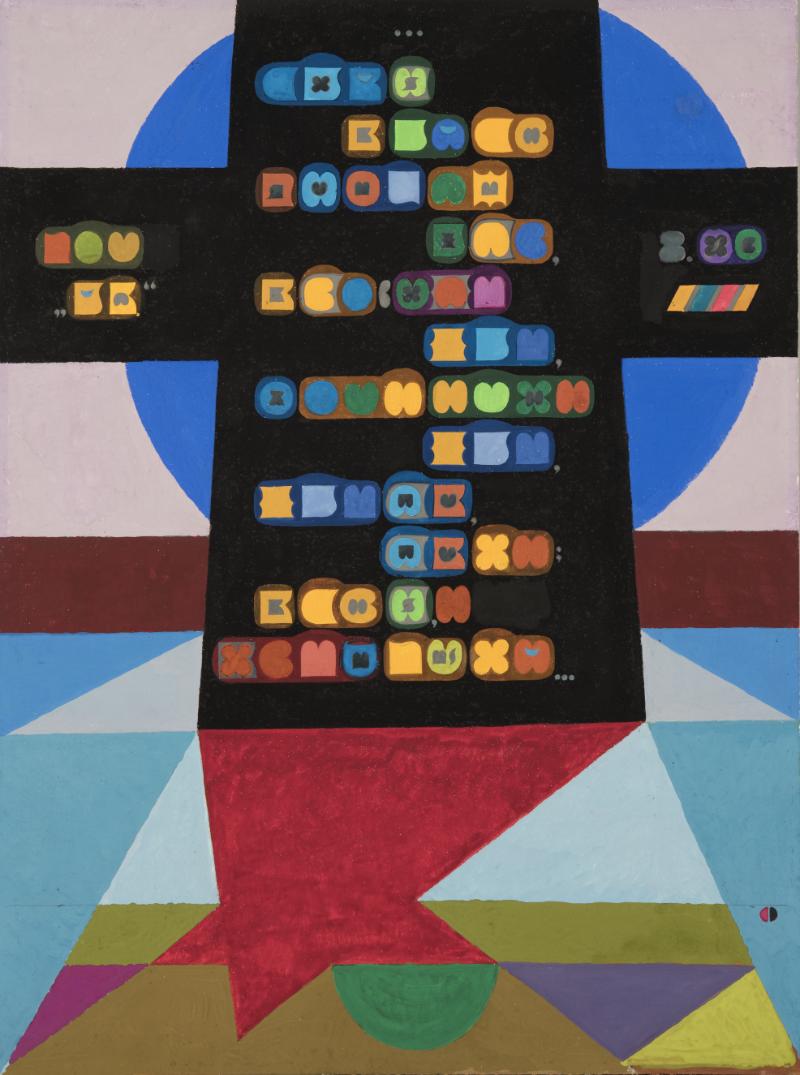
Siberian Snow, 1960. Tempera on cardboard, 49.5 × 37.3 cm (19 1/2 × 14 11/16 in.). Norton and Nancy Dodge Collection of Nonconformist Art from the Soviet Union. D21075
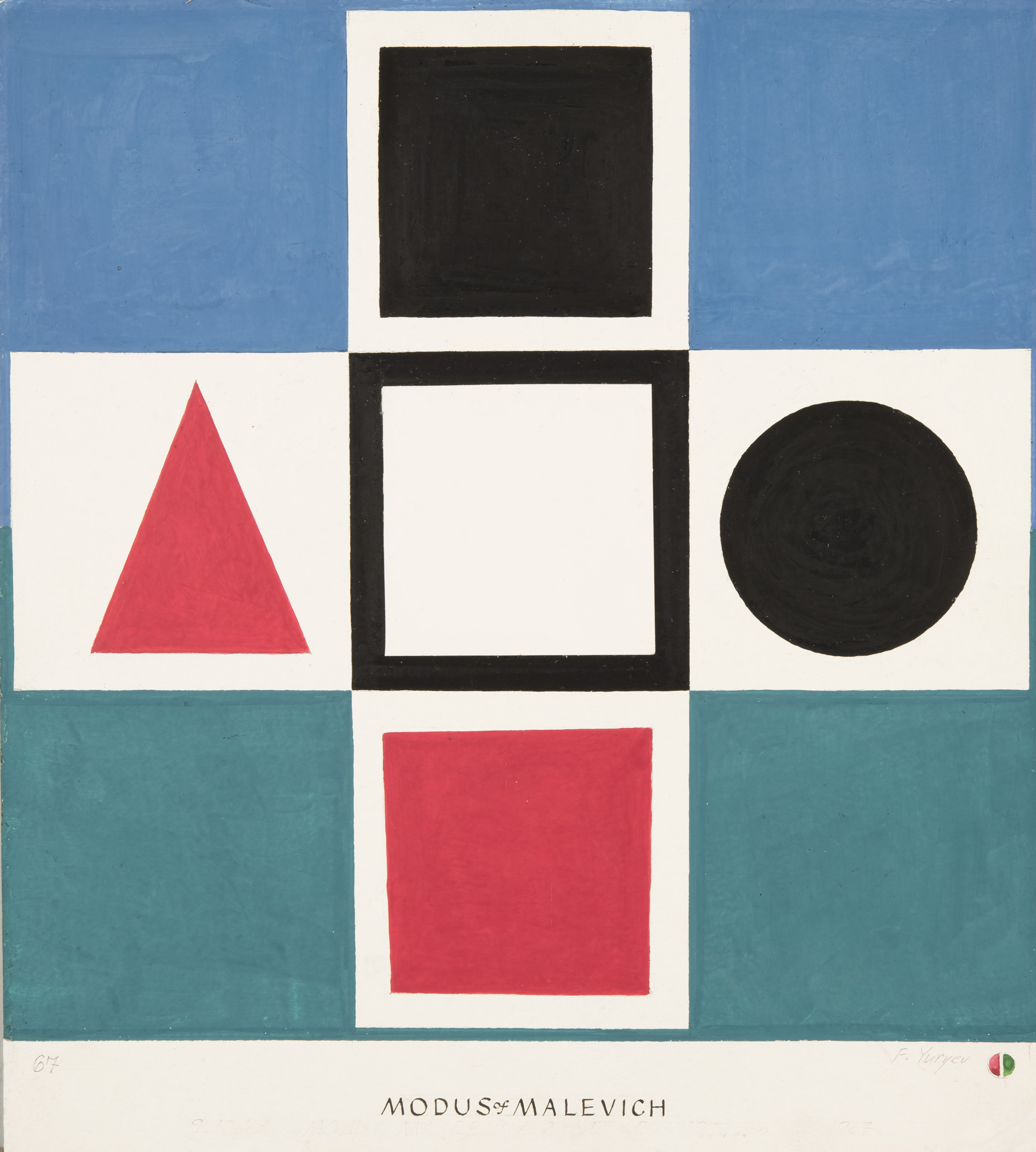
Modus: Cross of Malevich, 1967. Tempera on cardboard, 39.7 × 35.5 cm (15 5/8 × 14 in.). Norton and Nancy Dodge Collection of Nonconformist Art from the Soviet Union. D21076
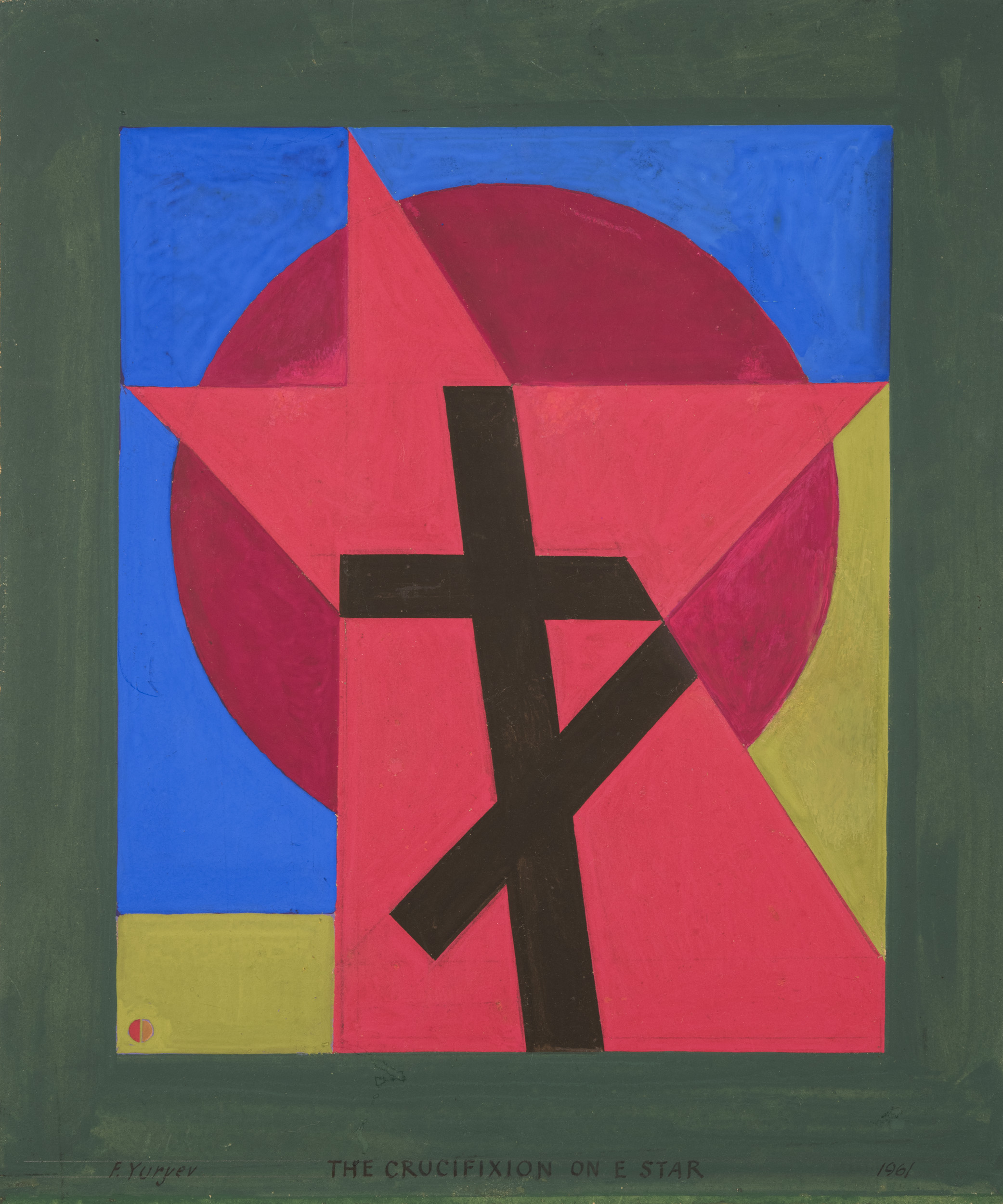
Crucifixion on E. Star, 1961. Tempera on cardboard, 37.8 × 31.8 cm (14 7/8 × 12 1/2 in.). Norton and Nancy Dodge Collection of Nonconformist Art from the Soviet Union. D21077
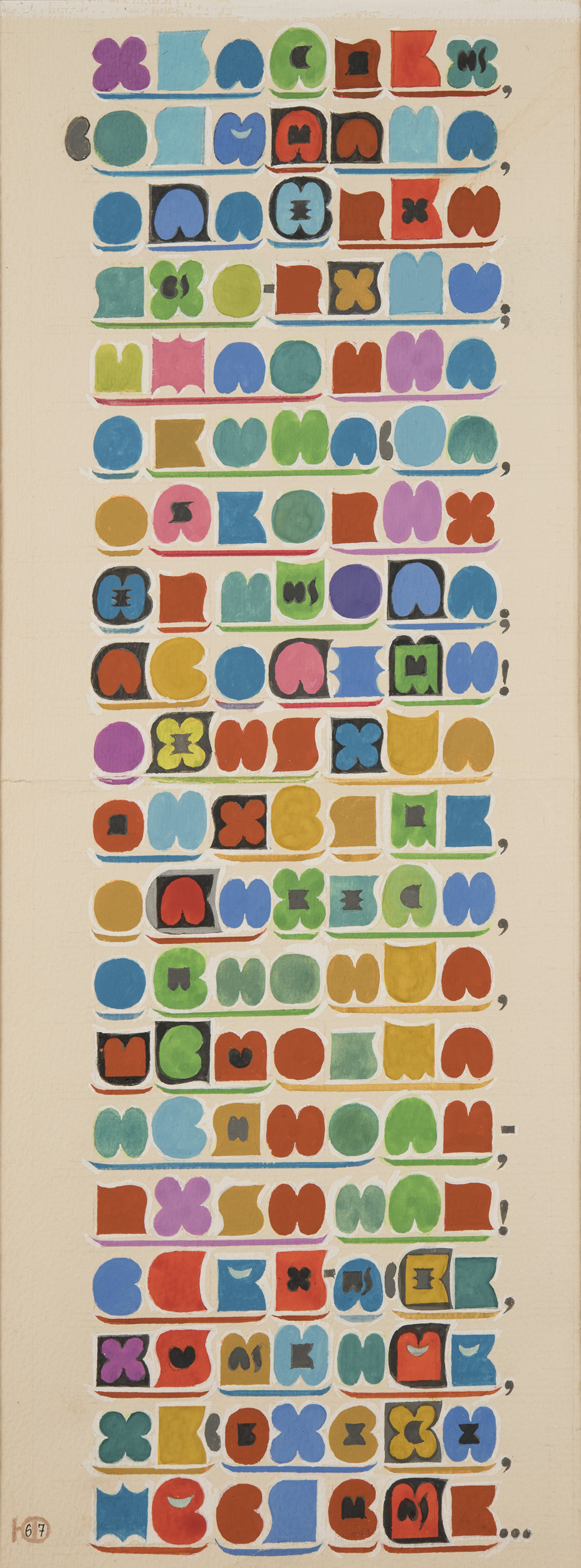
On Lena River, 1967. Tempera on paper, 46.5 × 18.1 cm (18 5/16 × 7 1/8 in.). Norton and Nancy Dodge Collection of Nonconformist Art from the Soviet Union. D21080