

Fedir (Feodosii) Tetianych
a.k.a. Fripulia (Freepulia)
1942 — Kniazhychi, near Kyiv (Ukraine) | 2007 — Kyiv (Ukraine). Worked in Kyiv (Ukraine)
Fedir Tetianych was a Ukrainian artist, painter, and monumental artist, and one of the first actionists in Soviet art during the 1960s, ’70s, and ’80s. He was named Feodosii at birth but renamed himself Fedir in honor of the writer Fyodor Mikhailovich Dostoevsky. In artistic circles, he was known under the pseudonym “Fripulia (Freepulia)”; the playful nature of this pseudonym gives some sense of the artist’s peculiar philosophy and approach to life, also reflected in his artworks.
In 1959 he entered the Kyiv School of Applied Art (now the Mykhailo Boychuk Kyiv State Academy of Decorative Applied Arts and Design) before dropping out and returning to the Kyiv State Art Institute (now the National Academy of Fine Arts and Architecture), where he would study from 1961 to 1966. He first began at the institution in the painting faculty, studying under V. Chekaniuk, though switched thereafter into the art and pedagogical faculty. After he graduated, he worked as an artist in the architectural design bureau of the Ukripromiskgaz Institute, then as an artist at the monumental and decorative art combine (kombinat) (1968–86). In 1973, he was admitted to the Union of Artists of Ukraine.
He made the following architectural works: the metal reliefs Музика [Muzyka, Music] and Весняні квіти [Vesniani kvity, Spring Flowers] in the Rovesnik [Peer] Youth Palace in Darnytskyi Victory Park in Kyiv (1971), the Склодуви [Skloduvy, Glassblowers] mosaics in the lobby of the Kyiv Art Glass Factory (1974), Квітучі сади [Kvituchi sady, Flowering Gardens] on the facade of the shopping center in the Darnytsia district of Kyiv (1976), the facade of the Faculty of Radio Electronics of the Kyiv Polytechnic Institute (smalt, metal, stone, 1977), the mosaics (from metal industrial parts and pieces of stone) and metal reliefs at Kyiv tram stops (1978–79, not preserved), and the design of the Rossiia [Russia] hotel in Smolensk (1980–1981). Among other examples of Soviet wall painting from that period, they stood out for the freedom and ingenuity of their composition, where figurative and decorative sections intersected, as well as for the unexpected combination of materials (natural stone, glass waste of different types, metal parts, chasing and relief from cement) and freedom of execution.
As part of a state commission, he created the architectural-sculptural sign Shchorsa State Farm at the entrance to the village of Kniazhychi in the Kyiv region (1966–67), into the form of which he covertly encoded the image of the Ukrainian national symbol, the trident. This artistic choice was particularly brave, as the use of the symbol risked persecution by authorities.
Furthering his resistance, Tetianych’s painting and graphics at this time (from the 1960s onward) were based on Ukrainian historical themes, such as the graphic series Козак-Характерник [Kozak-kharakternyk [Cossack Sorcerer-Warrior] and Козацькі образи [Kozatski obrazy, Cossack Images] (both 1970s). In 1972, he created a series of watercolors entitled Слово про Ігорів похід [Slovo pro Ihoriv pokhid, Tale of Ihor’s Campaign], wherein story motifs and images dissolved into the painted surroundings.
He made paintings, at first in the spirit of primitivism, but they then became increasingly complex in terms of their content and spatial structure. For these he used increasingly large canvases that became saturated with images of various sizes. The most significant examples of these include Атаман Сірко [Ataman Sirko] and Історія України [History of Ukraine] (1966–67), as well as the large diptych Фріпулья- Диво України- Диво Всесвіту [Fripulia—Miracle of Ukraine—Miracle of the Universe] (1970–77), where numerous images of human faces, figures, animals, plants, and other fragments intersect and are layered on top of one another. From the 1970s onwards, he turned to nonfigurative painting. While some canvases were close to abstractions in the informalist (art informel) style, others were completed in a colorful pastose style. Along with this, he painted portraits and fantastical compositions, where the naivete employed within the drawing itself was complemented by the ingenuity of the composition and the paradoxical nature of the idea behind the piece.
In the 1970s, Tetianych began to develop his own concept of “Fripulia (Freepulia)”—a key word in his work, the artist’s pseudonym, and a philosophical and aesthetic system. While the author remained vague, its origins are often ascribed to its root in the English word “free,” particularly when considering its liberatory characteristics in alignment with nonconformist art and actionism. [1] Tetianych himself considered it to be “a particular code, according to which humanity, radiating either in radio waves or in a ray of light and carrying all information about itself, will be reproduced again at any point in space.” [2] The artist’s philosophy combined ideas about the unity of the universe, which were mainly characterized in terms of infinity and boundlessness, ecological ideas of “preserving all living things,” the unification of the technocratic and organic worlds, the harmonization of the human personality through self-knowledge, and the transformation of the living environment and forms of existence.
Tetianych’s entire creative activity thereafter was spent developing the artistic practice of “Freepulia.” This included architectural works, poems, texts and books, collages, art objects, installations, performances, paintings, and “biotechnospheres,” constructions for human survival in case of a natural or man-made disaster. During the 1980s and ’90s, Tetianych built about five biotechnospheres, from wood, debris, cardboard, metal, and other found materials, which he developed as a universal module (diameter 240cm / 7.8 feet) for human life and movement. The designs of the biotechnospheres were laid out in numerous drawings and sketches made by the artist and his associates, including the architect Mariia Paliy, who collaborated with Tetianych from 1983 to 1990. These designs included the Module for Human Habitation (a spherical spatial construction in the shape of a human figure), which was a mechanism intended to combine with a hang glider, a boat, or a car. There was also the Mobile Module for a Person: a spherical construction with a person inside on three bicycle wheels (one small and two large) and the Raincoat-Tent-Hang Glider. The motif of Fripulia’s “biotechnosphere” is visible in the design of the Rossiia [Russia] hotel in Smolensk, located on a pylon in front of the hotel entrance. In the 1980s, he installed a “biotechnosphere,” this time in the form of a freestanding metal structure on rails, in the town of Popasna in the Luhansk region.
In his works, Tetianych incorporated ideas from the 1960s Italian avant-garde movement of arte povera (“poor art”) by using garbage and various items of industrial and household waste, as well as engaging with the principles of objet trouvé (“found things”), in which he combined collages, objects, and installations.
Significantly, while creating his utopian artistic world, the artist seemed to ignore the realities of his own world, not so much rejecting the Soviet lifestyle and its rigid system of art but trying to supplement and diversify it. Thus, we can understand his constant attempts to take part in official events of the Union of Artists, to come to party and art council meetings in his fantastic costumes (made from colored rags, foil, ribbons, dressed in high-heeled shoes, etc.). Due to how different the artist’s stylizations were from the aesthetic requirements of Soviet art, Tetianych’s creativity and behavior were not accepted by society and the art world. In 1987, Tetianych tried to exhibit his paintings at the first exhibition of nonsocialist art Pohliad [View] organized by monumental artists within the Union of Artists of Ukraine, but his paintings were not included in the exhibition catalog. Tetianych’s eccentricity, which transformed his exhibits into spectacular actions, and his “garbage” aesthetics scared off his colleagues.
Tetianych’s distinct style appeared in broader conceptual and performance projects. In 1974, the artist proposed the idea of using factories as a “theater of labor” where spectators would be invited to purchase tickets to watch the harmonious movements of workers. He also applied to the Kyiv Scientific and Popular Films Studio to make a film called Factory Theater and began writing a script for it, wherein artists, workers, and musicians would perform in a factory workshop. In the 1980s, he proposed another work entitled International Excursion and Exhibition Routes. The project aimed to connect the workshops of artists from different countries around the world, in turn creating new tourist destinations. This idea later developed into placing Tetianych’s own works in different parts of the world, therefore “turning the planet Earth into my own work of art, a kind of sculpture, after which, using the natural movement of my sculpture-planet around its own axis and the sun, I could draw a kinetic image of a bubble: the ritualistic symbol of ancient beliefs in the solar system. With this sign of the solar system, I study our galaxy, the galaxy-universe, the infinite-universe.” [3] In 1991, Tetianych collected money in Moscow for the “colonization of Mars.”
Public interest in Fedir Tetianych’s work began during the years of perestroika in the USSR, when, along with the liberalization of public life, there was greater opportunity for free creative self-expression. In 1989, his work Біотехносфера. Місто безсмертних людей [Biotechnosphere: City of Immortal People] was installed in Kyiv near the House of Artists in dedication to the Chornobyl tragedy. From 1989 to 1992, Tetianych conducted the unique actions Відродження землі [Rebirth of the Earth] near the Blue Lake in Kyiv. In 1990, he took part in the post-Chornobyl play O-O-I directed by Bogdan Zholdak in Kyiv and, in 1991, in the music festivals Reivy [Raves] and Chervona Ruta 91. For several years from the late 1980s, he performed his artistic actions during Kyiv’s city day celebrations.
In 1996, he took part in the official competition for the creation of the Independence Monument in Kyiv: According to his proposal, it was to be a huge biotechnosphere comprising several modules, connected by “man-conduits” (corridors along which people could move), or separate biotechnosphere-modules and squares. The jury of the competition did not support the idea.
The work of Fedir Tetianych, or Fripulia (Freepulia), is among the most unique phenomena to come out of Ukrainian art in the later decades of the Soviet period and the first years of Ukrainian independence. His work was founded upon a combination of the utopian ideas of the avant-garde of the early twentieth century, a fascination with space flight in the second half of the century, peasant pantheism, and a dramatic sense of the catastrophic nature of civilization and the fragility of human existence, which was confirmed after the Chornobyl disaster. The fantastical figurative space inhabited by the artist absorbed the projective power of creative thinking as well as emotional and metaphysical drama. Within that space, the ideas of flight and constructing an “apparatus for life” simultaneously outlined a shelter from the surrounding world and showed us how his improvisational-behavioral performances, generally aimed at aesthetically provoking the audience, were a kind of search for like-minded people, understanding, and dialogue.
Halyna Skliarenko
Translated from Ukrainian by Nathan Jeffers
Photo portrait: Fedir Tetianych on Andriivskyi Descent, 1990s. Author unknown.
Notes:
1.“Tetianych, Fedir” Artist Profile, Ukrainian Unofficial.
2. Fedir Tetianych, Fripulia [Freepulia] (Kyiv: Antkyvar, 2009), 10.
3. Sourced from the Tetianych family archive.

UFO, 1970. Tempera on paper, 13.1 × 19.2 cm (5 3/16 × 7 9/16 in.). Norton and Nancy Dodge Collection of Nonconformist Art from the Soviet Union. D18573

Arrest of Prostitutes, 1970. Oil and mixed media on canvas, 47 × 56 × 4 cm (18 1/2 × 22 1/16 × 1 9/16 in.). Norton and Nancy Dodge Collection of Nonconformist Art from the Soviet Union. D14503
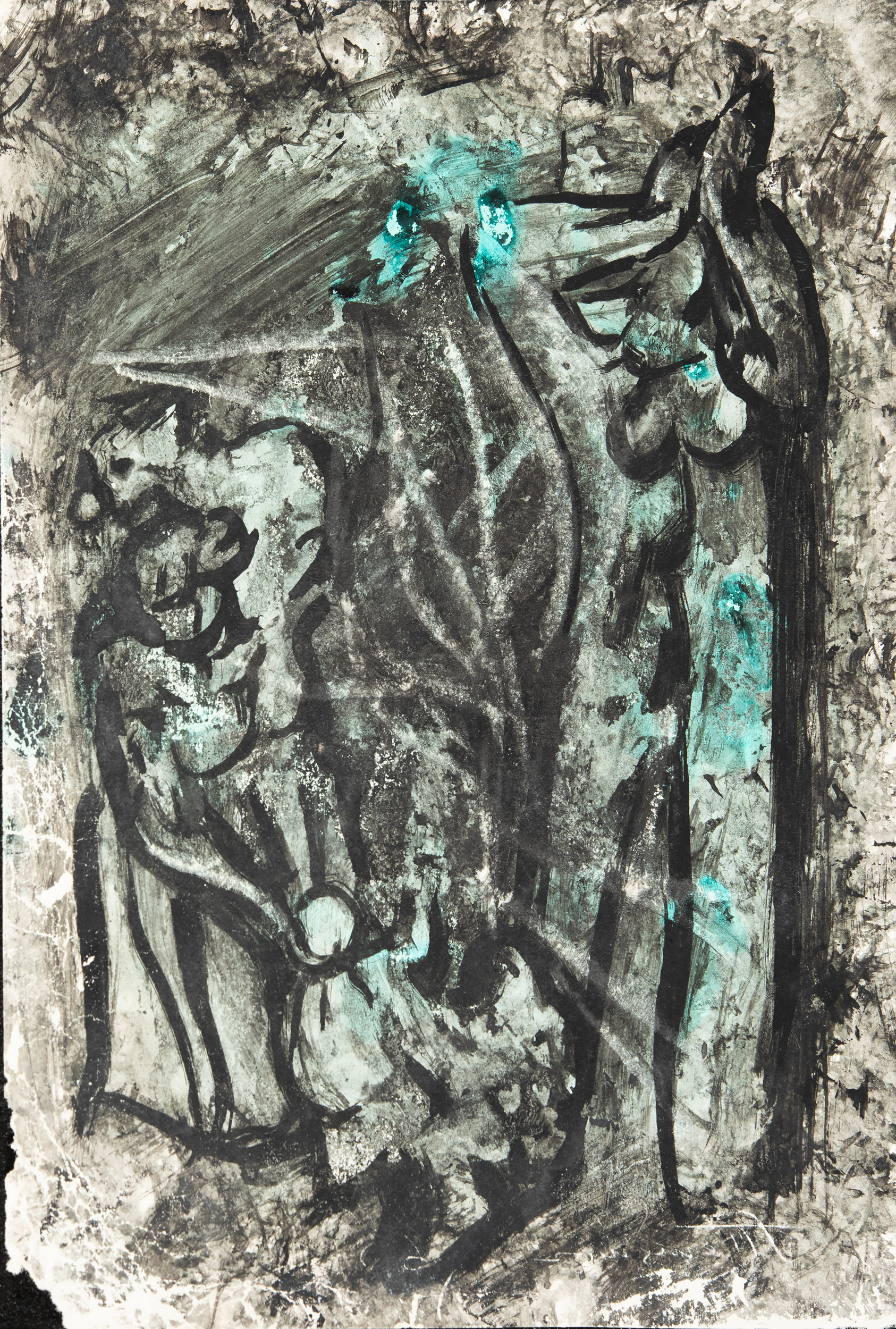
Untitled, 1968. Tempera on paper, 19.1 × 13 cm (7 1/2 × 5 1/8 in.). Norton and Nancy Dodge Collection of Nonconformist Art from the Soviet Union. D18575
Selected Exhibitions
1990 Ukrainian MalARTstvo 60–80s: Three Generations of Ukrainian Painting, Soviart Center for Modern Art, Kyiv, Ukraine, and Municipality of Odense, Odense, Denmark
1991 Exhibition of Fedir Tetianych, Lenin Museum (now Ukrainian House), Kyiv, Ukraine (solo)
2003 Malevich — Tetianych: They Flew, K-1 Gallery, Kyiv, Ukraine
2009 Fripulia — Infinity, Berva Gallery, Kyiv, Ukraine
2016 Another History: The Art of Kyiv from the Thaw to Perestroika, National Art Museum of Ukraine, Kyiv, Ukraine
2017 Fedir Tetianych: The Canon of Fripulia, PinchukArtCentre, Kyiv, Ukraine (solo)
2020 The Boundless I, Museum of Contemporary Art Odesa, Odesa, Ukraine
2023 Kaleidoscope of Stories, Albertinum Museum, Dresden, Germany
Selected Publications
Berdnyk-Sokorynska, Valentyna. “Tri spohady pro Fedora ‘Frypuliiu’” [Three memories of Fedor “Fripulia”]. Ukrainske slovo [Ukrainian word] 40, October 7–13, 2009.
Desiateryk, Dmytro. “Vsesvit Frypulia” [The universe of Fripulia]. Den [Day] 40, March 5, 2004.
“‘Frypulia—mii vichnyi dim, moie neskinchenne telo’”: ostanníi audiozapys Fedora Tetianycha, zroblenyi druzhynoiu Hannoiu vlitku 2006 roku” [‘Fripulia is my eternal home, my endless body”: The last audio recording of Fedor Tetianych, made by his wife, Hanna, in the summer of 2006]. Artaniia 17, no. 4 (part 1) and Artaniia 20, no. 3 (part 2) (2009): 62–69.
Hlybchuk, Uliana. “Luchshe byt golovoi u ryby, chem khvostom u lva” [It is better to be the head of a fish than the tail of a lion]. Zerkalo nedeli [Mirror of the week] 24, June 18, 2004.
Kochubinska, Tetiana, and Tetiana Zhmurko, eds. Fedir Tetianych. Fripulia. Kyiv: Antykvar, 2021.
Kruchik, Igor. “Tak govoril Frypulia. O khudozhnike Fedore Tetianiche” [That’s what Fripulia said: About the artist Fedor Tetianych]. Antykvar [Antiquarian] 47, May 27, 2015.
Skliarenko, Halyna. “Fedir Tetianych (1942–2007): khudozhnik, shcho vitlumachuvav planetu zemlia’” [Fedir Tetianych (1942–2007): An artist who “interpreted the planet Earth”]. Ukrainski khudozhnyky z vidlyhy do nezalezhnosti [Ukrainian artists from the thaw to independence]. Vol 2. Kyiv: Huss, 2019.
Skliarenko, Halyna. “Fedir Tetianych (1942–2007): Ya - Neskinchennist” [Fedir Terianych (1942–2007): I am infinity]. Muzeinyi provulok [Museum lane] 8, no. 2 (2007): 110–15.
Skliarenko, Halyna. “Fedir Tetianych: ostannii polit” [Fedir Tetianych: The last flight]. Obrazotvorche mystetstvo [Fine art] 4, December 19, 2007.
Skliarenko, Halyna, “Frypulia—eto beskonechnost . . .” [Fripulia is infinity . . .]. Kurier muz, June/July 1993.
Skliarenko, Halyna. “Khudozhnik Fedir Tetianych: mezhdu nebom i zemleiu” [The artist Fedir Tetianych: Between heaven and earth]. Obrazotvorche mystetstvo [Fine art] 5 (2008): 34–39.
Skliarenko, Halyna, and Sakharuk Valerii. “Malevych / Tetianych. Poletily” [Malevich/Tetianych: They flew]. Halereia [Gallery] 16, no. 4 (2003): 12–13.
Tetianych, Fedir. Frypulia [Fripulia]. Kyiv: Antkyvar, 2009.
“Tetianych, Fedir: Meni sami telepatuite . . .” [Telepath me yourself . . .]. Vizantiiskii angel: mezhdunarodnyi zhurnal sovremennoi literatury [Byzantine angel: International journal of contemporary literature] 2 (1996): 14.
“Vid Tetianycha i Frypuli. Zapysy 1993–2004” [From Tetianych and Fripulia: Notes 1993–2004]. Muzeinyi provulok [Museum lane] 8, no. 2 (2007): 116-17.
Zakhozha, Hanna. “Frypulia: khodiacha instaliatsiia” [Fripulia: A walking installation]. Polityka i Kultura [Politics and culture] 236, no. 7 (2004): 40–41.
See also