
Evgenii Strelkov
1937 — Tavda, Sverdlovsk region (USSR). Lives and works in Nizhny Novgorod (Russia)
Evgenii Strelkov is an artist, poet, and curator who works at the intersection of various contemporary art genres. He creates graphic works, installations, media projects, and animated films, and he organizes art interventions and museum exhibitions. Strelkov has developed his own graphic language, leaning toward a steampunk aesthetic that combines drawings, diagrams, blueprints, graphs, maps, and photographs. His interests lie at the intersection of science and art, particularly regarding themes of place and memory. The artist takes on the roles of researcher, philosopher, and ethnographer.
Strelkov is a radiophysicist by training. In 1985, he graduated from Gorkovsky State University (now Lobachevsky National Research State University) in Nizhny Novgorod, where he currently resides. He worked as a geophysicist at a research institute, but he was forced to leave science due to staff reductions in the 1990s, and he began earning a living through computer design and newspaper layout. Strelkov came up with the idea for a literary and artistic almanac called Dirigible, and he began inviting artists and poets to collaborate. Later, Strelkov co-founded a design studio of the same name with Dmitry Khazan, where he not only produced printed materials, design projects, websites, and artistic guides to Nizhny Novgorod and cities along the Volga but also developed a deep interest in the artist’s book. Strelkov achieved considerable success in this genre. In 1997, he won the main prize at the VII Moscow International Advertising Festival for his first book Воздушная Арктика [Air Arctic]. Two years later, the artist was already curating the exhibition Tales of Artists from the East in Prague.
Through exhibitions, book fairs, and a broad network of acquaintances, Strelkov came to realize that an artist’s book can serve as a container for diverse formats. As part of his experiments in multimedia work, the artist began incorporating audiocassettes and CDs into his graphic pieces. Depending on the concept, each work shifts its priorities—from text to graphics or construction—allowing the different media to maintain their autonomy from one another. By combining traditional graphic and media formats, Strelkov creates installations that include visual, tactile, and auditory experiences.
In the early work Письмо для неба [Letter to the Sky] (1998), contrasting images—tram tracks, neighborhood layouts, fragments of landscapes—are strung along a dotted line that runs across the pages, forming a continuous visual rhyme. The scale of the images shifts, creating a varied perceptual rhythm. Everything comes together as a single poetic statement, complete with postage stamps, packaged in a string-tied envelope.
The artist's book Vocal Kefaly (2009) included a CD with a film and music created in collaboration with Alexey Tsiberev and Dmitry Khazan. The panorama of the Yalta embankment with fishermen resembles the oscillogram of a sound signal. Metaphysical signals from the underwater world amplify this visual rhythm.
The book Атлас дыма [Atlas of Smoke] (1999) presents a graphic dissection of smoke from boiler houses. The book Каналы Марса [Channels of Mars] (2016) includes the film Невольный Прометей [The Unwilling Prometheus]. Together with coauthors Eduard Abubakirov and Vadim Filippov, Strelkov created the story of a cosmic dreamer, Ilya Strafievsky. This fictional biography is rooted in a real episode from the youth of Konstantin Tsiolkovsky, the pioneering Russian scientist and founder of theoretical astronautics. As a gymnasium student, he once built a small hot-air balloon with a burner, but it crashed into a neighbor’s barn. In the film, Ilya Strafievsky continues improving his rockets, each time causing a fire, first burning down a barn, then a steamship, then a train. Eventually, the fire spreads to Mars. The music of composer Mark Buloshnikov breathes life into the film.
The project Каналы Марса [Channels of Mars] vividly showcases Strelkov’s love for play and mystification. One can also recall his online game project WaterBust (Flash programming by Dmitry Khazan, 2003). This quasi-sociological study, based on regional heritage, is organized as a beauty contest. Participants vote for mermaids carved from boards—sculptures that once adorned the houses of Old Believers in the Nizhny Novgorod region and served as protectresses of their homes.
The incredible combinations and fusions in Strelkov’s projects fit well within the concepts of collage and hybrid art. In Channels of Mars, the artist used his favorite technique—a sequence of pictures collaged from vintage newspaper ads, Eadweard Muybridge’s motion photo series, drawings, and diagrams. Strelkov studied hybrids as a phenomenon appearing in science, culture, and everyday life. They can be interpreted as a synthesis of cultures, an ecological disaster, or the metamorphoses of nature and genetic practices. Authorial style, printing techniques, traditions, and innovations come together in new, essentially hybrid projects.
The exhibition X-Hybrids (2021) at the Museum of Fine Arts in Ekaterinburg showcased the full range of Strelkov’s work in the artist book genre. Projects from different years were organized into sections: Hybrids, Samples, Microscope slides, Tests, Impressions, and Alloys. As the artist explains, “X becomes a prompt to reflect on the moral evaluation of hybridization processes. Like a variable in an equation, its meaning and significance emerge through a process of discovery. These aren’t mathematical problems, but ethical challenges faced first by the scientist and the artist, and then by the viewer.” [1] In the project Sirenes (2003), Strelkov translated the contours of the shorelines of the Volga reservoirs into sound. This is no longer the voice of a river but that of a new, irrational entity made up of a chain of gigantic lakes.
Икс-лучи [X-Rays] was the original name for what is now known as Röntgen radiation in the Russian language. Strelkov uses electromagnetic waves to “illuminate” the internal structures of objects in several of his projects. These works combine the tradition of eighteenth-century icon painting with the twentieth-century scientific application of X-rays. These include The Third Idea, Transfiguration-X, and R.D.S. Abyss, all presented in his exhibition The Third Idea at the Nizhny Novgorod Arsenal in 2021. At the core of each image lies an iconographic theme (Deesis [supplication], the Transfiguration, the Harrowing of Hell), with bodies and faces of saints “illuminated” by a thermonuclear explosion.
The artist describes the project in his text for the exhibition: “In the 1950s, the hydrogen bomb was developed at the secret research site Arzamas-16, built on the grounds of the Sarov Monastery. It was there that the ‘third idea’ was formulated. This is the phrase that one of the bomb’s main developers, academician Andrei Dmitrievich Sakharov, used in his diaries to encrypt its mention. The essence of the third idea was the use of powerful X-ray radiation from an atomic explosion to trigger a thermonuclear reaction. A series of underground test explosions in Sarov damaged the Dormition Cathedral of the former monastery. The cathedral was soon dismantled, and its iconostasis was destroyed. Like X-rayed figures from the Deesis tier of the vanished iconostasis, the imagery refers both to the dramatic history of the hydrogen bomb’s creation and to a haunting reminder of the thinning line between knowledge and temptation.” [2]
Andrei Sakharov, Soviet nuclear physicist, dissident, and human rights activist, is, in fact, one of Strelkov’s favorite figures. The artist has also dedicated artist’s books to the poet Velimir Khlebnikov (Дельта Вэ [Delta V], 2005); to explorers of the Volga and the Urals Samuel Gmelin and Vasily Tatishchev (Таблица Гмелина [Gmelin’s Table], 2015; Орнитофония [Ornithophony], 2016; Мамонт-эффект [The Mammoth Effect], 2016); to spaceflight theorist Konstantin Tsiolkovsky; to nineteenth-century photojournalist Maxim Dmitriev (Фотопортация [Photoporation], 2016); and to mathematician Nikolai Lobachevsky (Фигуры разума [Figures of Reason], 2015).
Strelkov also gained recognition for his large interdisciplinary projects in Russia and abroad (Проекция неба [Projection of the Sky], След сада [Garden’s Trace], and others). In 1999, he created the installation Aerial Roots of the Rhine in the city of Duisburg, Germany. He attached a wooden beam to a twenty-five-meter orange-colored parallelepiped sculpture. This gave the metal structure wooden “flying buttresses” at its base, and Strelkov brought his concept of transitioning from the technogenic to the organic to life. In 2000, he organized the Floodplain of Time festival on the banks of the Oka River in Nizhny Novgorod, in an abandoned area.
Strelkov has also published six poetry collections. His collaborative project with Andrei Suzdalev, Lower than Lower: New Experiments in Volga-Adjacent Local History, received the state Innovation contemporary art award in 2014. In 2022, Evgenii Strelkov won the International Illustration and Book Design Competition with his artist’s book Экспедиция остроумов [Expedition of the Wits]. The artist also created an animated film of the same name to accompany the book.
Marina Ignatushko
Translated from Russian by Anna Matveeva
Notes
1. Solo exhibition of Evgenii Strelkov X-Hybrids at the Ekaterinburg Museum of Fine Arts, 2021.
2. The Third Idea exhibition at the Nizhny Novgorod Arsenal.
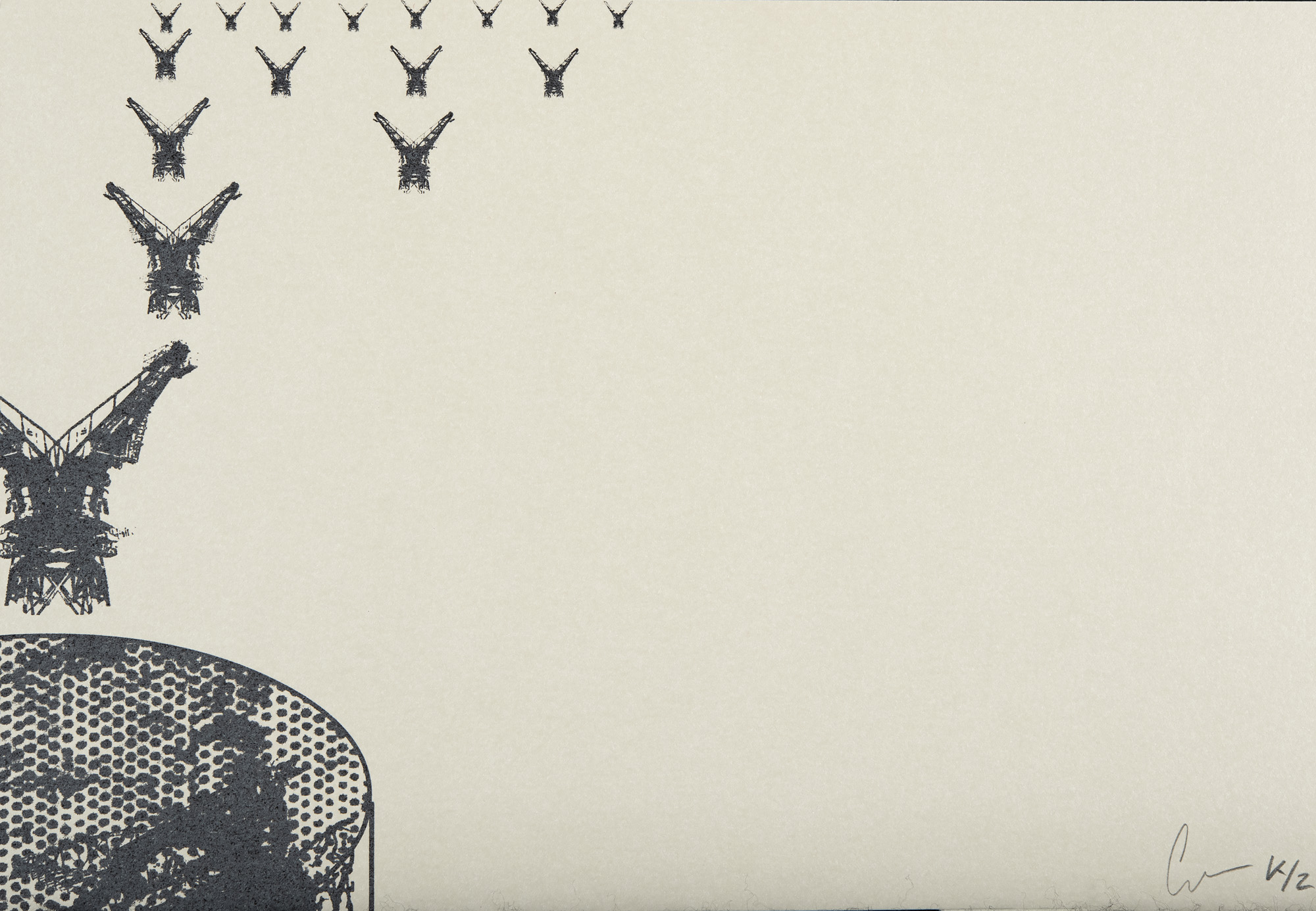
Technogenesis: Chromophase from the portfolio Russian Book Art, 2005. Screenprint on paper, 17 × 24.7 cm (6 11/16 × 9 3/4 in.). Purchased with funds donated by Norton Dodge and Nancy Dodge. 2005.0217.003