
Evgen (Yevhen) Petrenko
1946 — Ivanivske, Luhansk region (Ukraine) | 2016 — Kyiv (Ukraine). Worked in Kyiv (Ukraine), Moscow (Russia), Athens and Heraklion (Greece), and Krakow (Poland)
Evgen Petrenko was a Ukrainian painter, monumental artist, and printmaker and a representative of nonconformist Soviet art from the late 1970s through the 1980s.
Petrenko was born on May 4, 1946, in the village of Ivanivske, Luhansk, in the Donbas region of Ukraine. As a child, he moved with his family to the city of Uman in the Cherkasy region of central Ukraine. He studied in the painting department of the secondary art school in Kyiv (1962–65; now Taras Shevchenko State Art High School) and at the Moscow Higher School of Arts and Industry (1965–70; now Russian State Stroganov University of Design and Applied Arts); however, he did not graduate from the institute and instead was expelled in his final year after struggling to situate himself within the rigidity of the Soviet education system.
In 1971 he returned to Kyiv. He worked at the Kyiv State Art & Production Combine (kombinat), carrying out work focused on architectural and decorative art. There, he collaborated with Ivan Marchuk (b. 1936) and assisted him in mural painting.
Petrenko independently created several stained-glass windows. From 1974 to 1975, he completed a window on the concrete facade of the Kyiv cinema in Kyiv and, in the late 1970s, produced a stained-glass window for the Okean [Ocean] store in Kyiv. He also completed stained-glass windows for the administrative building of the Chornobyl nuclear power plant in the late 1970s. None of these works survive today.
Despite working in ornamental craft and public works, Petrenko remained involved in painting, a medium to which he remained dedicated in the decades to follow. His first artworks were created under the influence of Marchuk: romantic Ukrainian landscapes and metaphorical folk compositions. Gradually, in the late 1970s, he found his own artistic language and range of imagery, which consisted of vivid nonfigurative compositions imbued with a dramatic worldview and reminiscent of fantastic cosmic landscapes intertwining the natural, organic, and man-made. Central works exemplifying the artist’s distinctive style include Landscape (1980, ZAM, D10550), Biolandscape (1980), Double Landscape (1982), Emergent Revolution (1985), Still Life (1986), Bioengineering (1984, ZAM, D05514), and Accident (1980, ZAM, D10531). The “cosmic” aspect of these works functions as more than a simple spatial category and offers a lens into the artist’s broader, spiritual worldview. Petrenko’s figurative paintings, which explore Christian religious themes, similar to his nonnarrative works, are marked by dramatic intensity, plastic expressiveness, and spatial tension. This is demonstrated in works from the mid to late 1980s, most notably Повернення блудного сина [The Return of the Prodigal Son] (1985), Боротьба Якова з янголом [Jacob’s Struggle with the Angel] (1986), Богоматір з дитиною [The Virgin and Child] (1986), and Гріхопадіння [The Fall of Man] (1990).
There are several components to Petrenko’s artistic language and style: a lyrical abstraction with freedom of artistic expression; a medieval style of painting with its range of themes, motifs, and images; the influence of the art of Mikhail Vrubel [1]; and a certain surrealism, with its combination of the emphatically fictional, the illusory, and the concrete. His works reflect a premonition of social and man-made disasters, the first of which was the accident at the Chornobyl nuclear power plant in 1986, and the instability of the world order. Petrenko’s painting exists at the intersection of the abstract and the figurative, where the complexity of spatial constructions, color saturation, and figurative imagination are important components.
His first solo exhibition was to take place in 1985 at the House of Culture of the Moscow Institute of Atomic Energy; however, it was banned because the works did not meet the official requirements of socialist realism. In response to this rejection by Soviet authorities, he began exhibiting in Moscow two years later with the influential 1990s artist groups ARS-1 (Boris Orlov, Andrei Rost, Alexander Tsarev, Vitalii Ovsiannikov, Nikolai Makarevich, and others) and ARS-2 (Nikolai Rudkov, Yelena Kovaleva, Oleg Kovalev, and others), who worked across various media and collaborated on joint exhibition projects. [2] In 1988 Petrenko, together with the artists Yurii Myronov, Serhii Sherstiuk, Serhii Geta, Ihor Snehur, Viacheslav Koleichuk, Serhii Sharov, Aleksandr Semenov, Oleksandr Kostinyi, the sculptors Aleksandr and Igor Rukavyshnikov, and the architect Kostiantyn Khudiakov, founded Mars, the first independent private gallery in Moscow, which aimed to introduce the public to the latest art from different creative disciplines.
In 1990, Petrenko traveled with several Moscow artists to Greece, where he spontaneously decided to stay and live between Athens and the island of Crete, actively working and participating in exhibitions. He began with a solo exhibition in Thessaloniki and continued with successive exhibitions in Heraklion at the Municipality Art Gallery and Stavrakakis Gallery. His works were later exhibited in the Marika Kotopouli Museum in Athens in 2002.
In 1991, the artist was invited by Biennale committee “Lviv’ 91 Vidrodzhennia” to exhibit his painting The Fall of Man (1990) and Erosion of Memory (1989).
In 1996, a solo exhibition was held at the National Art Museum of Ukraine in Kyiv, during which he donated to the museum’s collection one of his most notable paintings, The Return of the Prodigal Son.
Petrenko also exhibited his work at the Museum of Natural History in Krakow, Poland, where his family lived. He was awarded a letter of gratitude from the then president of the metropolitan city of Krakow, Jozef Lassota.
In Crete during the 1990s and early 2000s, before he left Greece for permanent residence in Kyiv, Petrenko’s style had transformed into modern abstraction. His painting became more restrained in color, unfolding primarily within a silvery‑ocher palette, yet remained no less expressive. Portraits appear more often in his late works, inspired by ordinary Greek people he met at kafenios (traditional Greek coffeehouses). Motifs drawn from ancient Greek and Christian mythology and near‑abstract compositions embody the artist’s characteristic plastic imagination and are imbued with intense movement and inner emotional tension.
The artist’s works are held in collections of the National Art Museum in Kyiv, the Yaroslavl Art Museum (Russia), the Schnake Gallery (Germany), and the Museum of Natural History of the Polish Academy of Sciences (Krakow).
In 2003 Petrenko moved to Kyiv, where he continued his move away from painting. He became a recluse and spent his time producing poetry, digital art, illustrations, and collages until his death in 2016. Petrenko’s patriotism imbued his artistic practice and many of his digital works were created in response to the global political situation, particularly concerning Ukrainian independence from Russia.
Halyna Skliarenko
Translated from Ukrainian by Nathan Jeffers
Photo portrait: author unknown, courtesy Tetiana Petrenko
Notes:
1. Vrubel (1856–1910) was a Russian artist and representative of the Art Nouveau style who lived and worked in Kyiv in the 1880s. He completed paintings in St. Cyril’s Church as well as sketches of paintings in St. Volodymyr’s Cathedral, paintings, and watercolors, some of which remain in Kyiv. Exhibitions of Vrubel’s work were held in Kyiv in the 1970s, making a strong impression on Petrenko and many of his contemporaries.
2. From the Latin word ars, which means “art.”
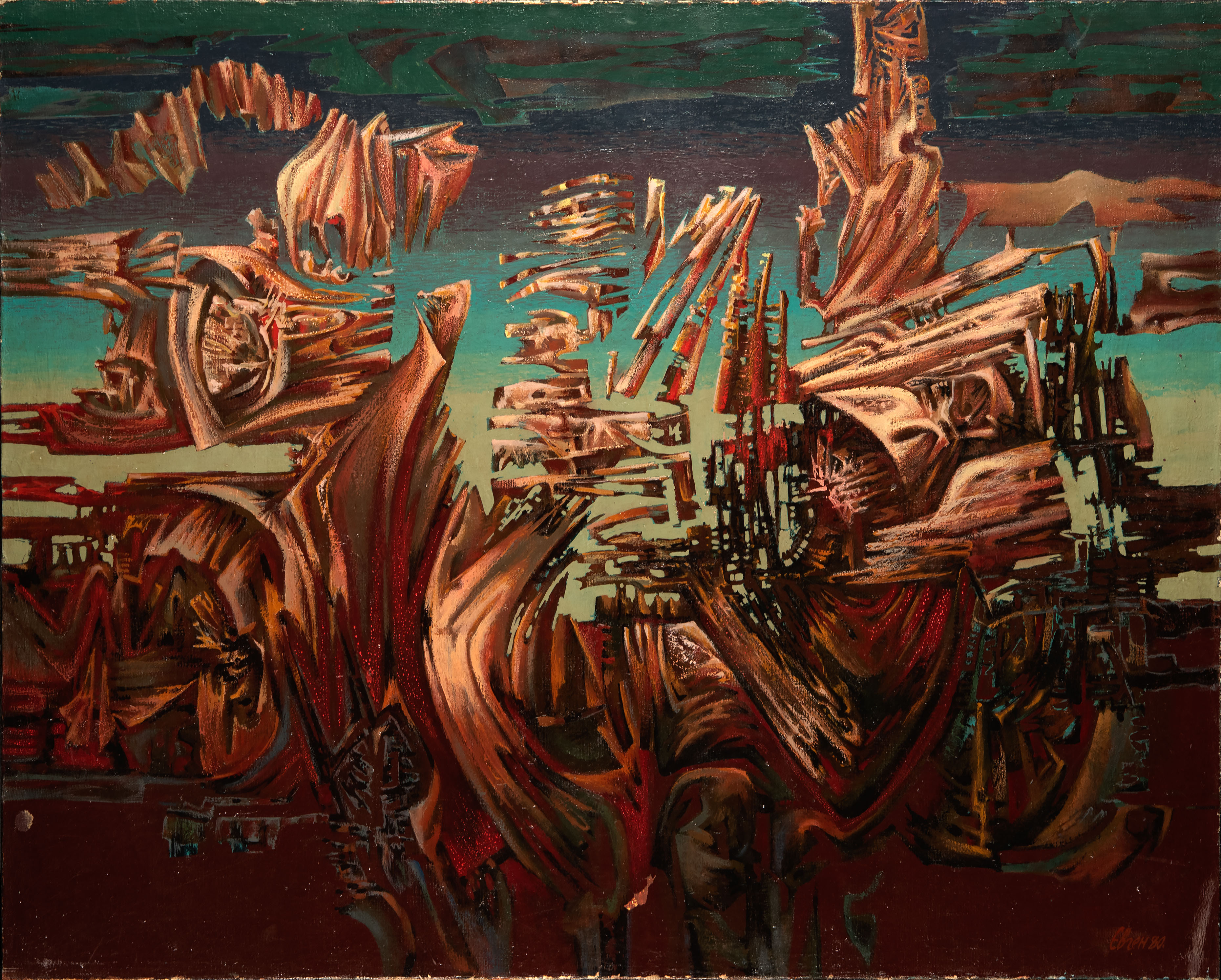
Accident, 1980. Tempera and polyvinyl acetate on canvas, 80.3 × 99.5 cm (31 5/8 × 39 3/16 in.). Norton and Nancy Dodge Collection of Nonconformist Art from the Soviet Union. D10531
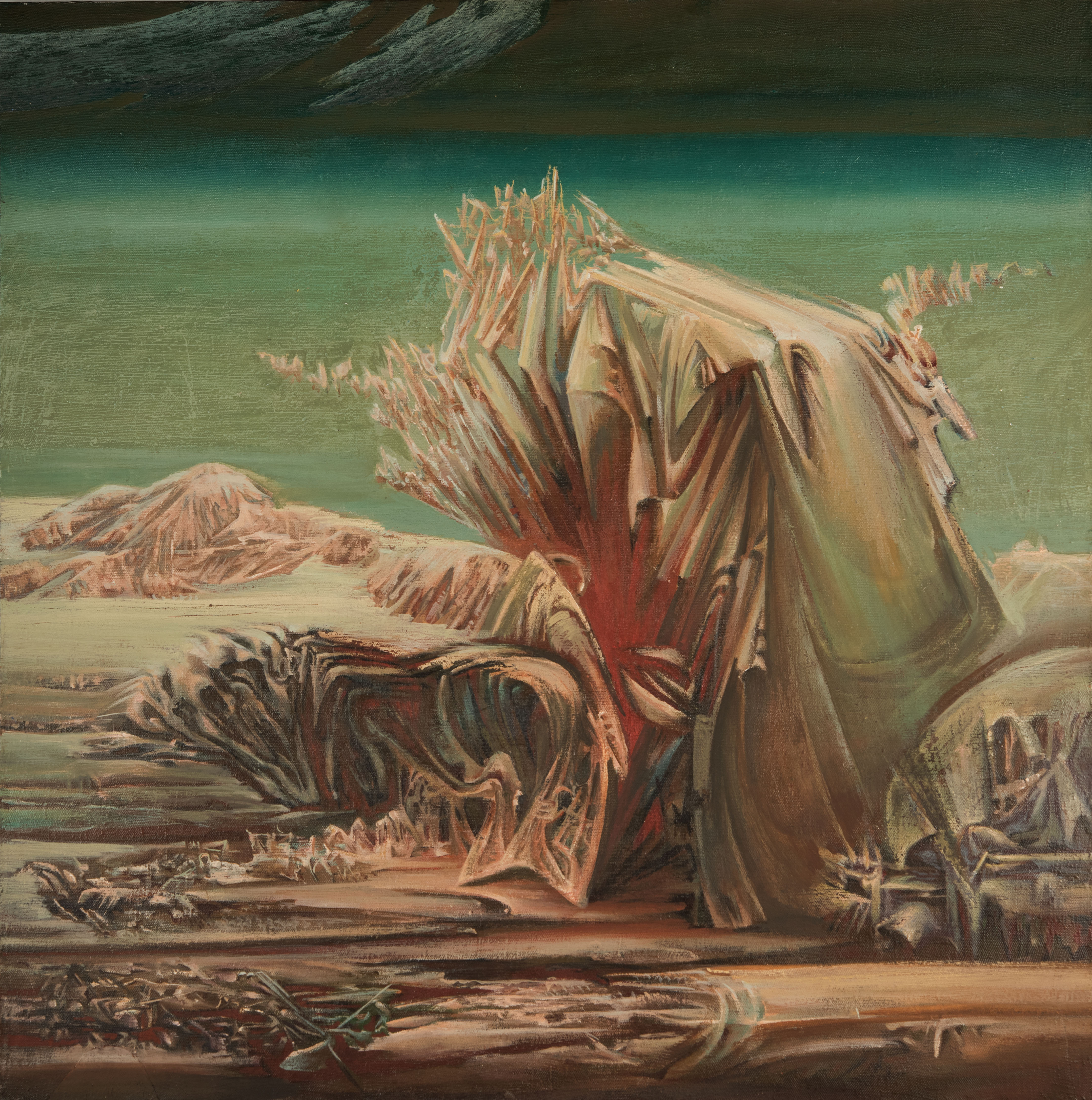
Landscape, 1980. Oil and tempera on canvas, 89 × 89 cm (35 1/16 × 35 1/16 in.). Norton and Nancy Dodge Collection of Nonconformist Art from the Soviet Union. D10550
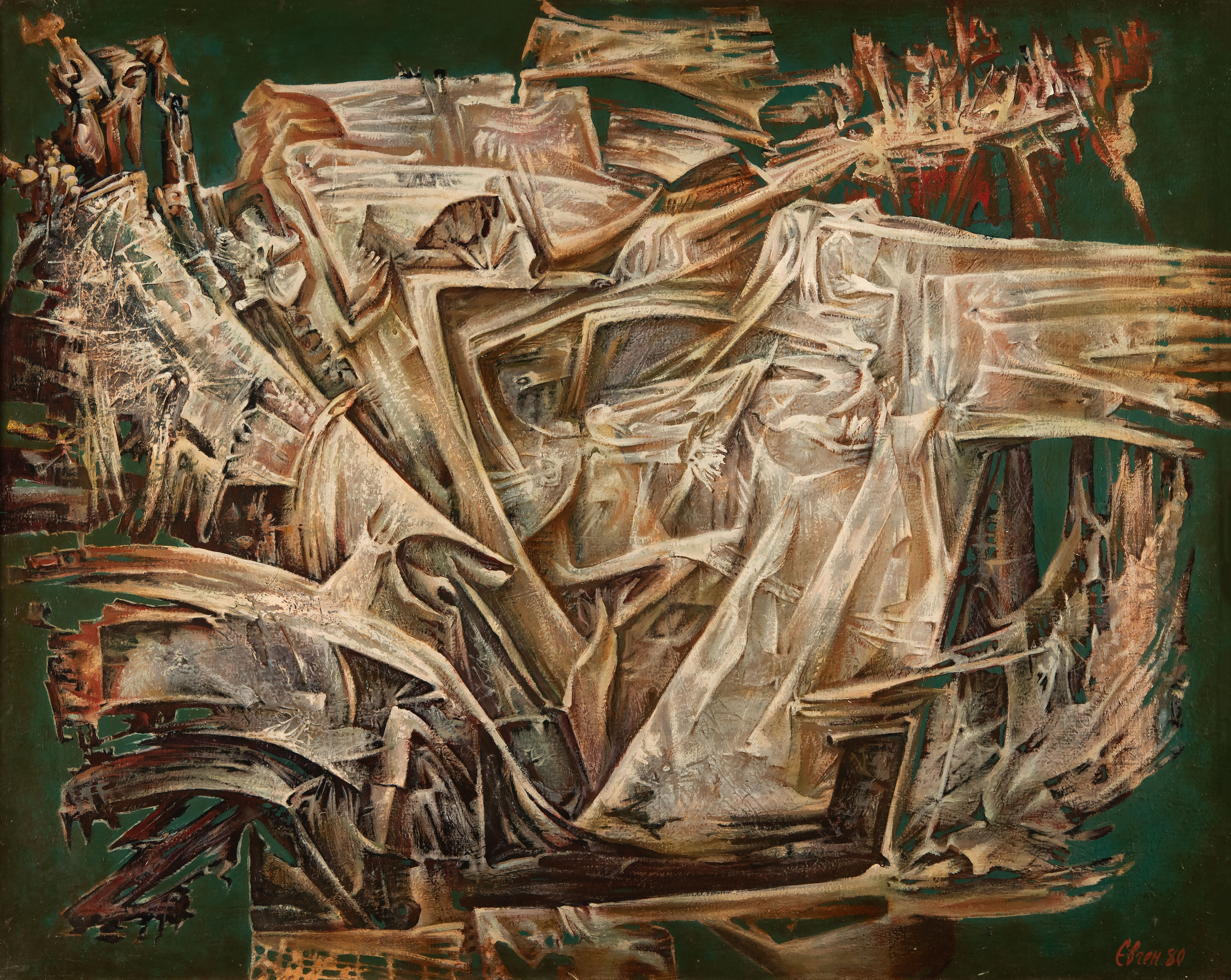
Preparation, 1980. Oil on canvas, 79.2 × 99.2 cm (31 3/16 × 39 1/16 in.). Norton and Nancy Dodge Collection of Nonconformist Art from the Soviet Union. D05414

Transformation, 1985. Tempera on canvas, 90.5 × 160 cm (35 5/8 × 63 in.). Norton and Nancy Dodge Collection of Nonconformist Art from the Soviet Union. D05415

Bioengineering, 1984. Oil on canvas, 79 x 89 cm (31 1/8 x 35 1/16 in.). Norton and Nancy Dodge Collection of Nonconformist Art from the Soviet Union. D05514

Fuga, 1984. Tempera and polyvinyl acetate on canvas, 90 × 90 cm (35 7/16 × 35 7/16 in.). Norton and Nancy Dodge Collection of Nonconformist Art from the Soviet Union. D10549