
Evald Okas
1915 —Tallinn (Estonia) | 2011 — Tallinn (Estonia). Worked in Tallinn (Estonia)
Evald Okas was born to a father who was a carpenter and a Russian-born mother who had various jobs. His father also crafted picture frames for established artists, many of whom visited his studio and met his son. The younger Okas’s interest in art began in high school, where his teachers encouraged him to study it, particularly appreciating his drawings.
Before World War II, Estonian painting was strongly influenced by French impressionism and its offshoots, yet Okas followed a slightly different path. In 1938, he enrolled at the Higher State Art School (now the Estonian Academy of Arts) in Tallinn, where the curriculum was more realism-based, which suited Okas’s technical skill. He was an archivist of everyday life, drawing and painting quickly to portray the events, people, and spaces around him.
Okas started exhibiting before the war, but during the war he spent years in the Russian city of Yaroslavl alongside several other Estonian artists, dedicating himself to war and military motifs. He quickly adapted to socialist realism, the official aesthetic doctrine of the Soviet Union, without visible resistance, continuing in this style after the war. He worked in different genres, establishing himself as a painter of monumental works—large canvases filled with historical and political scenes that were ideologically aligned with the Soviet regime. His images of Soviet daily life and industry, portraits of Lenin, heroic depictions of soldiers and workers, and portrayals of partisans and fishermen not only supported the new establishment but also confirmed Okas as one of its members. His style aligns with Soviet impressionism, as it combines intense brushwork and lush color with subjects from everyday life, but it is hard to pigeonhole him as having any one certain style; he shifted his focus as needed, sometimes employing realism, other times using a freer approach. He even veered toward abstract art but never quite got there, finding the avant-garde in its many forms too alien. Some of his best-known works are figurative compositions depicting workers, soldiers, mythical heroes, and other artists, but he was also an outstanding cityscapist.
After the war Okas became a professor at the State Art Institute of the Estonian SSR. Although he was a member of Soviet Estonia’s pseudo-parliament (a puppet parliament that did not have any real power) for some years, he never became an influential member of the communist party elite nor did he hold any significant positions or exercise potential power, limiting his ideological loyalty to his art. His career allowed him to enjoy various privileges, however, including the rare opportunity to visit foreign countries (such as Italy, Japan, France, the United States, India, and Greece), which he depicted in his work, and to access international art magazines. These magazines, which were a rare sight in Soviet Estonia, were later distributed by his son, the conceptual architect and artist Jüri Okas (b. 1950), in local avant-garde circles.
Okas was prolific throughout his nearly century-long career. Between the 1950s and ’80s, he produced numerous paintings and graphic works, including portraits, cityscapes, interiors, compositions, and historical scenes; he also painted nudes, which he became known for and which were steadily exhibited. Although nudes were not the most popular genre in the Soviet Union, they were not rare; several Estonian artists depicted the nude female body without encountering any problems. This was due to the fact that nudes were often depicted not erotically but symbolically, portrayed by the (male) artists as representations of harmony and beauty.
Okas’s work Peace (1971, ZAM, D09780) is from a period when the artist became increasingly interested in nudes. He had depicted women earlier, but over time the images grew a bit more erotic and voyeuristic. Peace became one of his best-known works; it was exhibited at the Tallinn II Graphic Triennial and reproduced many times in magazines and albums. The minimalist black-and-white palette shows some influence from Okas’s 1965 trip to Japan. The figure has her eyes turned toward the viewer, a position of control, though she is at the same time totally exposed to the viewer’s gaze—a style of depicting female nudes that was not uncommon.
Although Okas started as a graphic artist in the 1940s, he had quickly turned to painting, a more valued art form in Soviet Estonia. Nonetheless, he rebooted his career as a graphic artist in the late 1950s, alongside his painting practice. He worked with many techniques, especially aquatint, linocut, drypoint, and (auto)lithography. Graphic arts allowed Okas to explore emotional dramatics (the contrast between black and white offered many options) and storytelling. He worked quickly and ferociously, creating thousands of prints over the course of his career. His graphic works, which include portraits, historical and mythological scenes, views of Estonian and foreign cities, and depictions of industrial complexes, harbors, woods, and villages, deftly capture reality and theatricalize it to a certain degree—with the addition, for example, of pathetic expressions, intense color, lush ornamental elements, or figurative volume—without deviating too far. Okas was very active up to the end of his life, creating new paintings until his death in 2011, at the age of ninety-five.
Eero Epner
Photo portrait: Evald Okas, 1970s. Photo by Kalju Suur. Courtesy of Art Museum of Estonia. EKMj55629FK919
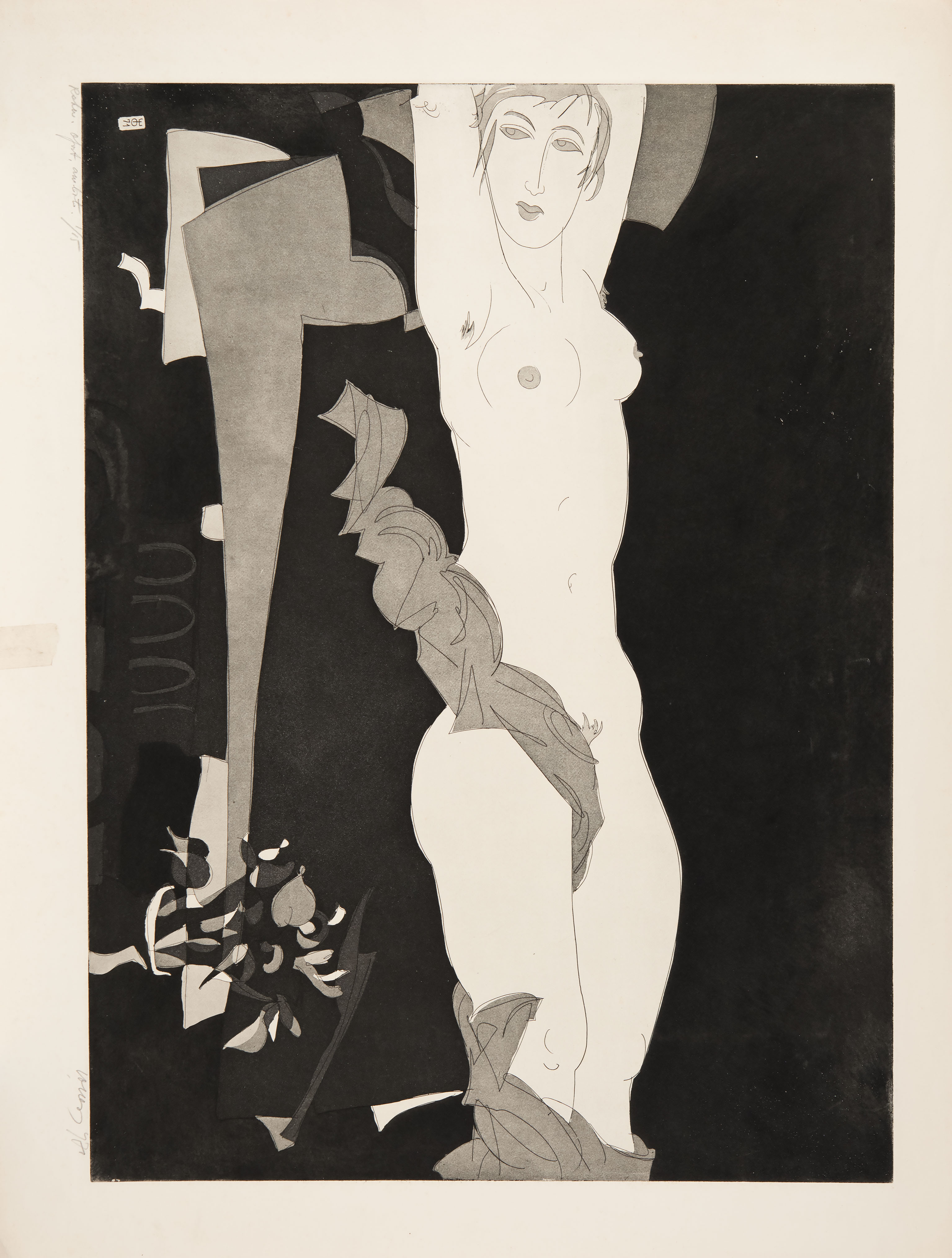
Peace, 1971. Etching on paper, 49 × 64.7 cm (19 5/16 × 25 1/2 in.). Norton and Nancy Dodge Collection of Nonconformist Art from the Soviet Union. D09780