
Eva Levina-Rozengolts
1898 — Vitebsk (Russian Empire, now Belarus) | 1975 — Moscow (Russia). Worked in Moscow (Russia)
Eva Levina-Rozengolts was a painter and graphic artist. She was born in Vitebsk to Pavel Rozengolts, a merchant of the second guild, and Klara Rozengolts, who attended the private school of Yudel Pen (1854–1937), the famous mentor of Marc Chagall (1887–1985) and Lazar (El) Lissitzky (1890–1941). At almost 40 years of age, Klara Rozengolts decided to continue her painting studies with Kazimir Malevich (1879–1935) at the UNOVIS art school in Vitebsk; her notebook with sketches of suprematist compositions from that period survived and is now in the Pushkin State Museum of Fine Arts in Moscow. Klara Rozengolts’s ambition to grasp new artistic and sculptural ideas served as an example for her daughter Eva.
During the First World War, between 1914 and 1917, Eva Rozengolts worked as a nurse in a military field hospital. In 1918, she met the expressionist sculptor Stepan Erzya (1876–1959), from whom she took lessons in clay modeling. She continued studying sculpture in the workshop of Anna Golubkina (1864–1927), and in 1921, she enrolled in the painting department of VKhUTEMAS (Vysshie khudozhestvenno-tekhnicheskie masterskie, Higher art and technical studios), where she ended up in the studio of Robert Falk (1886–1958), a member of the Jack of Diamonds association—a group of Moscow artists who espoused a modernized version of Cézannism.
Relying on Falk’s advice, Rozengolts achieved considerable success as a student. Her works were exhibited and reproduced in magazine surveys. Her complex, multilayered painting style formed under Falk’s influence; he had abandoned the avant-garde practice of using pure colors and had embraced a chromatically nuanced approach in the spirit of the old masters. In 1925, she presented her diploma thesis and received the highest marks upon graduating from VKhUTEMAS.
In 1923, Rozengolts met the young writer Boris Levin (1899–1940) and married him. Levin worked as a correspondent for a number of periodicals, wrote satirical pieces and editorials, and was a master of the short story.
In 1926, Rozengolts—now Levina-Rozengolts—traveled to London. Living with her brother Arkady, who was the USSR’s plenipotentiary representative in Britain (Chamber of Commerce and Industry), she worked in the Soviet trade mission and visited London museums, where she found inspiration in the paintings of J. M. W. Turner (1775–1851).
In the early 1930s, Levina-Rozengolts worked on cycles of pastel landscapes of Moscow, which reflected the influence of the postimpressionist works she had seen in Europe. She worked in industrial design and made sketches for mass-produced textiles, borrowing motifs from children’s art and folk art. She was also involved in preparing the designs for the Soviet pavilion at the International Expo in Paris (1936–37).
In 1937, a tragedy impacted the artist’s life. Her brother, Arkady Rozengolts, who had become the People’s Commissar for Foreign Trade in the Soviet government, was arrested and subsequently executed as an “enemy of the people.” As a close relative, Levina-Rozengolts lost her job and means of subsistence.
Her husband, Boris Levin, died in 1940 during the Soviet–Finnish war, which he was sent to cover as a front reporter. During the 1940s, Levina-Rozengolts worked in the copy shop of the Moscow Association of Artists, making copies of works by the leading proponent of socialist realism, Aleksander Gerasimov (1881–1963), as well as classics of Russian art—by Isaac Levitan (1860–1900) and Nikolay Bogdanov-Belsky (1868–1945)—on commission from Soviet agencies and institutions.
In August of 1949, Levina-Rozengolts was arrested on a fabricated charge of anti-Soviet activity and sentenced to ten years of exile in a Gulag camp in Siberia. During her prison term, she worked in forced-labor logging, as a cleaning woman, a hospital attendant, a painter on barges, and an unskilled laborer.
In 1956, with the denunciation of Stalin’s personality cult and the beginning of the Khrushchev-era “thaw,” Levina-Rozengolts was rehabilitated and returned to Moscow. She began working intensively in graphic art, mainly pen and ink on paper. During the late 1950s and early 1960s, she created the cycles that became her artistic calling card: Trees (ZAM, D25280), Swamps (ZAM, D25282), People (Rembrandt Series, ZAM, D25278-79; 2001.1042-44). In these works, she reinterpreted her previous experience: her visual culture was given a sharper, more emphatic expression in recognition of her many years of forced inactivity. Her works were executed without preliminary sketches, alla prima. Her ink drawings were filled with living emotions, a re-experiencing of the past. Images of trees, swamps, and remote locations in nature symbolized loss, bitterness, and pain due to the absence of any place where peace and joy might be found.
To enhance these works’ narrative drama, Levina-Rozengolts subjected them to a form of artistic dissection: not simply using the traditional set of techniques—drawing a line with a pen or making a stroke with a brush—she scratched through the surface of the paper and rubbed out spots already covered with paint until the snow-white foundation showed through. In such manipulations, one senses a mechanism concealed within the creative act that enables accumulated energy to emerge.
In the works of the Rembrandt Cycle, as it was called by the art critic Mikhail Alpatov, Levina-Rozengolts turned to the idol of her youth, whom she had come to love through Falk, who was himself inspired by the great Dutch artist. Her compositions with human figures are beyond any generic classification. The life-size people depicted in some kind of procession are not connected to each other by any narrative; these figures constitute the human masses, snatched out of the flow of time. They represent condensations of matter, which has been subjected to some kind of “compacting” force, but which, as a unified whole, continues to present resistance. “Prison, the prosecutor, and exile made me into a real artist,” she said. [1] This was how Levina-Rozengolts understood her life; this was how she metaphorically embodied her knowledge of life in her works.
In the 1970s, Levina-Rozengolts returned to pastels, creating the cycle Sky (1971, ZAM, D20773–75, D25281), which at the end of her dramatic creative path appears as a conclusive coda. Her gaze, directed toward the sky, looks for a nonmaterial medium in which light becomes effectively the only subject for representation. A crucial inspiration for the cycle came from the paintings of J. M. W. Turner, which elicited a flood of memories, comparable to dream visions, about the years spent in London during the 1920s. In these works, the celestial serves as an indicator of time, as a kind of threshold to a world in which nothing is distorted and there are no objects, no broken lives, no anxious expectations.
Levina-Rozengolts executed these laconic compositions on large sheets of drawing paper, moving away from the intimate formats of her previous works. The artist achieved a smooth gray-blue textured surface, on which light reflections break through at different angles. The notional designation of the sky is highlighted by rare charcoal inserts, denoting the earth’s solidity, and upward-stretching clumps of plants and grasses—sprouts of life, which serve as decoration for eternal immaterial light. According to the painter Erik Bulatov (1933–2025), Levina-Rozengolts’s Sky cycle had a strong influence on his work. The solution to spatial problems in his compositions of the 1970s, to some extent, had its source in the pastels of his close friend Levina-Rozengolts.
In 1974, the Pushkin State Museum of Fine Arts reached out to Levina-Rozengolts with an offer to acquire a set of her works, a belated recognition of her art.
The artist had no solo exhibits during her life. In 1978, the Moscow House of Artists hosted a one-day exhibition where her work was shown for the first time.
She died on June 10, 1975, and was buried at the Vostryakovskoye Cemetery in Moscow.
Ildar Galeyev
Translated by Ilya Bernshtein
Photo portrait: Eva Levina-Rozengolts. 1960s. Photographer unknown. Collection of the artist's family, Moscow
Notes:
1. "Eva Levina-Rozengolts in Galeyev Gallery" [exhibition announcement]. Коммерсантъ Weekend. September 26, 2008.
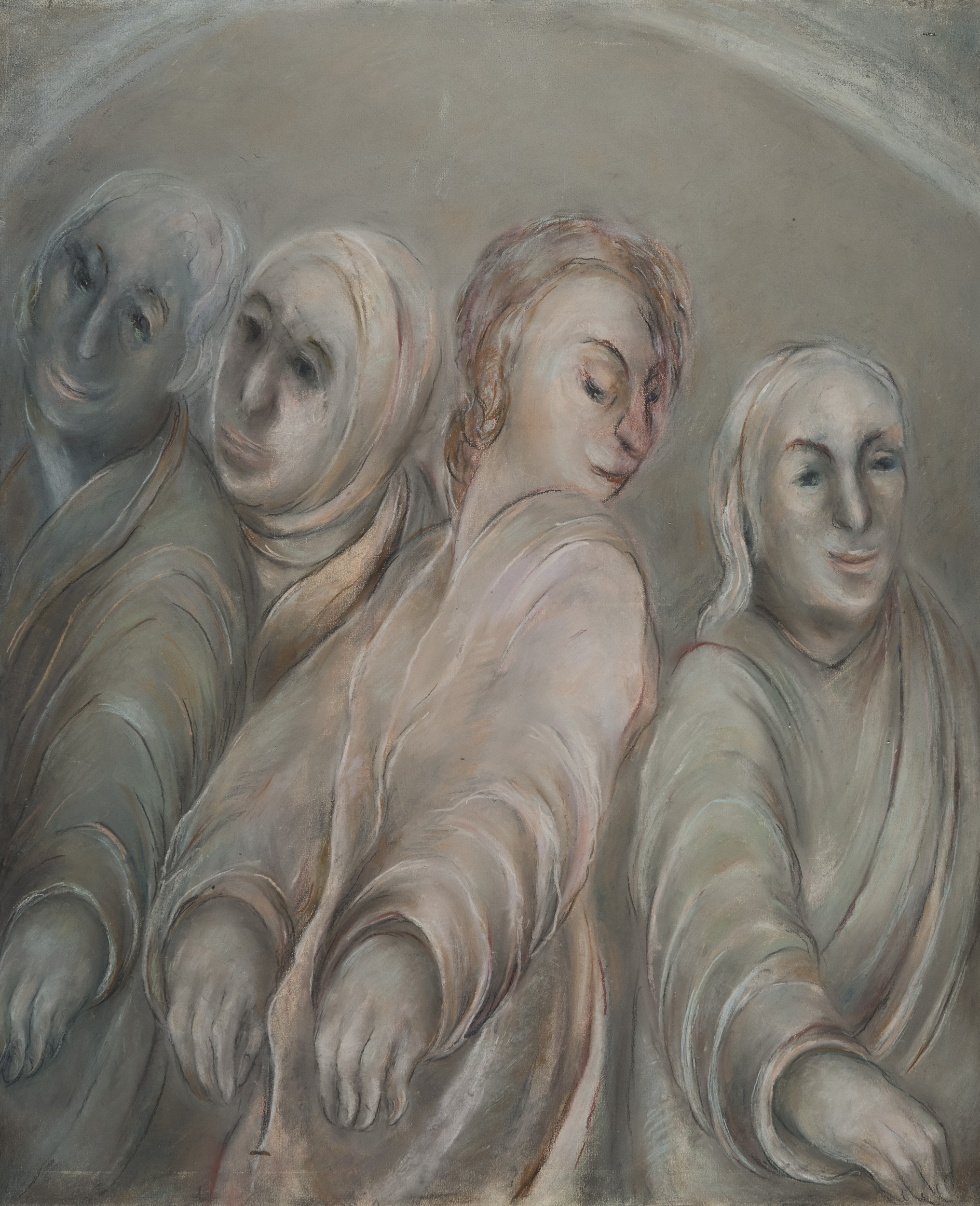
Untitled from the series Frescoes, 1965. Pastel on paper, 76 × 63.5 cm (29 15/16 × 25 in.). Norton and Nancy Dodge Collection of Nonconformist Art from the Soviet Union. D20772
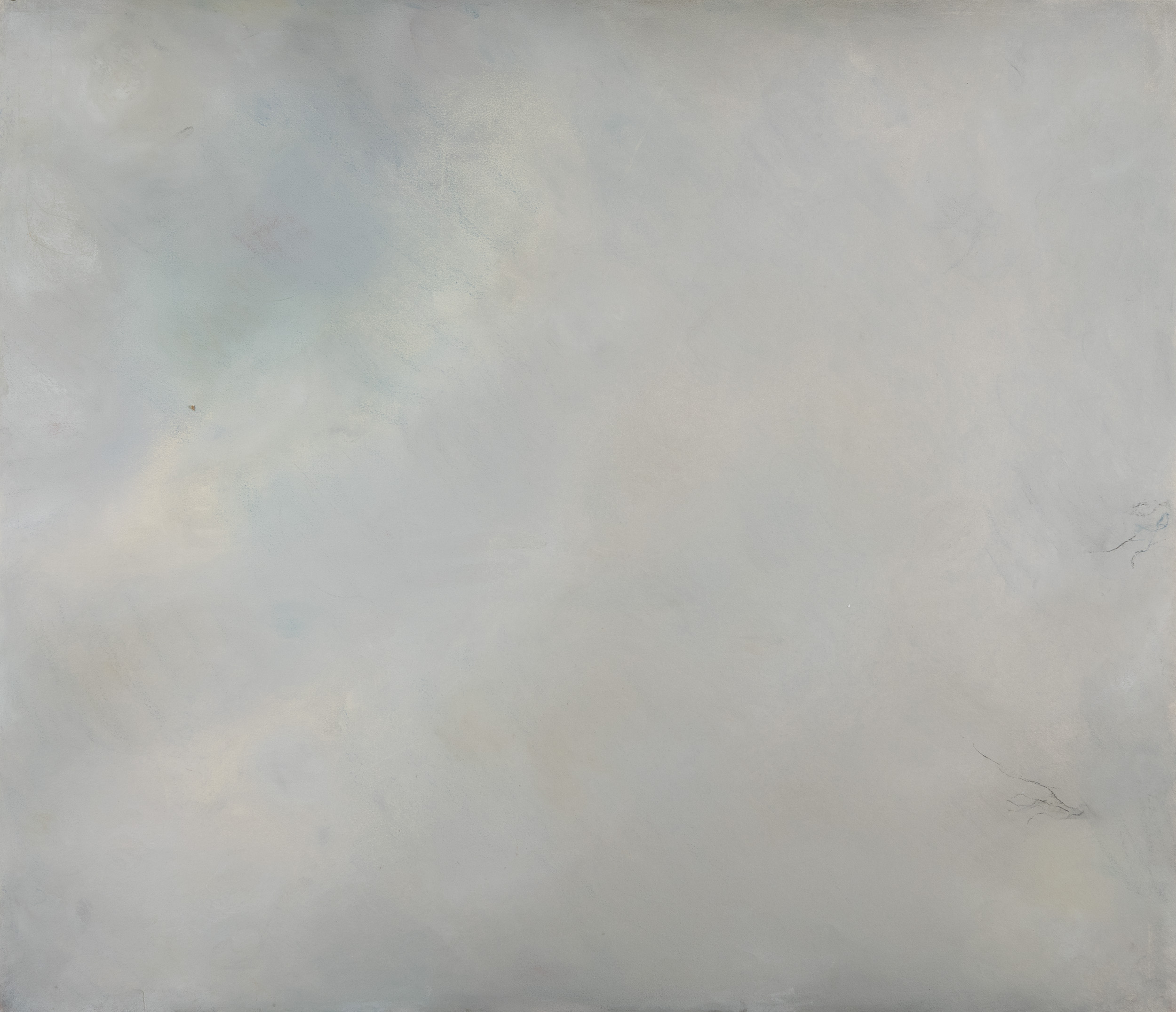
Movement of the Clouds from the series Sky, 1972. Pastel on paper, 75.6 × 63.3 cm (29 3/4 × 24 15/16 in.). Norton and Nancy Dodge Collection of Nonconformist Art from the Soviet Union. D20774
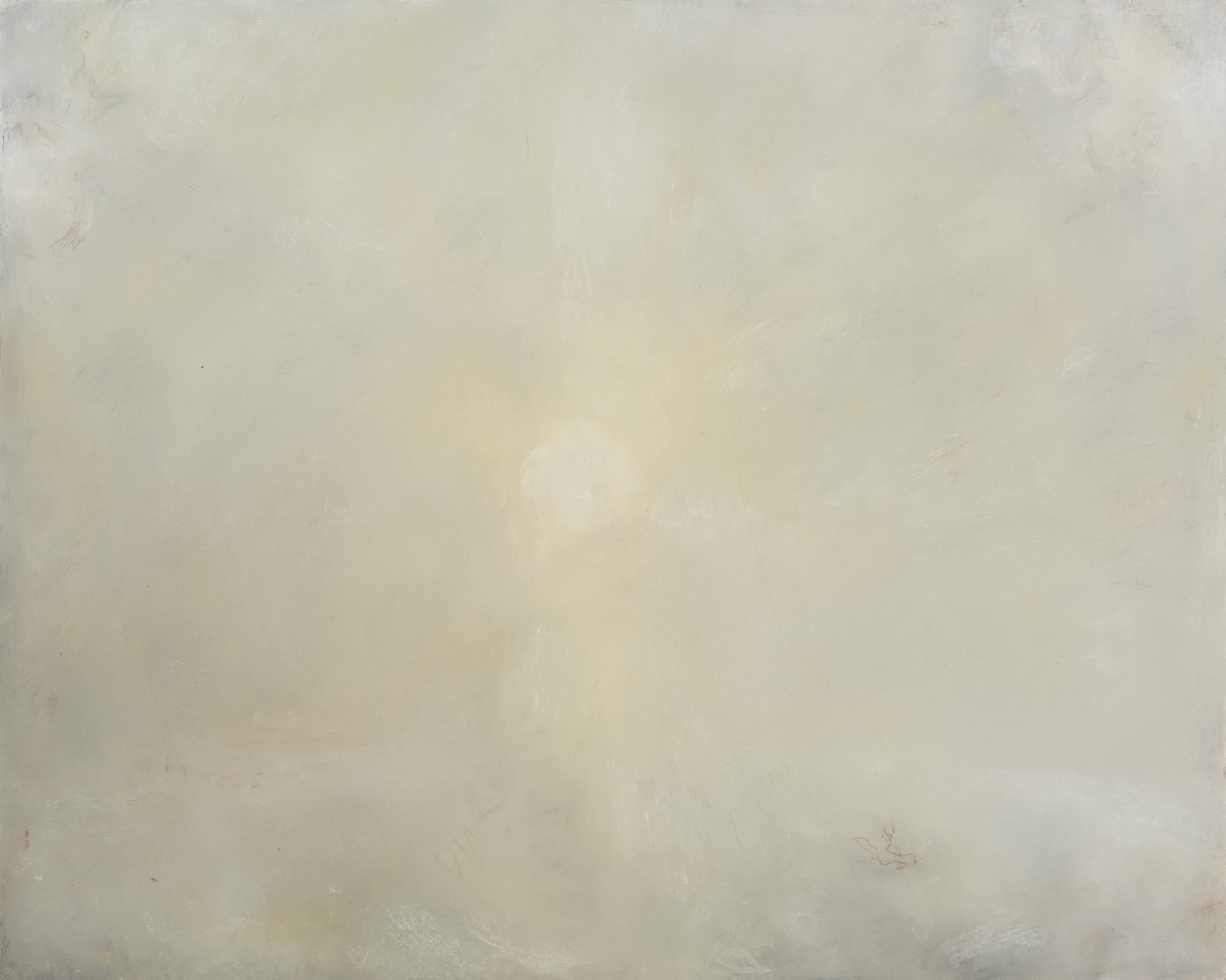
Yellow Sun from the series Sky, 1973. Pastel on paper, 58.2 × 71.8 cm (22 15/16 × 28 1/4 in.). Norton and Nancy Dodge Collection of Nonconformist Art from the Soviet Union. D20775

From the series People, subseries Rembrandt, 1964. Ink and ink wash on paper, 28.5 × 20.5 cm (11 1/4 × 8 1/16 in.). Norton and Nancy Dodge Collection of Nonconformist Art from the Soviet Union. D25278
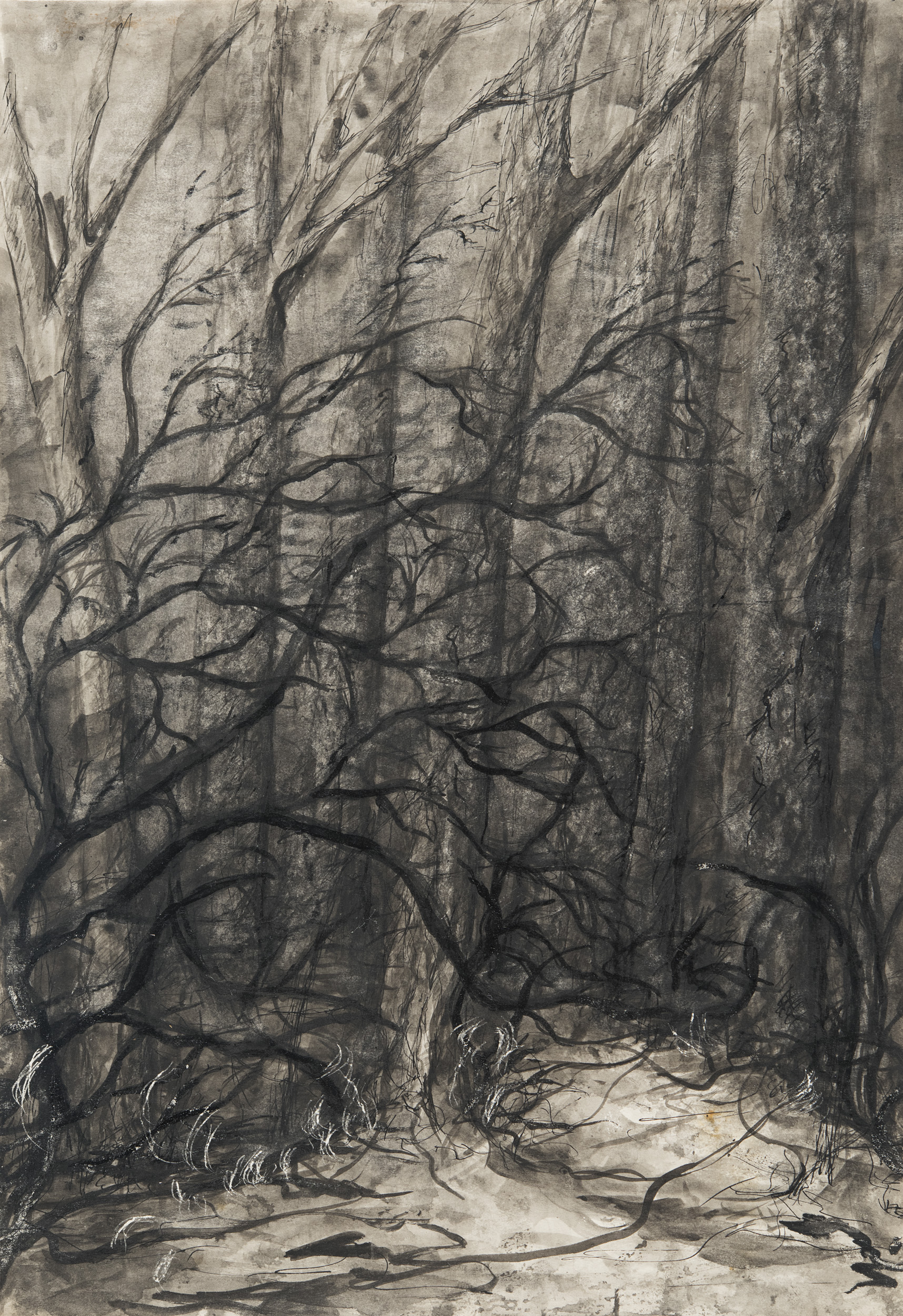
Untitled from the series Trees, 1959. Ink, ink wash, and sgraffito on paper, 40.7 × 28.3 cm (16 × 11 1/8 in.). Norton and Nancy Dodge Collection of Nonconformist Art from the Soviet Union. D25280
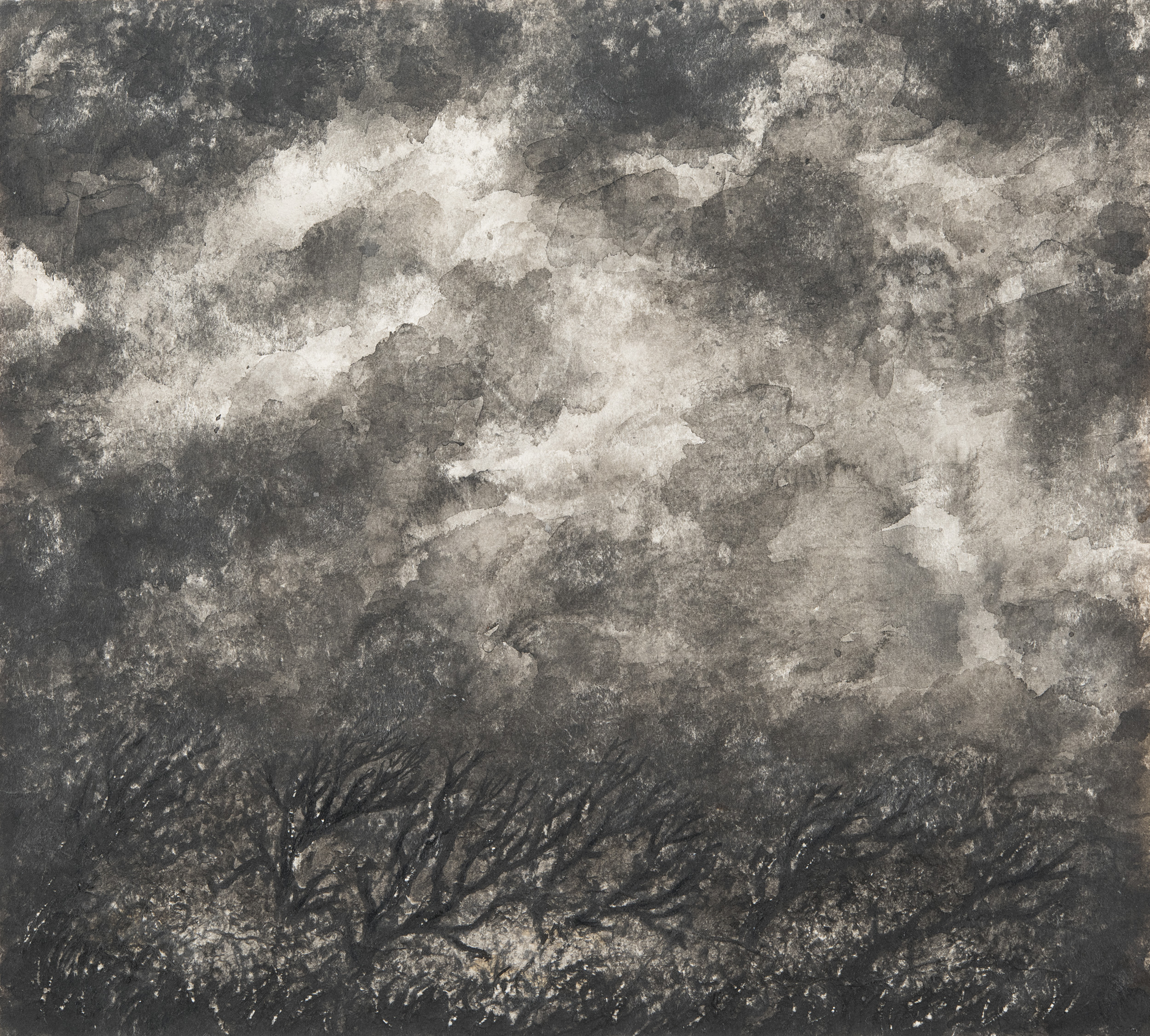
Untitled) from the series Sky, 1963. Ink, ink wash, and sgraffito and paper, 40.6 × 45.1 cm (16 × 17 3/4 in.). Norton and Nancy Dodge Collection of Nonconformist Art from the Soviet Union. D25281