
Eugenijus Antanas Cukermanas
1935 — Kaunas (Lithuania). Works in Vilnius (Lithuania)
Eugenijus Antanas Cukermanas was born in Kaunas, the temporary capital of recently independent Lithuania, to Maksas Cukermanas (1896–1976) and Elena Cukermanienė (née Makauskaitė, 1905–1982). Raised in a family of civil engineers, he graduated from the Kaunas Institute of Polytechnics (now Kaunas University of Technology) with a degree in architecture in 1960. In the same year, he married his classmate Valerija Ema Jakubonytė (1935–2018)—who would later become a renowned furniture designer—and moved to Vilnius.
Following the completion of his studies, Cukermanas’s primary professional career from 1960 to 1980 was centered around his work as an interior architect and furniture designer. Most of the time, he worked at the Bureau of Furniture Design and Construction, which was the primary furniture design institution in Soviet Lithuania, and he became a member of the Union of Architects in 1968. He grew increasingly dissatisfied with the lack of creative freedom in his architectural teams within the dysfunctional Soviet system, with its planned economy, limited technological advancements, and unwritten rules. In his late thirties Cukermanas turned to painting after work, convinced that canvas and paint provide equal opportunities for everyone. Although his six-year degree had included several semesters of drawing and watercolor classes (taught by the painter, stage designer, and puppeteer Stasys Ušinskas [1905–1974]), he is a self-taught artist.
Without a formal painting degree, Cukermanas faced hurdles in accessing essential painting supplies and services granted to artists under the Soviet system—for example, the rights to request an art studio and to reside in the Houses of Creativity, the specialized resorts open for members of the Artists’ Union. During the Soviet era, this alone provided ample reason to label him an amateur painter. As a result, Cukermanas remained largely absent from the public eye until the mid-1980s: His works were not showcased in official art venues, acquired by the state, or featured in art publications. While still an architecture student, he became familiar with contemporary art and design through Polish, Czechoslovakian, and Italian magazines. However, it was the cultural weapon of the Cold War—the American National Exhibition (Moscow, USSR, 1959), showcasing celebrated American abstract expressionists—that marked a turning point, revealing to him the possibilities of abstraction, which he considers his most natural mode of expression. [1]
In his early works from 1972 to 1978—a period the artist himself considers his independent apprenticeship in painting—Cukermanas boldly challenged the notion of painting as a window to the world and instead explored the formal and conceptual issues of the medium. This approach led to his first solo exhibition, Painting (1976), held in the cellar back rooms of the Lithuanian SSR Artists’ Union—spaces usually reserved for social gatherings. The artist painted hard-edged geometric abstractions on shaped supports, emphasizing the painting as both an image and an object, as in A (1974, ZAM, D01866), or Prism I, Prism II, and Prism III (1976, private collection). The dim lighting of his first workspace—a low-ceilinged semi-basement where he painted in the evenings after work and on weekends—influenced his use of bright, bold colors, while limited resources shaped his choice of materials. In some works from this period, the pictorial space is organized around a square grid—a recurring motif that evokes the modular logic of architectural design. For the artist, the grid is not merely a compositional tool but a reference to civic structure and the cultural memory embedded in shared public spaces—a reminder, as he notes, of the paving stones of Roman piazzas. [2] This motif anchors such works as Square (1975, ZAM, D01868); Green Green Grass of Home (1976, private collection); and Green Green Grass of Home II (1978, ZAM, D01409), where the grid acts as a reality-charged framework, linking visual order to deeper architectural and historical associations. Working in synthetic tempera on shaped cardboard and incorporating cylindrical forms, fabric, and thick paint, the artist built layered, collage-like compositions that extend into three dimensions—some designed to rest on the ground or hang from the ceiling, as in Square (1978, MO Museum, Vilnius, Lithuania).
Since Cukermanas began working on canvas, his work has reflected a core belief about the medium: that painting should not obscure its own physicality. For the artist, the canvas, the stretcher, and the paint—what he called “a colored, pliable substance”—are not passive supports but central players in the painting’s narrative. [2] Echoing suprematist ideas, he constructed pieces from three black-painted square frames, partially left unstapled, with loose canvas edges—burned, cut, smeared—fluttering freely (Margins II, 1977, MO Museum). In Red (private collection) and Red #2 (1977, ZAM, D00731), a rusty red, elongated canvas is stretched over a triangular frame, with one edge carefully torn away. By exposing the raw, unfinished sides of the painting—what is usually hidden, stapled down, or trimmed away—Cukermanas redirects our attention to what lies outside a conventional picture. These unstretched, unruly margins become charged spaces of ambiguity and resistance. In Soviet Lithuania, where official culture projected a polished ideological surface, the truth of lived experience often revealed itself off frame—in private kitchens, behind closed doors. In Cukermanas’s work, the drama unfolds not just on the painted surface but in the spaces where the structure reveals itself: vulnerable, exposed, and insistently real.
Following his relocation to a brighter and more expansive studio in 1978, Cukermanas began to devote himself more fully to his practice. Conceiving each painting as an exploration of space and matter, from the late 1970s to mid-1980s he fully developed his own direction: a unique compositional style, linked to color field painting, based on layered or superimposed painterly “figures”—elemental forms that emerge through chromatic and material intensities, which he described as “disjointed spatial fragments of varying density.” [1] The often ambivalent relationships between these forms—which evoke stratified geological structures—are central to his practice. This visual language came into full view in his 1984 solo painting exhibition at the Exhibition Salon of the LSSR Photography Art Society—his first presentation in a dedicated exhibition space—where he exhibited works from the Zone series alongside other pieces.
The artist transforms canvas into a seemingly corporeal living matter by engaging the entire material body of the painting in the creative process. He allows the mass of paint to flow like lava across the canvas, burying natural and cultural layers beneath its surface, as in the work Graffiti (1977, Lithuanian National Museum of Art, Vilnius, Lithuania); layers canvas upon canvas and tears through surface to reveal another layer underneath, as in the Atodangos [Strata] series (Atodangos V / Strata #5, 1989, ZAM, D14208); attaches strings to the surface of the painting sometimes only to peel them off, wounds it, roughens the texture by scratching motions or by applying paint straight from the tube, seals certain parts with resin (as in Basilica, 1995, private collection, and Riva, 1998, private collection), and burns linear marks into the painting’s surface with a soldering iron, inscribing heat into the skin of the work (as in Zones VIII, 1982, private collection). In the same way, he burns his initials into every painting. A line stands out as a characteristic compositional element of his pieces—at times graphic, marking the boundaries of color areas, and elsewhere corporeal, resembling scars (Stigmas, 1980, private collection; Zones #15, 1985, private collection). The cultural layers—once appearing in earlier works as script-like marks, geometric forms (Around the Cube II, 1977, private collection), or subtle references to tombstones (see Epitaph II, 1979, private collection; Fazės / Phases, 1984, ZAM, D16985)—gradually are being replaced by gentle allusions to architectural plans or building structures, as in Court (1983, National M. K. Čiurlionis Art Museum, Lithuania) and Cathedral (1997, private collection).
His works from the late 1970s are almost monochromatic, dominated by dirty, subdued shades of gray and brown. In the 1980s and ’90s, he blended vibrant color areas with nearly achromatic ones, incorporated muted reds and various shades of ocher, and created subtle tonal transitions and rich textures. Cukermanas works slowly, meticulously considering and feeling out the smallest nuances, creating his paintings in series. To him, “a new piece is an extension of the previous one and at the same time a negation.” [1] As the art critic Alfonsas Andriuškevičius observed, through color, form, and surface, Cukermanas’s painting at times evokes aspects of Jewish history and culture, and the universal rhythms—the collision of layers of culture and nature, spirit and matter—seem to play out on their own terms, subtly guiding the viewer toward a sense of fatalism. [3]
After the restoration of Lithuania’s independence in 1990, monumental changes swept through the nation’s art world, reshaping its dynamics and notions of art. Cukermanas finally achieved publicity and institutional recognition: he joined the Lithuanian Artists’ Association (1990) and had his first solo exhibition of drawings at the main art venue in Vilnius, the Arts Exhibition Palace; he became a member of Group 24 (active 1989–99), which united semi-nonconformist painters and the art critics representing them; and he served on the board of the Soros Centers for Contemporary Art from 1995 to 1999. Grants from the Austrian KulturKontact Foundation (1992) and the Pollock-Krasner Foundation (1997) made painting and traveling possible. His contribution to Lithuanian painting finally was recognized with the Lithuanian National Prize for Culture and Arts in 2000, a few years after the presentation of his long-term work Flying Dutchman (1978, ongoing) in a solo exhibition at the Contemporary Art Centre, Vilnius. Since January 15, 1978, the artist has been painting a black rectangle—referencing the mythical ship named in the work’s title—onto a canvas divided into 180 squares, using only black and white, as if playing a game of Battleship with eternity. Each time the ship’s position changes, from daily to monthly, the previous location is painted over in white, leaving a faint trace. Its movements have been systematically documented on a scroll of millimeter graph paper, now over 200 meters long and recording around 1,500 positions. The work remains in progress, contingent on the ship’s motion—controlled solely by Cukermanas. The solo exhibition marked the only occasion on which Flying Dutchman was presented as an installation. It brought together the painting with a scroll tracking its positions over time alongside a series of enamel and metal-mesh works, each representing a year of the rectangle’s trajectory (1978–97), and a row of basalt paving stones inscribed with dates. More recently, the work, shown in digital format, was exhibited alongside pieces by On Kawara (1932–2014), Roman Opałka (1931–2011), Nam June Paik (1932–2006), and others in Spirit Labor: Duration, Difficulty, and Affect (2021–22).
By 2010, the once-ambivalent relationships between compressed spaces in Cukermanas’s painting gave way to “controlled bursts of energy,” especially in the works on paper made in outdoor events (see Untitled, 2010, MO Museum, Vilnius, Lithuania). [4] Drawing has run parallel to Cukermanas’s other work since the beginning of his career, as in the pastel and collage Atodangos (1981, ZAM, D00793); since the 1990s it has become the artist’s frequent choice for art residencies and plein-air sessions. He creates these works in a variety of techniques, including ink, acrylic, oil, pastel, and mixed media on paper.
From the outset of his career, Cukermanas has occupied a distinct position within the Lithuanian art scene, operating largely outside dominant artistic circles and forging an independent trajectory. While his work was occasionally exhibited alongside that of Linas Katinas (1941–2020) and Kazimiera (Kazė) Zimblytė (1933–1999)—artists with whom he shared certain affinities in abstract composition and spatial structuring—Cukermanas maintained a solitary stance, socially and aesthetically. Through its constructive approach to abstraction, Cukermanas’s work is associated with Lithuanian émigré artists in the United States, such as Kazys Varnelis (1917–2010), Kęstutis Zapkus (b. 1938), and Kazimieras Žoromskis (1913–2004).
Art-historical scholarship has also drawn parallels between Cukermanas’s work and that of artists such as Marijan Jevšovar (1922–1998), Antoni Tàpies (1923–2012), Lucio Fontana (1899–1968), and Clyfford Still (1904–1980). More recently, curatorial frameworks have repositioned his early practice within the broader context of Moscow and Baltic conceptual art, as well as durational and process-based methodologies that transcend regional categorization.
Dovilė Tumpytė
Photo portrait: 2009, Photography by Jonas Staselis. Courtesy of the artist.
Notes
1. Eugenijus Antanas Cukermanas, “Eugenijus Antanas Cukermanas” (April 1989), in Alfonsas Andriuškevičius, ed., 72 lietuvių dailininkai—apie dailę [72 Lithuanian Artists—About Art] (Vilnius: Vilniaus dailės akademijos leidykla, 1998), 59.
2. Personal communication with the artist, April 15, 2025, Vilnius, Lithuania.
3. Alfonsas Andriuškevičius, “E. A. Cukermanas—sala tapybos upėje” [E. A. Cukermanas—An Island in the River of Painting] (1994), in Alfonsas Andriuškevičius, ed., Lietuvos dailė 1975–1995 [Lithuanian Art: 1975–1995] (Vilnius: Vilniaus dailės akademijos leidykla, 1997), 169–70.
4. Živilė Ambrasaitė, “Drobių slėpiniai ir atsivėrimai. Eugenijaus Antano Cukermano tapyba galerijoje “Meno niša” [The mysteries and revelations of canvas: Paintings by Eugenijus Antanas Cukerman at the Meno Niša Gallery] in 7 meno dienos 17, no. 939 (April 29, 2011).

Square, 1975. Wood and acrylic on fiberboard, 86.4 × 81.3 × 4 cm (34 × 32 × 1 9/16 in.). Norton and Nancy Dodge Collection of Nonconformist Art from the Soviet Union, D01868

Green Green Grass of Home II, 1978. Oil on canvas, 83.1 × 76 cm (32 11/16 × 29 15/16 in.). Norton and Nancy Dodge Collection of Nonconformist Art from the Soviet Union, D01409
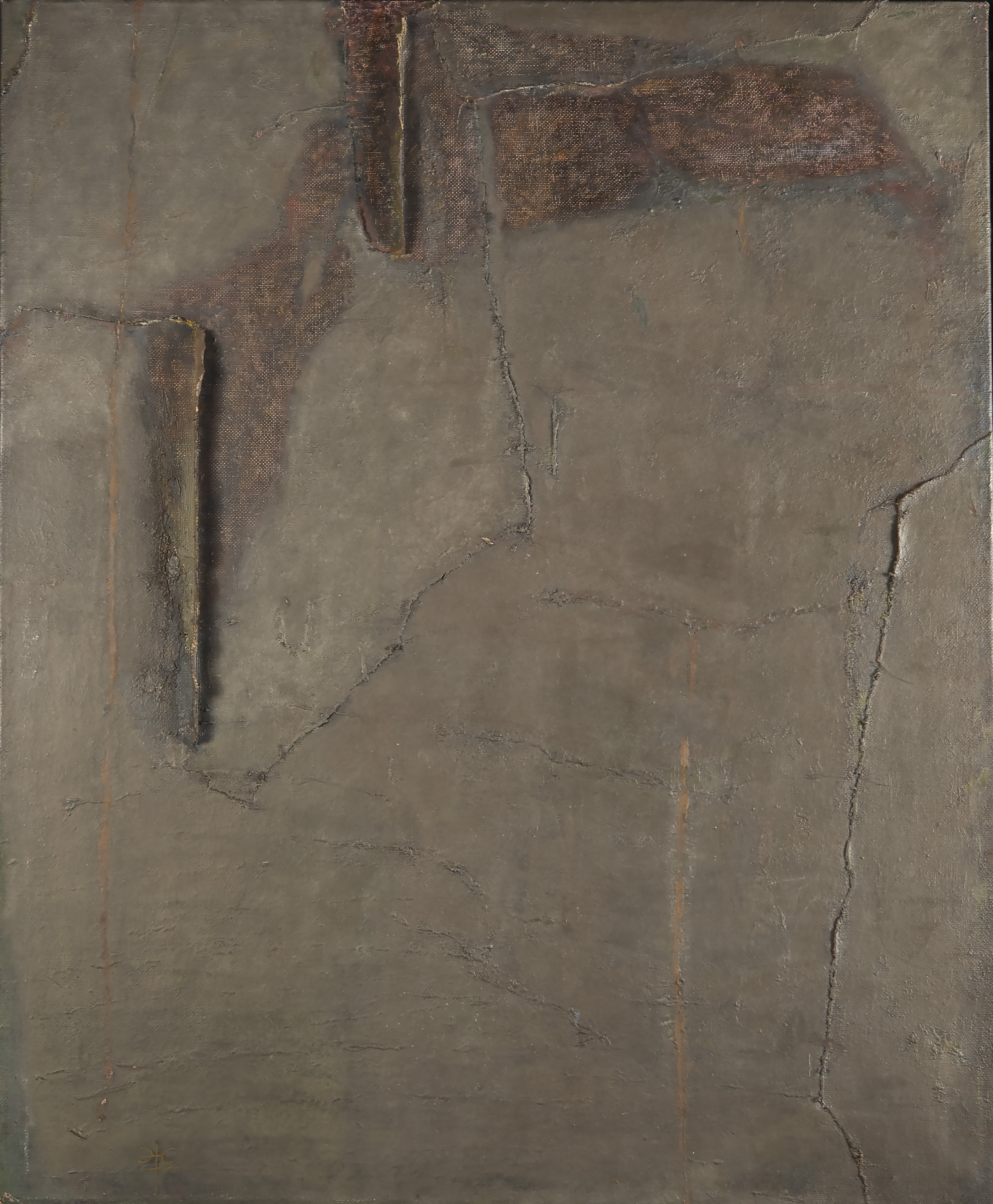
Strata V, 1989. Oil on canvas, 87 × 71.5 cm (34 1/4 × 28 1/8 in.). Norton and Nancy Dodge Collection of Nonconformist Art from the Soviet Union. D14208
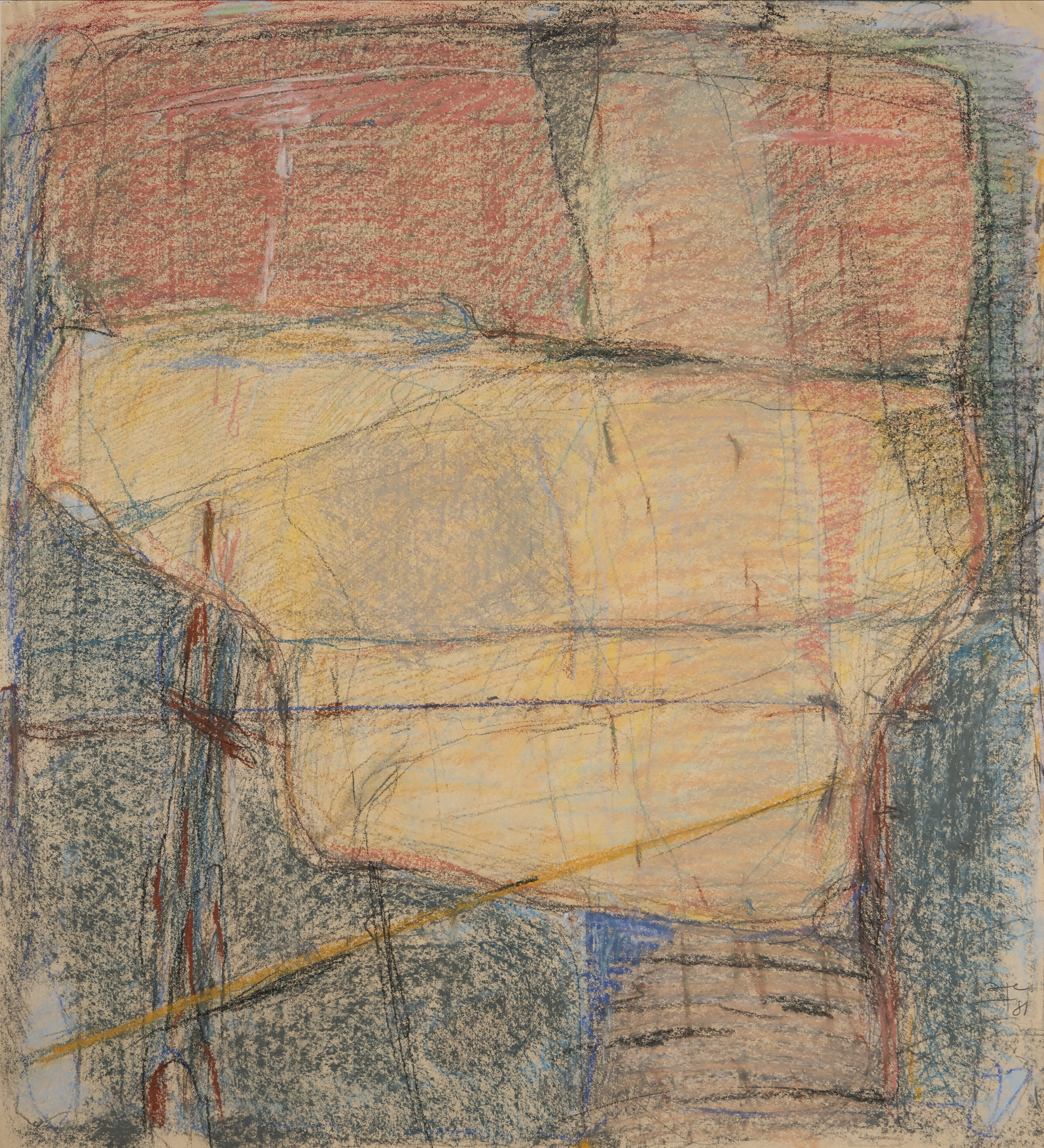
Untitled, 1981. Pastel on paper, 65.7 × 60 cm (25 7/8 × 23 5/8 in.). Norton and Nancy Dodge Collection of Nonconformist Art from the Soviet Union. D00792