
Eugene Rakhmanin
(sometimes spelled Yevhen, Yevgenii, or Evgen)
1947 — Voschatyn (Volyn Region, Ukraine). Works near Cologne (Germany)
The Ukrainian artist Eugene Rakhmanin was a member of the group known as the Odesa nonconformists. From 1972 to 1977, he worked in the design workshop and then in the workshop of monumental and decorative art of the Odesa Art and Production Combine (kombinat) of the Art Fund of the Ukrainian SSR. [1] In 1993 he became a member of the National Union of Artists of Ukraine. His signature style blends lyrical abstraction with nonfigurative forms, favoring atmospheric color fields and subtle textures to evoke emotional and spiritual depth rather than literal representation.
For Rakhmanin, drawing became a way to escape the bland reality of an oil workers’ village in Kazakhstan, where his father ended up working when Eugene was a child. Drawing was not his only escape; music became a second passion. In the 1960s he moved to Odesa and enrolled at the Odesa Conservatory, in the vocal department. Despite a potentially promising career as an opera singer, in 1965 he dropped out in order to enter the newly established department of Art and Graphics at the Odesa State Pedagogical Institute (now the South Ukrainian National Pedagogical University). His teacher was Valerii Gegamyan (1925–2000), who himself was an outstanding artist. Gegamyan taught his students to draw the “essence” of an object constructively and characteristically—to see through the object, not just copy it. Among the main principles that Gegamyan conveyed to his students were an emphasis of analytical skills, the capacity to observe and capture an essence, and being demanding of yourself and your work.
Rakhmanin befriended the artist Valentyn Khrushch (1943–2005), and through him met the legendary film director Kira Muratova. Twice he appeared in her movies: in 1987’s Change of Fate, filmed in Central Asia, for which Rakhmanin visited the Pamir Mountains, and then in Passions (1994). Mountains as well as the Black Sea are recurring subjects in Rakhmanin’s work.
Rakhmanin oscillates between figurative and nonfigurative with incredible ease. For the latter he sometimes resorts to geometrical abstraction, then moves toward landscape with constructivist roots or abstract expressionism inspired by Japanese and Chinese calligraphy. His work manifests as an endless series of attempts to capture the fleetingness of every moment. He does so by depicting the smallest changes in the appearance of an object, such as in repeated images of pomegranates, which the artist depicts from year to year using different techniques. Rakhmanin’s paintings are characterized by a variety of textures, a complex play of colors, and plastic perfection. Unlike many of his colleagues, such as Volodymyr Strelnikov (b. 1939) or Oleg Voloshynov (1936–2020), he is not much interested in city landscapes, although Odesa occupies a special place in his heart. [2] His favored medium is oil on canvas, but there are drawings and watercolors too, and even some works made on the surfaces of found objects, like a piece of a door.
Music has maintained a role in Rakhmanin’s work. He has made numerous musical instruments. He is particularly interested in Asian instruments, like sitars, vinas, and sarons, which he often modifies to his taste. His passion for Eastern philosophy, especially Confucianism and Taoism, serves as a methodological basis. For Rakhmanin, painting, music, and philosophy flow into one another to ultimately form one. He has espoused a philosophy of laziness, arguing that it can be productive if it is regarded more positively. What if, he once asked, humanity was too lazy to create an atomic bomb? [3]
After graduating from the Pedagogical Institute in 1970, Rakhmanin was assigned to the Ukrainian city of Donetsk. From there he joined the army, where he sang in a military ensemble. The Soviet assignment system for graduates was a mandatory employment that provided young specialists with social and employment guarantees. Oftentimes the available working position was in another city or even another republic. Upon returning to Odesa in search of a stable income and a studio (which back then was obtainable only through the Union of Artists), Rakhmanin joined the design workshop of the Odesa Art and Production Combine of the Art Fund of the Ukrainian Soviet Socialist Republic in 1972, working in the design workshop and then in the workshop of monumental and decorative art. [4] His job was to draw and design posters for various public events. At the same time, he joined the nonconformists circle and contributed to apartment exhibitions. Unlike more radical members of the group, like Strelnikov, Aleksandr Anufriev (1940–2024), or Liudmyla Yastreb (1945–1980), he managed to simultaneously exhibit officially at the Union of Artists salons and unofficially with the underground artists.
In 1967 Rakhmanin witnessed an improvised, unauthorized fence exhibition, organized by Khrushch and fellow Odesa artist Stanislav Sychov (1937–2003) on the fence surrounding the Odesa Opera Theater, which made a strong impression on him. In homage to this event, ten years later, together with his colleague Viktor Risovych (1935–2011), Rakhmanin organized the second fence exhibition. The exhibit was dismantled in no time by the authorities. Subsequently the artists were called to the KGB headquarters for a talk and, like many others who belonged to the nonconformist movement, were thereafter kept tabs on.
The workshop of monumental and decorative art of the Odesa Art and Production Combine of the Art Fund of the Ukrainian SSR was one of the very few options for underground artists to sustain their financial needs. The country was under construction, and visual propaganda required monumental decorative art in public spaces. Due to the huge demand, sometimes even underground artists were able to receive commissions. To make money Rakhmanin decorated public spaces. However, he most often received assignments that other artists did not want to take—for example, a rural club or a bus stop in the regional center.
At the turn of the 1990s, the opposition to officialdom ended because of the collapse of the Soviet Union. Everything became possible and, according to the artist, creating became less interesting. [3] In 2010 he received the title of Honored Artist of Ukraine. Due to the ongoing war in Ukraine, he currently holds a refugee status in Germany.
Kateryna Filyuk
Notes:
1. The Combine (kombinat) was a financial institution within the Artists’ Union that supplied artists with commissions, through which the Ministry of Culture would then purchase the artwork.
2. Evgeny Golubovsky and Evgeny Demenok, interview with Eugene Rakhmanin, Art Ukraine, 2011, originally published in Smutnaia Alchba.
3. “Visiting the Artist – Eugene Rakhmanin,” episode 8 of Visiting the Artist, La pipelette, posted October 14, 2020, by La Pipelette Art, YouTube.
4. The USSR Art Fund was a public organization under the Soviet Artists’ Union. The aim of it was to promote the creative activities of artists who were members of the fund, as well as to improve their financial and living conditions by offering a wide range of commissions. The Production Combine supplied the art industry with decorative and applied artistic products used to decorate everyday life and the interior. In this particular case, it could be interior or graphic design, or monumental painting for public spaces.
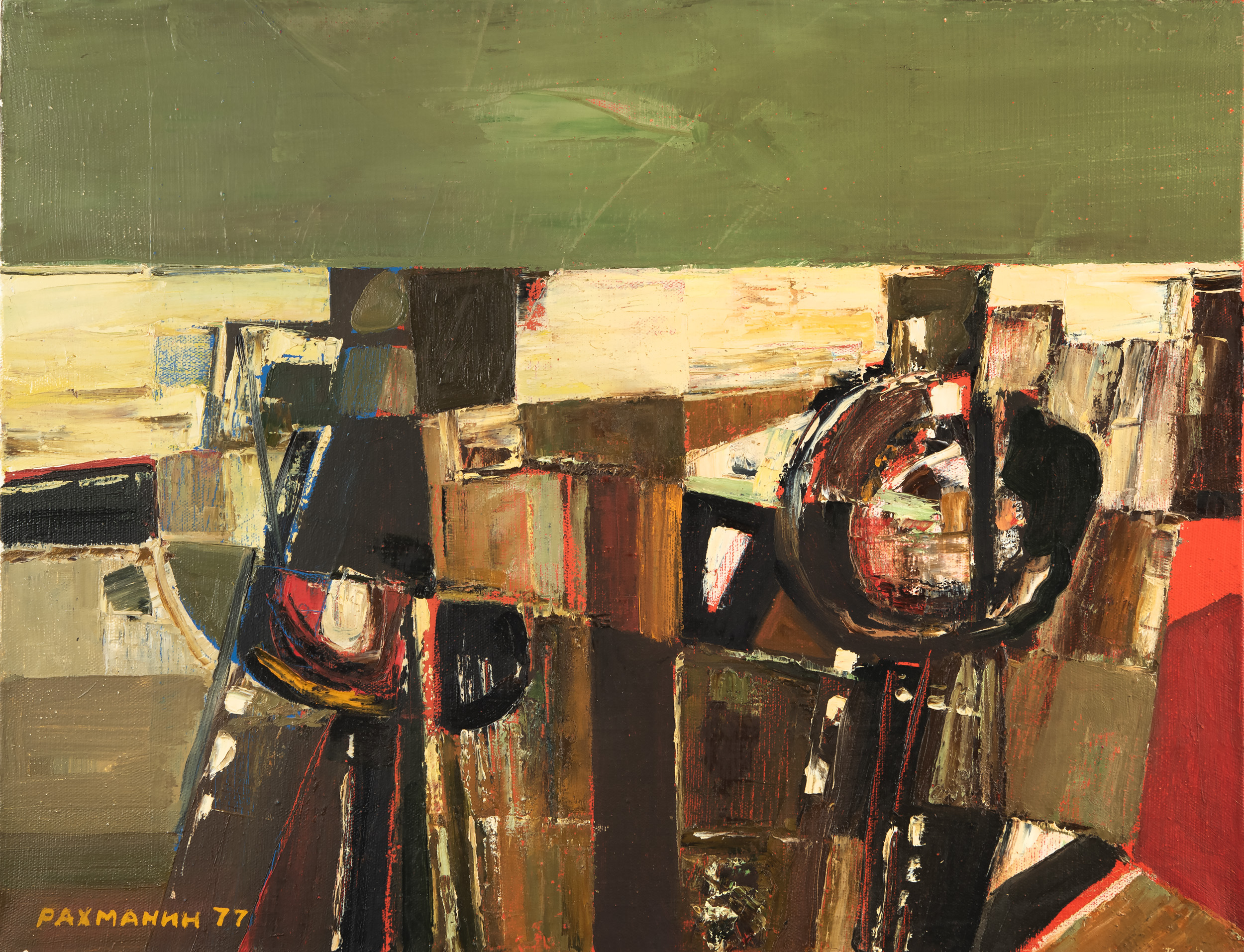
Untitled, 1977. Oil on canvas, 51.5 × 66 cm (20 1/4 × 26 in.). Norton and Nancy Dodge Collection of Nonconformist Art from the Soviet Union. D01197
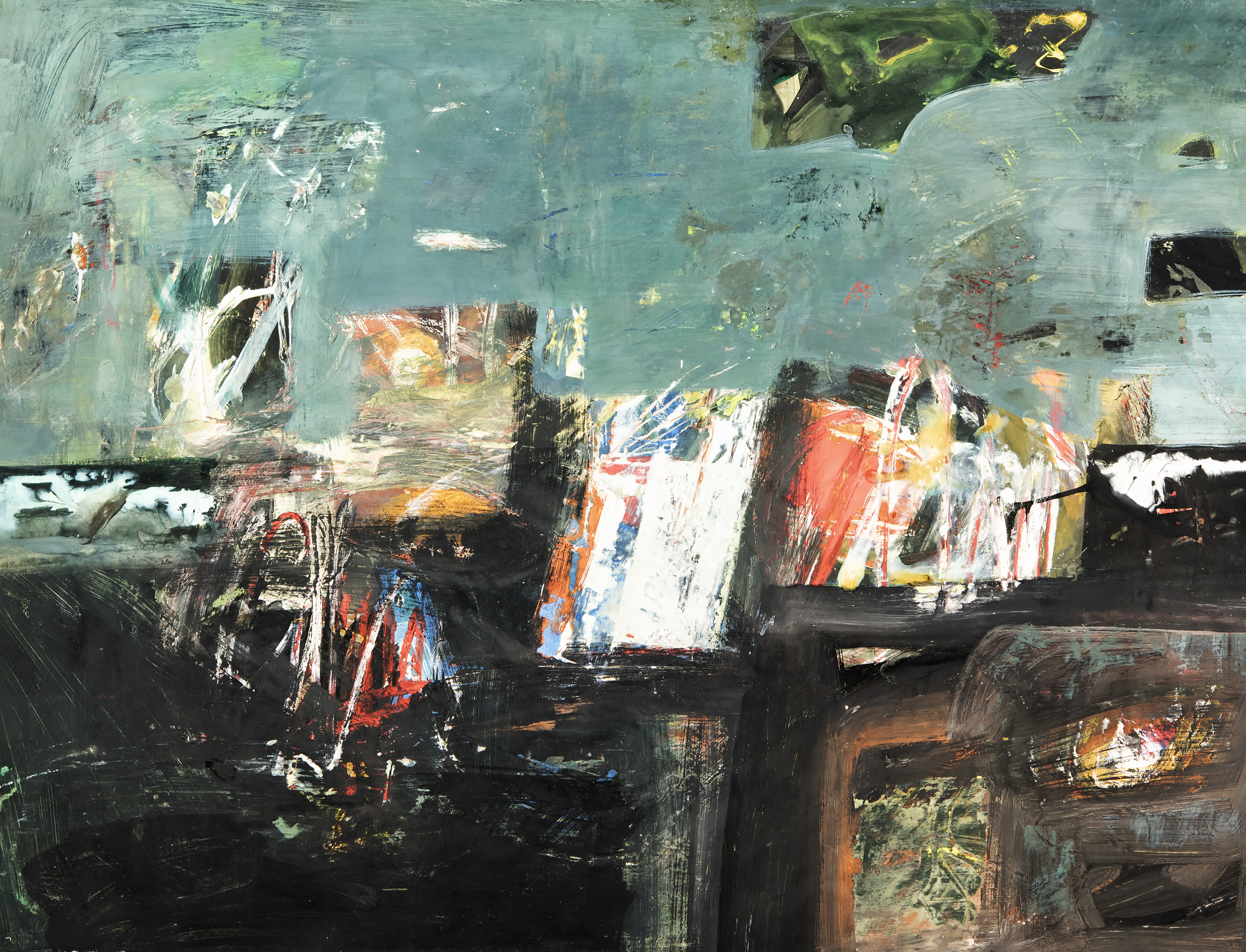
Untitled, undated. Oil on paper, 54.5 × 74.2 cm (21 7/16 × 29 3/16 in.). Norton and Nancy Dodge Collection of Nonconformist Art from the Soviet Union. D04644
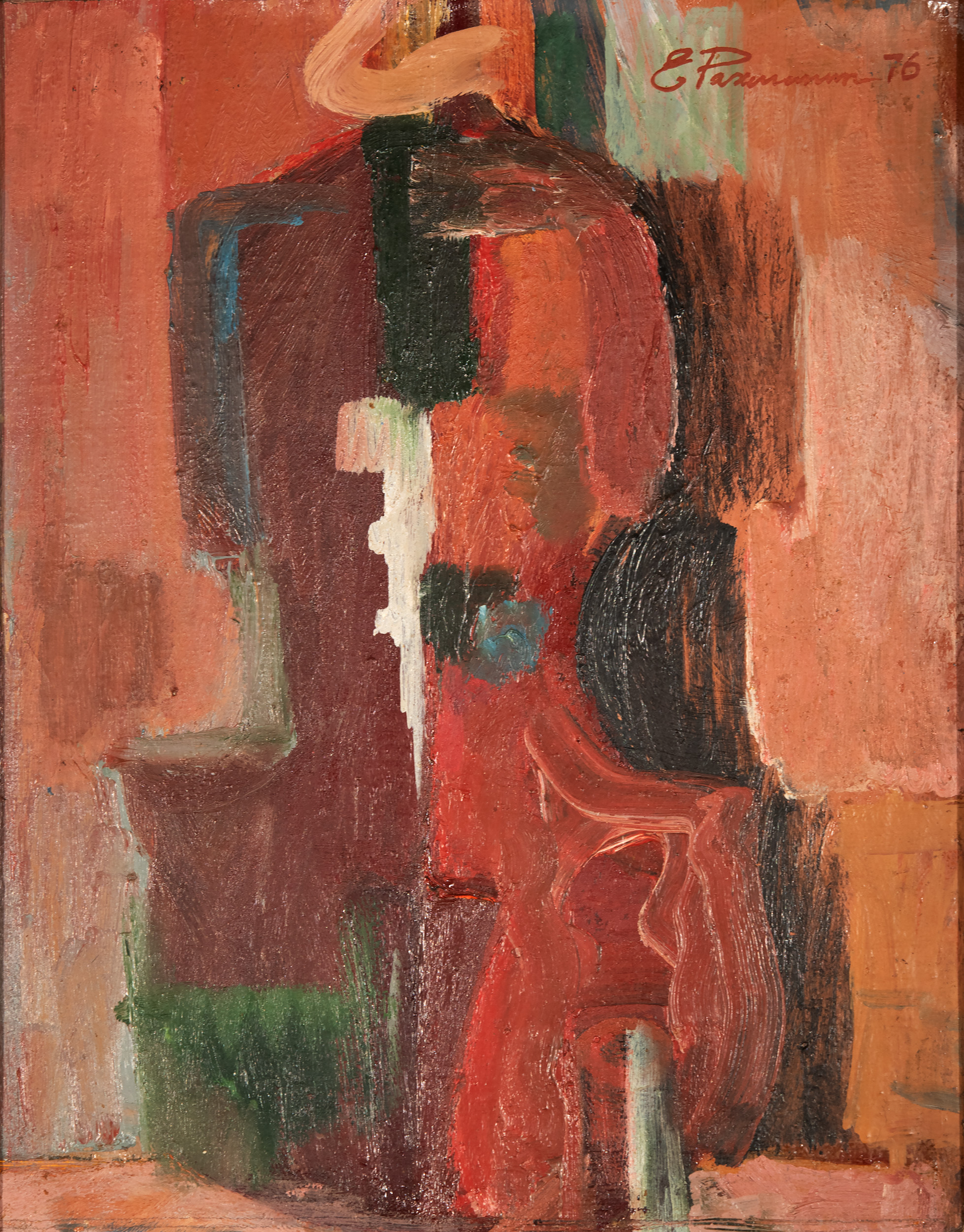
Untitled, 1976. Oil on fiberboard, 39 × 31 cm (15 3/8 × 12 3/16 in.). Norton and Nancy Dodge Collection of Nonconformist Art from the Soviet Union. D04657