
Enn Põldroos
1933 — Tallinn (Estonia). Has worked in Tallinn (Estonia); now works in Viljandi (Estonia)
Enn Põldroos was born in Tallinn to Priit Põldroos, a theater director, Benita Põldroos, a theater artist. During World War II, his family evacuated to Yaroslavl, Russia. From 1952 to 1958, he studied painting at the State Art Institute of the Estonian Soviet Socialist Republic (now the Estonian Academy of Arts) in Tallinn.
Põldroos began his studies at the height of Stalin’s campaign of terror, just a few years after the last mass deportations in the Baltic states, and he graduated from the State Art Institute at the start of the Khrushchev Thaw. The era itself provided Põldroos with a mission to change the current artistic tradition and express the younger generation’s need for contemporaneity. As a young painter, he adhered to the then-fashionable modification of socialist realism known as the severe style, which combined expressivity with a romanticized vision while using strong contours and a limited color scheme. In his earliest works, he depicted reality quite truthfully, albeit with a certain clumsiness.
Põldroos is often credited with establishing a certain amount of freedom for Estonian artists during the late Soviet period. He was a highly influential leader in the Soviet Artists’ Union from the 1960s to 1990s, serving as chairman and president in 1985–89 and 1995–98. As a bureaucrat, Põldroos skilfully played the role of intermediary between Communist Party demands and artists’ creative freedom. He recalled: “It is difficult for newer generations to conceive the schizophrenic divisions and totalitarian pressures of this era. To do something, you had to find cracks in the monolith of the system or live ignoring it. Although the isolation from the rest of the world had weakened a bit, the general stagnant atmosphere became increasingly unbearable. However, there is nothing to be ashamed of the art created in those days. Despite everything, life and creating art was enjoyed.” [1]
The artist’s first breakthrough was his solo exhibition of 1966 at the Tallinn Art Salon and his group exhibition with Olav Maran and Olev Subbi in 1967 at the Tartu State Art Museum (now the Tartu Art Museum). In the second half of the 1960s, he became one of the leaders of Estonian painting. This reputation was enhanced by his writings and active participation in art politics.
Over his long career, Põldroos has never adhered to a single style and draws from a multitude of sources, including expressionism, surrealism, and geometric abstraction, yet his works are easily recognizable. His distinctive individual style began to emerge in the late 1960s to early 1970s, when he often combined the figurative and the abstract in his work. Emphasizing silhouette and detail, his compositions were based on contrast, highlighting the conflict, drama, and tension of situations. Some of his more radical works from the late 1960s achieved geometric abstraction, while others flirted with grotesque surrealism.
Põldroos used painting to raise philosophical and existential questions, often by means of symbolism and religious allusion. His larger figural compositions such as Sõjapõgenikud [War Refugees] (1968) or Sõjapõgenikud [Supper] (1969) (both Art Museum of Estonia) address eternal ethical questions including condemnation of war or the human inability to find consensus.
In the early 1970s, Põldroos often painted with expressive brushstrokes and bright colors in a style reminiscent of fauvism. Works from this period include several portraits and sensual nude paintings. In the second half of the decade, some of his paintings also show influences of pop art and hyperrealism.
The artist’s paintings from the 1980s present deliberate quotations and pastiches from art history. For example, his large painting Universitas Tartuensis, made in 1982 for the University of Tartu’s main building, quotes directly from Raphael’s School of Athens. Other of his notable monumental works from that time include the curtain of Tallinn’s Linnahall concert hall (1985) and a mural for the Estonian National Library (1993).
In the 1980s he also painted a series of grotesque portraits that mainly depicted his artist colleagues (e.g., Ando Keskküla [1984, Art Museum of Estonia]). In addition, he created a number of self-portraits that are often ironic or even clownlike, such as Self-Portrait with a Clown’s Hat (1983, Art Museum of Estonia).
From 1988 to 1992, Põldroos played an active role in Estonian politics. He was a member of parliament and one of the leaders of the popular movement (Popular Front of Estonia) that paved the way for the restoration of Estonian independence in August 1991. Soon after his intensive stint in politics, he returned to his art practice, but like many artists adjusting to democratic freedom and a capitalist market society, he had to find his way. As the artist himself has put it: “The victory had arrived, so it was time to make a serious return to art. However, the immeasurable increase in freedom of choice was unexpectedly accompanied by a degree of uncertainty. It was not so easy to make choices. It seemed that in the altered situation, it was necessary to make a different kind of art. But what kind was not clear.” [1]
Põldroos’s answer was to stay true to his ever-changing self. In the 1990s he returned to his geometric style of the 1960s. Nevertheless, he never gave up his painterly style. In recent years Põldroos has sometimes demonstrated an acute sense of social awareness in depicting the neglect of the homeless and vices of careerism, while mostly dissecting existential problems that come with aging. Even when dealing with serious themes of life and death, Põldroos never abandons his sense of humor and self-mockery in his paintings.
Triin Metsla
Photo portrait: Enn Põldroos, c. 1980–87. Photographer unknown. Art Museum of Estonia. EKM j 56024 FK 1314
Notes
1. Artist’s website.
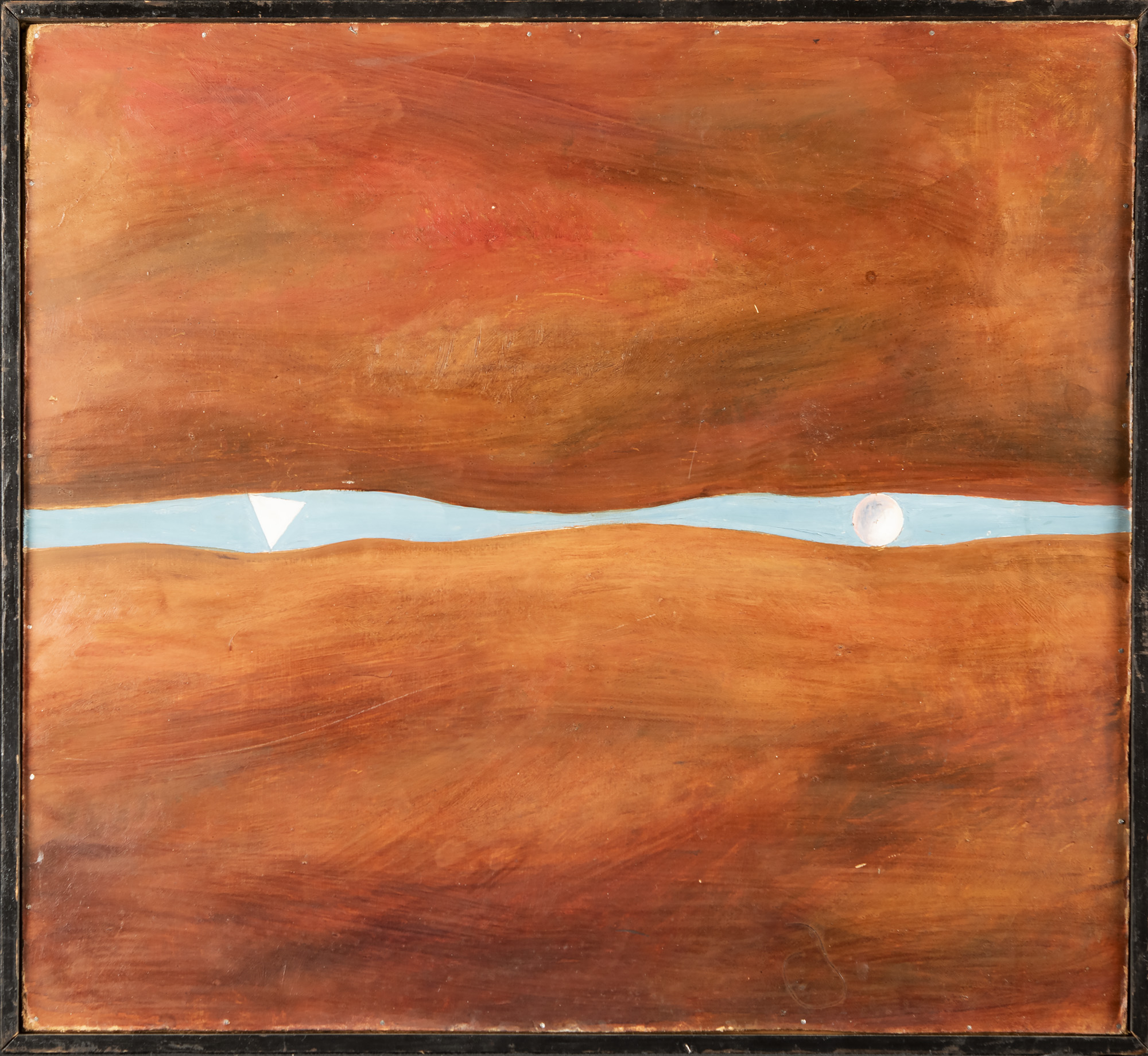
Hoondumine, 1968. Oil on fiberboard, 57.5 × 66 cm (22 5/8 × 26 in.). Norton and Nancy Dodge Collection of Nonconformist Art from the Soviet Union. D16843