
Elena Gritsenko
1947 — Krasnoyarsk (Russia). Worked in Leningrad and Tikhvin (Russia); currently works in St. Petersburg (Russia)
Elena Gritsenko attended the Surikov Art School in her home city of Krasnoyarsk, graduating in 1967. She then moved to Leningrad, where, in 1973, she graduated from the Ilya Repin Institute of Painting, Sculpture, and Architecture, having studied with A. F. Pakhomov in the graphic arts department. Her graduation project at the Russian Academy of Arts was a series of colored linocuts titled In the Baltics. In 1972, she met the artist and poet Vladimir Sterligov—one of the last living links to the modernist avant-garde, a student of Kazimir Malevich and Pavel Filonov—who had a decisive and enduring impact on her subsequent creative development. Gritsenko began to study with Sterligov and soon joined his circle of artists. Under his influence (and with his encouragement), she developed a style with clear similarities to Sterligov’s own, yet at the same time unique: characterized by luminous color, a sense of airiness (even in her thickly impastoed canvases), and a delicate balance between representational and nonobjective tendencies.
After graduating from the Academy of Arts, Gritsenko was offered a place in the Soviet Artists’ Union, but, under Sterligov’s influence, she chose instead to associate herself with unofficial artists. In 1973, she relocated to Tikhvin, a small town in Leningrad Oblast, where she helped establish an art school and taught. She returned to Leningrad in 1981 and worked as a book illustrator, specializing in color linocut illustrations of fairy tales and Russian folk stories. Between 1972 and 1985, she participated in exhibitions at the studios of Sterligov and Tatiana Glebova.
For Sterligov, nonobjectivism—an idea most closely associated with suprematists and constructivists like Malevich and Aleksander Rodchenko—was a kind of key or lens through which it was possible to understand the entire history of art, from Orthodox icons, through Delacroix and the impressionists, to Cézanne, the cubists, and of course the suprematists themselves. As a living link to the Soviet nonobjective art of the early modernist period, Sterligov was crucial to the development of this synthetic, and syncretic, perspective on European art. Indeed, Gritsenko has said that her entire artistic trajectory has unfolded in dialogue with her teacher. It was also Sterligov who taught her how to deploy the lessons of nonobjective art in the elements of her composition, even when the subject of her work was representational. Gritsenko thus belongs to the tradition of artists who, in the 1970s, rediscovered and reinterpreted Russian avant-garde currents from the early twentieth century, adopting the formative methodologies practiced at the Leningrad State Institute of Artistic Culture (GINKhUK) led by Malevich.
Of the many art-historical strands that Gritsenko has synthesized in her own work, the tradition of icon painting is perhaps the closest to her. She has often spoken of her own work in spiritual terms, as though her paintings and drawings were a portal to an otherworldly or divine presence. Thus, her work reflects—in her own words—a certain “skyward striving,” and elsewhere she has described her work in terms of the interpenetration of the earthly and the celestial. Indeed, in many of her works, the representational subject matter—an image from nature, or a human figure—is composed on the canvas as though it were within a light-filled cupola.
Though this spiritual bent is undoubtedly her own, the possibilities for portraying it compositionally in her art seem to have been inspired by Sterligov as well. Gritsenko was struck by Sterligov’s use of a symbolist underpinning to his painterly system, which manifested in his allusions to “other worlds.” Gritsenko picked up on these partially concealed symbolist tendencies and made them a theme in her own work. For Gritsenko, symbolism grew into a means for transforming images from memory and imagination into concrete subjects. In the process, her work has come to reflect “a kind of otherworldly, spectral, and strange existence. Not only does she virtually never paint from nature, it is as if she doesn’t notice reality at all. Her canvases give rise to a world of reveries and dreams, of imagination and the beautiful past. Here, even if for a short time, one can find peace of mind, and sanctuary from the noise and bustle of contemporary life.” [1] Gritsenko’s paintings thus have strong affinities not only with modernist art but with the legacy of literary symbolism as well, specifically its fin-de-siècle Russian iteration.
Gritsenko favors a relatively small number of subjects and motifs to which she has returned throughout her career, approaching the same ideas using different media, color combinations, or emotional tonalities. Her work is notable for its timeless subject matter; her portraits and other genre paintings seem drawn from tradition rather than from life, though at the same time their allusions to specific old masters or art-historical periods are intentionally obscured. Beholding them, we are enveloped in an aura of classicism, but one that is serenely diffuse. A constant in her work, however, is the importance of the human figure, even in pieces that don’t explicitly feature human subjects, and even in those that are altogether abstract. The compositional centrality of the human, particularly the human face, goes back to Gritsenko’s indebtedness to traditional Russian icon painting. This is evident in her paintings in the Dodge Collection. The human figure is clearly visible in Couple (ZAM, D01193) and Portrait (ZAM, D01619), both from 1976; it is also implicit in Landscape (ZAM, D00028), painted in the same year and compositionally very similar to the explicitly human subjects of the other two paintings. These works all feature passages of textural relief, as well as overlapping color zones whose rounded forms, delicate gradations, and harmonious placement create a sense of vibration that reinforces the feeling that one is standing before a human presence.
Gritsenko is known for painting on a variety of materials, including canvas, cardboard, and wood, and for using a broad palette (whether in paint, colored pencil, or color linocut) and textured surfaces. More recently, she has been painting on found materials––wooden boards taken from shelving, discarded doors, and the like. In painting over these objects, she incorporates the unique features of the material—cracks, knots, blemishes—into her compositions. These, too, are in part an homage to Sterligov, whose studio was full of works he had painted on found wooden objects; these include an elaborately painted chiffonier that made an indelible impression on the young Gritsenko, and which she has recalled with great admiration and tenderness.
Gritsenko’s works are held in the State Tretyakov Gallery in Moscow, the State Museum of the History of St. Petersburg, the Arkhangelsk Museum of Fine Arts, the United Directorate of Museums of the Leningrad Region, and in private collections in Russia, Austria, France, Germany, Finland, Italy, and the United States.
Ainsley Morse
Notes:
1. Karasik, Irina. “O Elene Gritsenko,” Muzei Iskusstv XX-XXI vv (Museum of Arts of the 20–21st).

Landscape, 1976. Oil on canvas, 35.5 × 40.8 cm (14 × 16 1/16 in.). Norton and Nancy Dodge Collection of Nonconformist Art from the Soviet Union. D00028
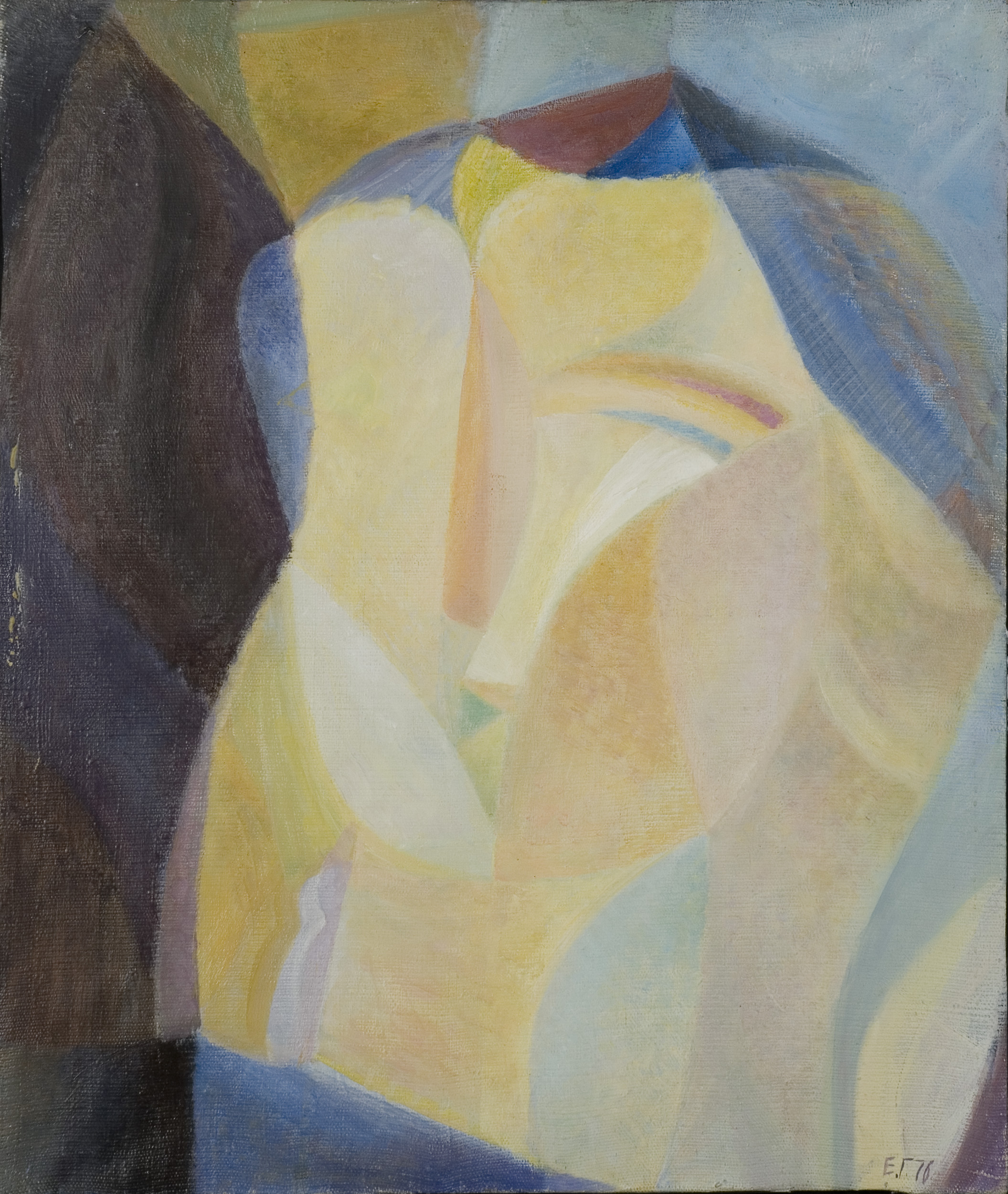
Couple, 1976. Oil on canvas, 54 × 45.5 cm (21 1/4 × 17 15/16 in.). Norton and Nancy Dodge Collection of Nonconformist Art from the Soviet Union. D01193

Portrait, 1976. Oil on canvas, 42 × 38.5 cm (16 9/16 × 15 3/16 in.). Norton and Nancy Dodge Collection of Nonconformist Art from the Soviet Union. D01619
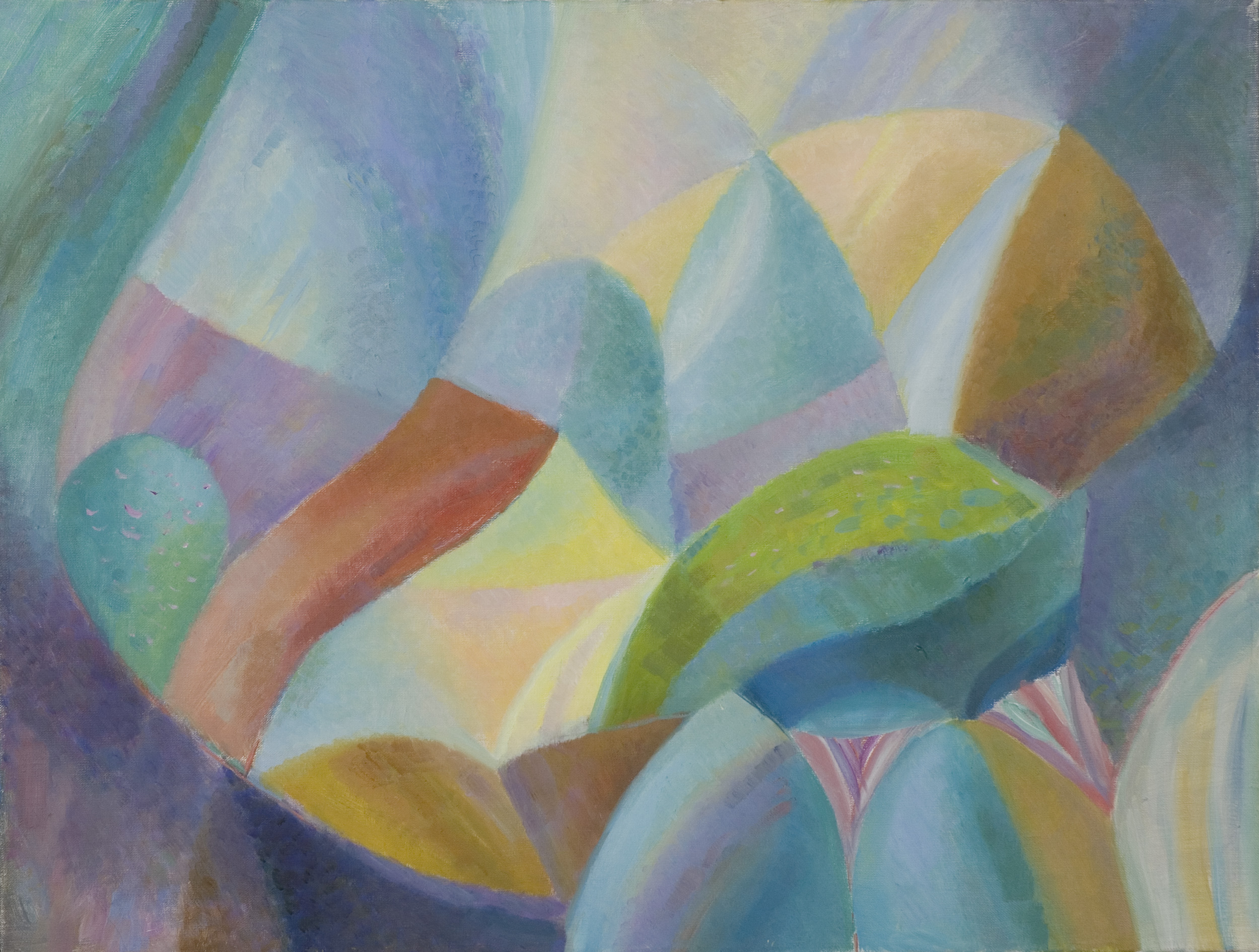
Untitled, undated. Oil on canvas, 60.2 × 79.7 cm (23 11/16 × 31 3/8 in.). Norton and Nancy Dodge Collection of Nonconformist Art from the Soviet Union. D11801