
Dmytro Kavsan
1964 — Kyiv (Ukraine) | 2024 — Kyiv (Ukraine). Worked in Kyiv (Ukraine)
Dmytro Kavsan is one of the primary representatives of the Ukrainian pictorial, postmodern movement. His work consisted of mythological, figurative canvases characteristic of neo-expressionism and still lifes full of citation and mystery that were often combined with animalistic motifs, landscapes, and narrative painting. Kavsan was a member of the Kyiv art squat called the "Paris Commune." He lived and worked in Kyiv, where he died in 2024.
Kavsan entered the Kyiv State Art Institute (now National Academy of Fine Arts and Architecture) in 1981. In 1983, his studies were interrupted when he was drafted into the Soviet army. After two years of service, Kavsan returned to the Institute to complete his studies, where he graduated from the department of monumental painting in 1991. While still receiving thorough, academic artistic grounding as a student, Kavsan began to form his own independent artistic practice, which developed in line with the then-dominant movement of postmodernist neo-expressionism. He was not alone in this: a new Ukrainian art, which was replacing the official canon of socialist realism, was also evolving in connection with the broader global artistic mainstream, albeit with a certain delay. Kavsan’s painting during this period displays characteristic signs of postmodernism, including large-scale and figurative artworks, and an energetic and spontaneous approach to painting (even engaging with the idea of incompleteness). Utilizing an eclectic mix of styles, genres, and methods, his work demonstrates a deliberate, postmodernist disregard for conventional notions of artistic quality and a departure from art historical tradition, employing ironic interpretations of historical and mythological themes to shift their original meanings.
Unlike the many representatives of this Ukrainian New Wave who were more attracted to the Italian transavantgarde, refracted through the prism of national baroque traditions, Kavsan leaned more toward the painting of the German “Neue Wilde." [1] Echoes of this movement, in conjunction with the same baroque, nativist worldview, are evident in a number of paintings by Kavsan from this period: Хто прийде останнім, той отримає кістки [Whoever Comes Last Will Get the Bones] (1986, ZAM, D10536), Memento vivere (1988), Альтернативне рішення [Alternative Solution] (1988), Статика [Static] (1988), and Годування білих вальдшнепів [Feeding White Woodcocks] (1988). Adjacent to this series are thematically nationalist works, such as Битва під Жовтими Водами [The Battle of Yellow Waters] (1989), or world historical pieces, such as Ave Caesar, morituri te salutant (1988). Kavsan also created a series of mythological paintings: Введення Марії до храму [The Entry of Mary into the Temple] (1988), Ангел [Angel] (1988), Дарунки волхвів [The Gifts of the Magi] (1989), and Каїн, Каїн, Авель [Cain, Cain, Abel] (1989). These paintings were often square in composition, using the shape as a unifying formatting principle when depicting a large foreground with dynamic half-figures, the sky as a background, and expressive brushwork in either a deliberately vivid or more restrained color scheme. The painting Angel was shown in the Ukrainian section at the All-Union Youth Exhibition in the Moscow Manege (1988), the first time this kind of exhibition had been organized by national Soviet republics. This gave reason to talk about new Ukrainian painting as an exciting and original postmodern phenomenon.
Kavsan took part in many other large exhibitions at this time, demonstrating the range of his artworks. At the Republican Youth Exhibition of 1989, in the Kyiv House of Artists, he presented a large-scale painting on canvas with the intricate title Кілька моментів нещирого наближення до дерева [Several Moments of Insincerely Approaching a Tree] (1989), which is highly representative of the artist’s characteristic, flexible style (i.e., very "Neue Wilde”). He used a name in a similar vein for his artwork Платонічна любов до каменю [Platonic Love for Stone] (1989), which he showed alongside another landmark work, Спроба менуету на руїнах [An Attempted Minuet on the Ruins] (1989). The pieces were exhibited in January 1990 in the Chamber of Commerce in Kyiv at the exhibition Українське малARTство [Ukrainian MalARTstvo (1960s–80s)], a milestone that refreshed perceptions of the recent history of Ukrainian art. An Attempted Minuet on the Ruins is an eclectic mix of elements, eras, and spatial structures. It features a baroque, architectural background with street graffiti and gestural sketches, even student-like “doodles,” interspersed throughout the canvas. These illustrative elements depict cherubim, the image of a mother with a baby stylized in the manner of religious iconography, and gothic chimeras weaving between the columns and arcades. All of these combine to create the magic of a coherent imaginary, even chimerical world, that allows for the most paradoxical or absurdist interpretations by those viewing the piece.
Images of chimeras first appeared in Kavsan’s 1989 painting of the same name and reappeared in his later works. A kind of kama sutra for red chimeras can be seen in his 1990 work Імітація крема для взуття [Imitation Shoe Cream] (1990): a “readymade” old door, removed from its hinges. [2] The artist's work Чи я Сусанна? [Am I Susanna?] (1990) was chosen for the project Ukrainian Painting of the 20th Century in the National Museum of Art in 1990. The biblical parable of Susanna and the Elders is ironically reinterpreted through postmodern layering and contrasting visual styles.
At the Kyiv exhibition Artists of the Paris Commune in November 1991, which became a kind of manifesto centering the participants of the squat, [3] Kavsan exhibited the paintings Завіса [Curtain] (1991) and Летючі Сади Семіраміди [The Flying Gardens of Babylon] (1990), which became emblematic of his style. This work employs his signature techniques of layering and allusions, referencing Ilya Repin’s painting Ivan the Terrible and His Son Ivan on November 16, 1581 (1883–85). It further uses a semantic rupture between the image and the title in a deliberate transformation from explicit formal incompatibility of artistic languages into a purposeful and constructive aesthetic strategy. The resulting effect is that of a "picture within a picture," a common feature of the painter’s other works.
Kavsan worked in the Paris Commune squat from the summer of 1990 to the summer of 1994. He painted many of his most famous works there, including Велика карлиця [The Big Dwarf] (1991), which he first showed at New Figurations, a group exhibition of Ukrainian artists held in Odesa at the Museum of Regional History in the fall of 1990. This impressive canvas became the centerpiece of his painting series on women with dwarfism. He began creating this series a year before moving to the Paris Commune squat, while he was living in the squat on Lenin Street (now Bohdan Khmelnytsky Street), where, in the middle of 1989, he settled with other young Kyiv artists with a postmodern bent (Oleksandr Hnylytskyj, Oleh Holosiy, Valeria Troubina, Leonid Vartyvanov, Yuri Solomko, Vasyl Tsaholov, Oleksandr Klymenko, Oleg Tistol, and Konstantin Reunov). Many of them, together with Kavsan, moved to the Paris Commune squat in the summer of 1990.
The series on women with dwarfism came about through the artist's interest in subjects from the 18th century and the flourishing rococo style, with its opulent forms, extravagant wigs, ornate clothing, and distinctive color palette. The artist managed to unify these bold combinations by immersing them in a more restrained and painterly atmosphere, as if dusted with a patina. This idyllic, museum-like beauty and harmony is unexpectedly disrupted by sections of unpainted canvas, casually outlined with lines that again evoke the stylistics of graffiti.
The artist's diptych Гама зісковзування [Palette of Slippage] (1990) is close to this series in approach. This piece was painted when Kavsan was already at the Paris Commune squat, but is more radical in its accentuated non-finitism and in the demonstrative rejection of traditional painting. The paint seems to be flowing across the large plane of untouched canvas in striking drips, while the path of the paint itself contains female figures wearing flowing gowns in a traditional style.
In 1992, Kavsan worked in the German city of Bonn under the IFA program and showed a series of new paintings at the program’s final exhibition, where he referenced 17th-century Dutch still lifes. Like in some of his previous works, here he did not finish their lower edges and did not remove the traces of drips from them. On the remaining section of the white canvas, he applied an inscription borrowed from pop culture: “I love you." This series marked a significant turning point in his work—expressionism and mythological themes came to an end, replaced by a use of tonality and genre scenes that gravitated toward meticulous execution and classical authenticity. All these still lifes are inhabited by miniature figures in old-fashioned costumes, fairies with wings, boatmen, and acrobats. The dramaturgy of their interaction seems to return a sense of life back to these otherwise still lifes (or “nature mortes”). Nonetheless, these changes to Kavsan’s approach did not affect the main organizing principle of his work: the artist remained true to postmodernist referencing and appropriation.
Kavsan’s still lifes from the late ’90s and 2000s use both floral and water motifs—see Натюрморт на воді [Still Life on the Water] (2003) and Вода [Water] (2009)—as well as somnambulism, such as in Сон [Sleep] (2003). Often, the artist resorted to mixing genres, as a rule by combining still life, landscape, genre scenes, and animal subjects into one composition: Натюрморт з гіпопотамами [Still Life with Hippos] (1998), Антилопа [Antelope] (1998), Великі газелі і голландський натюрморт [Big Gazelles and Dutch Still Life] (2011), and Сніданок з жирафами [Breakfast with Giraffes] (2016). In many ways, the artist was fueled by the impressions he received during his travels, in particular to Africa (1997) and India (2005). After trips to Western Europe, the author created a series of paintings depicting medieval knights in armor, such as in Лицар. Полювання [Knight. Hunting] (2006), which appeared at his Gothic exhibition at Kyiv’s Irena gallery.
In the 2000s and 2010s, Kavsan's works were regularly included in major museum exhibitions: First Collection (2003), Farewell, Arms (2004), The Ukrainian New Wave (2009), The Myth of “Ukrainian Baroque” (2012), and Parkommuna. Place. Community. Phenomenon (2016).
Dmytro Kavsan passed away on February 2, 2024. Three and a half months after his death, the exhibition Protagonists. Painting Reserve / Paris Commune opened in Kyiv at the Ukrainian House, exhibiting his works from the late 1980s through the early 1990s, on loan from private Ukrainian collections.
Oleksandr Soloviov
Translated from Russian by Nathan Jeffers
Notes:
1. In English, the “New Wild,” a term used to denote a movement of German neo-expressionists from the 1970s and 1980s.
2. Readymade art, or objet trouvé, is art made from found materials or objects that are not usually associated with artwork.
3. The squat was located on Paris Commune Street, which is now called Mykhailivska.
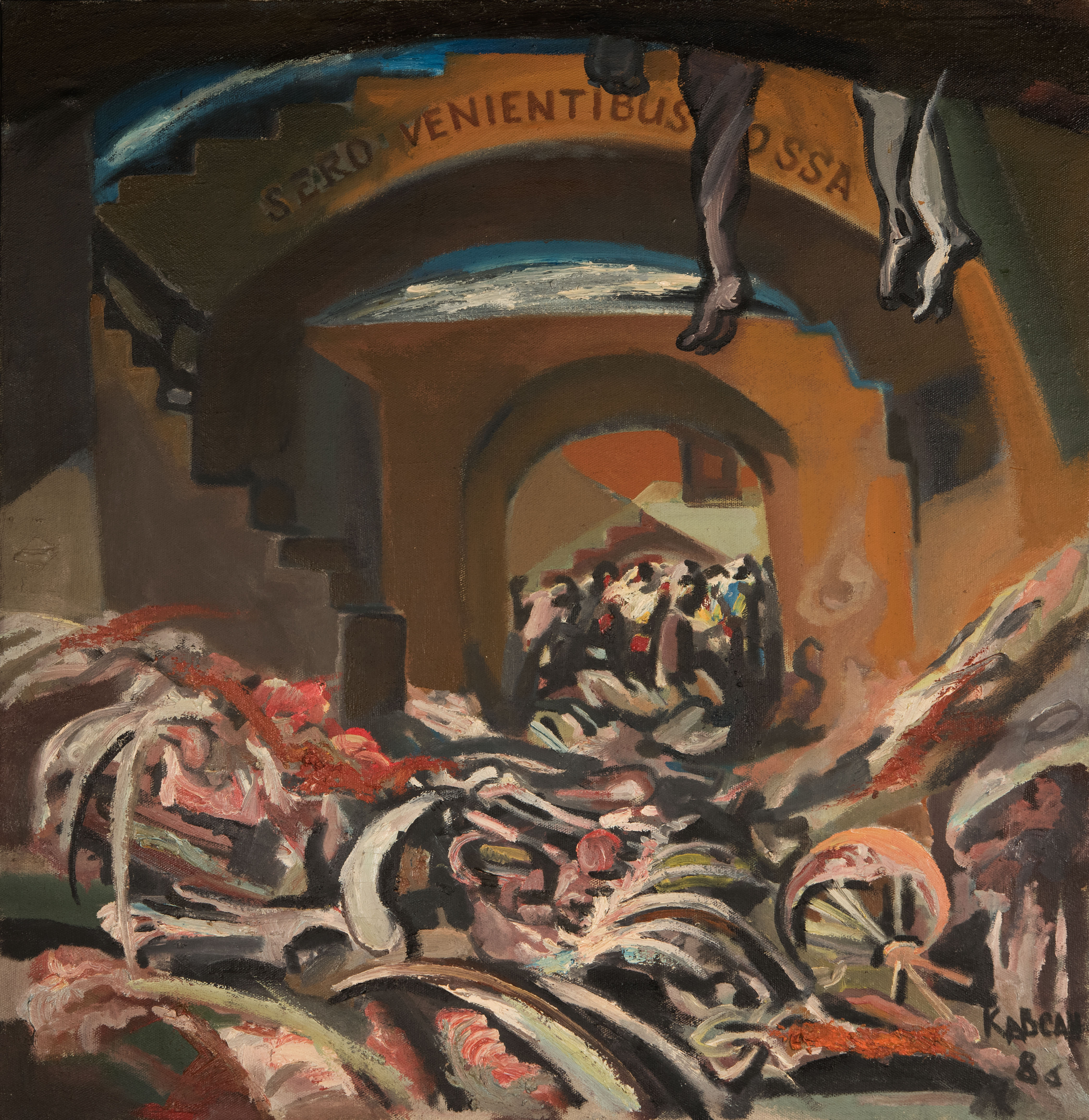
Who Comes Last get the Bones, 1986. Oil on canvas, 93 × 89 cm (36 5/8 × 35 1/16 in.). Norton and Nancy Dodge Collection of Nonconformist Art from the Soviet Union. D10536
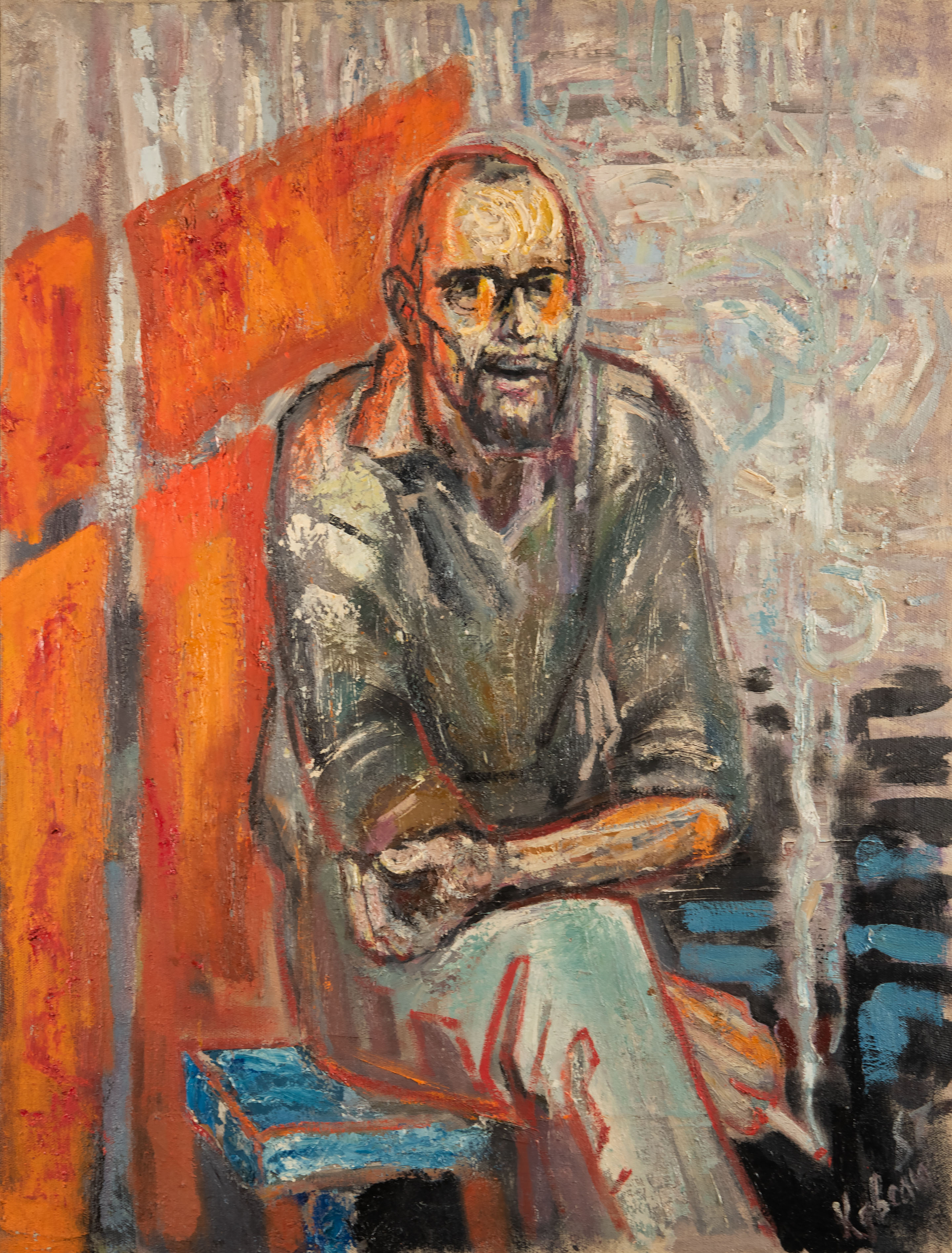
Portrait of Artist, Lymariov, 1987. Oil on canvas, 89.6 × 69.6 cm (35 1/4 × 27 3/8 in.). Norton and Nancy Dodge Collection of Nonconformist Art from the Soviet Union. D10527