
Bella Matveeva
1962 — Troitsk, Chelyabinsk Oblast (Russia). Works in Saint Petersburg (Russia)
Bella Matveeva is a painter, printmaker, photo artist, and filmmaker affiliated with Timur Novikov’s New Academy of Fine Arts in Saint Petersburg, Russia, where she was a professor in the department of painting in the 1980s and ’90s. [1] In her work, she combines the aesthetics of late-nineteenth-century Saint Petersburg bohemianism, the Leningrad underground of the 1980s, and neo-academic art. Her paintings frequently explore the idea of an “ancient symbol of beauty.” In her black-and-white photography, she transforms subjects of classical paintings by staging them in contemporary domestic settings and garden landscapes.
Matveeva is a vivid example of how the Saint Petersburg aura––with its homegrown myths and aesthetics––has influenced artists, writers, poets, and filmmakers. She studied at the Leningrad Vladimir Serov Art School (today the Nicholas Roerich Saint Petersburg Art School) and graduated as a certified art restorer specializing in tempera and oil painting. [2] Two of Matveeva’s classmates––Denis Egelskii and Georgy Gurianov––would go on to become professors at the New Academy of Fine Arts. After graduation, Matveeva became a book illustrator and created illustrations for a number of literary works, preferring romantic or mythological subjects. Those same years saw the emergence of her individual style, the main themes of her paintings, and––no less importantly––her circle of friends. Among these new acquaintances was a man who, to a large extent, would determine her subsequent career path and creative identity: Timur Novikov, an artist, journalist, teacher, cultural promoter, and provocateur, who was largely responsible for the development of one of the key movements in the Saint Petersburg art scene of the late ’90s. Novikov started out as a nonconformist artist, but with his keen sense of the changes taking place during Mikhail Gorbachev’s perestroika––and of the crisis in the model of “artists as fighters against the Soviet system”—he decided to make a clean break with the past and put academic painting front and center with his neo-academic movement.
However, every artist at the New Academy of Fine Arts understood Novikov’s mission differently. As a visiting professor, Matveeva advocated for a return to classical beauty (her affinity for romanticism was already evident in her early works), but introduced elements of postmodern irony into the process. Essentially, her work was a response to Soviet utilitarianism and the aggressive commercialization of the 1990s in the wake of perestroika. In her work, the aesthetics of ancient motifs and mythological heroes are a form of resistance. At the same time, she freely mixed these ancient ideals with the “biomechanical” experiments of the revolutionary theater director Vsevolod Meyerhold and the new post-Soviet underground. Blurring the line between art and life, she turned her apartment into a salon where an atmosphere of “playing for stakes” and bohemian posturing prevailed.
Like other artists born in the 1960s, Matveeva tried to distance herself as much as possible from the lifestyle of her Shestidesyatniki (“Sixtiers”) parents. This image of the ’60s was associated with the Thaw that followed the denunciation of Stalin’s cult of personality, the attempts by the new leader, Khrushchev, to rebuild Soviet-American relations, and the frustration after these hopes for change were shattered. In 1992, Matveeva’s apartment in the center of Saint Petersburg became an artistic and literary salon, reminiscent of prerevolutionary Saint Petersburg traditions of the late nineteenth and early twentieth centuries, otherwise known as the Silver Age. [3] This apartment also served as her art studio, so that every time guests arrived, the space underwent a transformation: the easel and paints were pushed into a corner, leaving on view her finished canvases and collection of furniture from the early and mid-twentieth century, including carefully restored Viennese chairs and a huge mirror in a carved frame with lilies. The generation of Saint Petersburg underground artists of the mid-1980s and early ’90s lived by the credo of “life-creation,” which at one time had inspired many writers and artists of the Silver Age. According to art historian Andrei Khlobystin, “In Petersburg, the word ‘artist’ implied a way of life, rather than a profession. It usually implied that you could be a writer, a dandy, a musician, a filmmaker, an actor, etc.—all rolled into one.” [4]
The historic Saint Petersburg decadence of the 1920s, with its mixture of bitter irony, aesthetic defiance, and nostalgia for a lost world of imperial sophistication, became a cultural template that decades later would find expression in Matveeva’s paintings. Her images, imbued with Silver Age allusions and decadent motifs, can be seen as a reincarnation of fin de siècle decadence, reimagined through the prism of post-Soviet reality. In her phantasmagorias, figures who resemble the artists Konstantin Somov or Léon Bakst exist outside of time. [5] Art historian Arkady Ippolitov has noted that “Bella Matveeva’s paintings seem to prove that the Silver Age never ended in Petersburg, and that its decadent worldview is timeless. Strange and racy visions, haughtily disregarding every sign of contemporary life, stride beguilingly and proudly across her canvases, proving that in Petersburg it will always be the Silver Age, that time has no power over it, and that there is nothing more natural for a real Petersburg denizen than feeling like a character in a play for stakes, an act of bohemian posturing that is, at its core, a heroic exploit.” [6]
Alongside painting, photography occupied a special place in Bella Matveeva’s artistic practice during the 1990s. Its appearance attests not only to the growing popularity of photo-based art in Russia in the ’90s, but also to Matveeva’s friendship with the photographer Vita Buivid. [7] As Buivid recalled, “For Bella, the boundaries between art and reality are blurred. Everything having to do with Bella, everything that goes on in her home, can be summed up in one phrase: ‘salon culture.’ Not in a pejorative sense, but as a continuation of the cultural traditions of Petersburg salons from the beginning of the century; the culture of quality in our art.” All of her experiments with staged photography are grouped into a single series titled Эстетика классического борделя [The Aesthetics of a Classical Brothel] (1994).
In an essay accompanying the 2011 exhibition Памяти Мэпплторпа и конец XX века. Белла Матвеева [In memory of Mapplethorpe and the end of the twentieth century: Bella Matveeva], Ippolitov develops a series of parallels between the work of American photographer Robert Mapplethorpe and Matveeva. The basis for this comparison lies in their shared themes: eroticism, classical form, decadence, and the reinterpretation of the Western art historical canon in times of cultural crisis. Ippolitov, an expert on mannerism, emphasizes that art does not follow a linear timeline, instead creating “parallels beyond time.” In Matveeva, whose projects are poised between ancient myths and post-Soviet reality, Ippolitov identified a similarly “mannerist” approach, noting her exaggerated theatricality and the way she plays with canonical ideas of beauty, as in her series The Aesthetics of a Classical Brothel. “For Mapplethorpe and Matveeva, death is not the end, but rather a part of their aesthetics: the former has flowers in vases, the latter has images of decay in the spirit of Anna Akhmatova’s poetry... Extravagant and controversial, Bella Matveeva has long been a Petersburg myth, living proof that in Petersburg it is always the Silver Age; and as a mythological figure, she faces certain inconveniences. You have to get inside the frames... What I mean to say is that Bella is tough and ruthless in her art, as befits a major artist.” [8]
Eroticism permeates Matveeva’s representations of same-sex love. In Лисонька моя [My Little Vixen] (1990) and Японская ширма [Japanese Screen], lesbian love becomes a metaphor for freedom and rebellion against repressive social norms. Matveeva has called herself a “decadent artist,” emphasizing that her work is an exploration of a “broken and sick world” and the struggles within it. She recalled that the first contemporary art exhibition in which she took part was Flora and Fauna. Painting & Petting (1991), curated by Viktor Mazin and Olesya Turkina. Matveeva presented her paintings there, and the artist and impersonator Vladislav Mamyshev-Monroe gave a performance in the cross-gendered spirit of Sleeping Beauty. All this was made still more piquant by the fact that the exhibition was held at the Leningrad Museum of the Revolution, which prior to the 1917 Revolution had been the luxurious townhouse of the ballerina Mathilde Kschessinska.
“The exhibition was rather provocatively titled Flora and Fauna. Painting & Petting. Neither the English language nor Greek mythology was so widely known as to give us any inkling of what awaited us. On the appointed day, January 22, 1991, a group of young artists, musicians, philosophers, writers, and ravers gathered at Kschessinska’s townhouse. They were met by a living statue––the artist Mamyshev-Monroe. On a table decorated with flowers lay his idol, Marilyn Monroe, played by an admirer of Vladislav’s talent, a telephone receiver in one hand, portraying the actress’s tragic death. On the walls hung collages by Mamyshev, for which he had used playing cards with the famous image of Marilyn Monroe in the nude. In the winter garden stood easels with paintings by Bella Matveeva, and nearby, Vladislav performed at a white grand piano.” [9]
In 1995, Matveeva, together with choreographer Sergei Vikharev, staged a production of the ballet Леда и лебедь [Leda and the Swan], which incorporated the decadence, mythological symbolism, and visual theatricality characteristic of her work. Drawing on the Silver Age and neo-academic aesthetics, she transformed the ancient story about Leda and Zeus (who took the form of a swan) into a provocative metaphor for eroticism and power. The costumes and scenery were full of allusions to her paintings, which heightened the mystical atmosphere in which a visual story about beauty, violence, and transgression unfolded. As Matveeva recalled, “The ballet was a meditation on beauty. Splendid, unknowable, resistant to any and all formulations. None of the people who worked on the ballet came into contact with each other until the very last rehearsals. Everyone was trying to find their own solution. My idea for a backdrop was not set design in the usual sense, but a series of paintings. This resulted in a fusion of different art forms. The paintings complemented the dance, heightening certain sensations... Success or failure wasn’t something I worried about. Of course, there were some highly controversial moments. The Swan’s exit, for example, was accompanied by a fascist march. The music was quite jarring. The ugly intensified the beautiful. The ballet proved quite controversial. But I think it turned out interesting. With its eclecticism and fusion of the classical and unclassical, the ballet reflected the aesthetic sensibility of our age.” [4]
In the early 1990s, Matveeva turned to filmmaking and made her first films in the neo-academic style: Воскресенье [Sunday] (1990), Путешествие господина В.К. [The Journey of Mr. V. K. (1990), and Серебро не золото, золото не серебро [Silver Is Not Gold, Gold Is Not Silver] (1991)––all made in collaboration with Vladimir Zakharov. These films, shot on 16 mm film, combine visual metaphor with fragmentary storytelling, and are reminiscent of the experiments of avant-garde cinema. The shots, which look as if they were taken straight from a dream, are evocative of theatrical productions, creating the effect of a tableau vivant.
In the late 1990s, Matveeva revealed yet another facet of her creativity, this time literary. Письма к Белле [Letters to Bella] (1997, letters dated 1994) was occasioned by letters from friends, girlfriends, and her own daughter, accumulated over the course of several years, and reworked into an original literary form poised between confession, poetry, and philosophical essay. Some of the letters are accompanied by sketches or collages—a technique characteristic of the Silver Age, when poets and artists collaborated in the creation of artist’s books.
The style of Letters to Bella hearkens back to the epistolary culture of the Silver Age. For example, the letter “О борделе и музее” [Of brothels and museums] plays on the juxtaposition of high and low culture, comparing the halls of a museum with the rooms of a “classical brothel”––a metaphor that she had previously explored in a series of paintings. Art historian Olesya Turkina notes that the book served as a “textual double” of her visual projects. The texts include themes that are fundamental to Matveeva’s oeuvre: melancholia, the fleeting nature of beauty, bohemian escapism. In the letter “О леопардовых очках и черных перчатках” [On leopard-print glasses and black gloves], items of clothing become a metaphor for the artist’s mask, and in the fragment “Запах старой пленки” [The smell of old film], nostalgia for analog cinema is intertwined with reflections on the death of art. Letters to Bella was first published in Mitin Zhurnal in 1997. [10]
The Norton and Nancy Dodge Collection at the Zimmerli Art Museum has several of Matveeva’s early works dating to the beginning of the 1970s. These include illustrations for both Soviet literary works (Maxim Gorky, Alexander Blok) and classics of world literature (E. T. A. Hoffmann). Even in these early pieces, her penchant for fairy tales and mythological plots (e.g., the Judgment of Paris) is clearly evident.
Dmitrii Pilikin
Translated from Russian by Philip Redko
Photo portrait by Masha Nesterenko
Notes:
1. As an alternative to institutions offering a nominal education in contemporary art, in 1989 the artist Timur Novikov (1958–2002), founded the New Academy of Fine Arts “with the goal of preserving classical aesthetics in contemporary artistic practice.” To this end, professors from the Academy taught the theory and history of classical art, traditional techniques, and modern technologies with a view to preserving classical academic traditions.
2. The N. K. Roerich Saint Petersburg Art School (before 1992 called the V. A. Serov Leningrad Art School) is a state professional educational institution located in Saint Petersburg. The school traces its history back to 1839, when the School of Drawing for Nonresident Students was founded. In 1858, the school was transferred to the Society for the Encouragement of the Arts. From 1906 to 1918, it was headed by Nicholas Roerich. The instructors included Pavel Chistyakov, Leon Benois, Ivan Kramskoy, Sergey Makovsky, Alexey Shchusev, and Ivan Bilibin. After the October Revolution, in July 1918, at the initiative of People’s Commissar of Education Anatoly Lunacharsky, the school began offering free courses in drawing and sketching.
3. “Silver Age” refers to a period of Russian poetry during the late nineteenth and early twentieth centuries; the name comes by way of the term “Golden Age” for the early nineteenth century. The Silver Age gave rise to Russian poetic symbolism, a reaction to the profound crisis that gripped European culture at the end of the nineteenth century. Russian symbolism emerged in the context of the collapse of the Narodnik movement, the bloody socialist revolution of 1905, and widespread social pessimism.
4. Natalia Sharandak, “Будни и Праздники современной художницы. Неразделимость жизни и искусства. Белла Матвеева” [Weekdays and holidays of a modern artist. The inseparability of life and art. Bella Matveeva.]. Owl.ru
5. Konstantin Somov (1869–1939) was a Russian painter and graphic artist, a master of portraits and landscapes, an illustrator, and one of the founders of the artistic society Мир искусства [Mir Iskusstva, World of Art] as well as the eponymous magazine. He was also an academician of the Imperial Academy of Arts. Léon Bakst (1866–1924) was a Russian and French painter, graphic artist, and set designer, one of the most famous Petersburg artists of the Silver Age, a member of World of Art, and a collaborator on Sergei Diaghilev’s theatrical and artistic projects. He was one of the trendsetters of the European fashion for exoticism and orientalism at the beginning of the twentieth century.
6. Bella Matveeva, Грот Венеры [The Grotto of Venus]. A-Ya.
7. Vita Buivid (b. 1962, Dnepropetrovsk, Ukraine) is a Russian photographer and artist. In the mid-1990s, she moved from pure photography to mixed media, introducing elements of watercolor, appliqué, and collage into her photographs. By 1999, Buivid was working at the intersection of photography and computer technology. Thematically, many of Buivid’s works explore the deconstruction of the corporeal.
8. Arkady Ippolitov, Памяти Мэпплторпа и концу XX века. Белла Матвеева [In memory of Mapplethorpe and the end of the twentieth century. Bella Matveeva], I Love Petersburg.ru, April 21, 2011.
9. Viktor Mazin and Olesya Turkina, “Как мы подружились с Владиславом Мамышевым-Монро и стали монрологами” [How we became friends with Vladislav Mamyshev-Monroe and became Monrologists], in Владислав Мамышев-Монро в воспоминаниях современников [Vladislav Mamyshev-Monroe as remembered by his contemporaries], ed. E. Berezovskaia (Moscow: Art Gid, 2016), 310–19.
10. Bella Matveeva, “Письма к Белле” [Letters to Bella], ed. Dmitry Volchek and Olga Abramovich, Mitin Zhurnal 55 (1997).
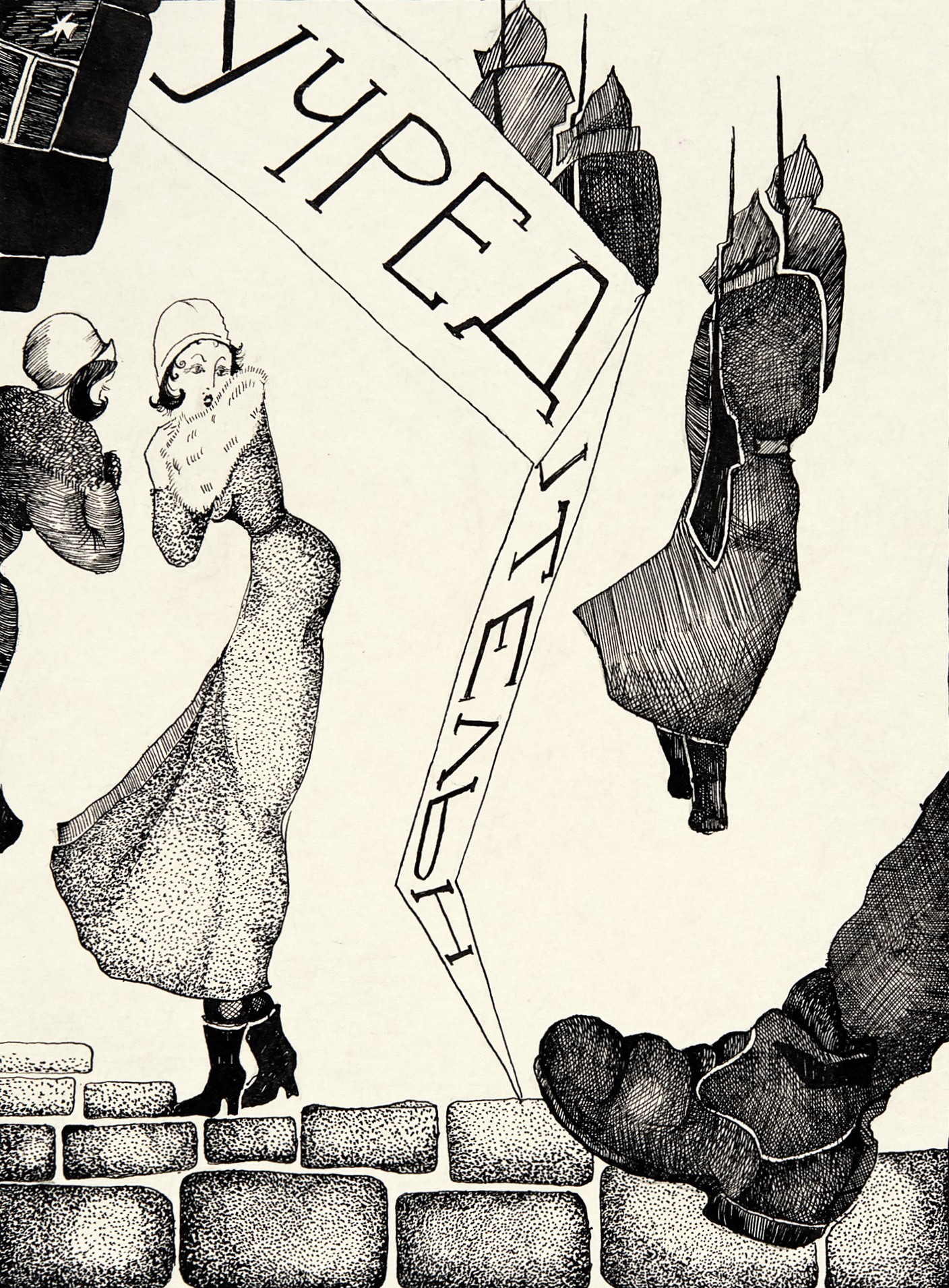
Illustration from Twelve by Alexander Blok, 1976. Ink on paper, 24 × 17.8 cm (9 7/16 × 7 in.). Norton and Nancy Dodge Collection of Nonconformist Art from the Soviet Union. D11659
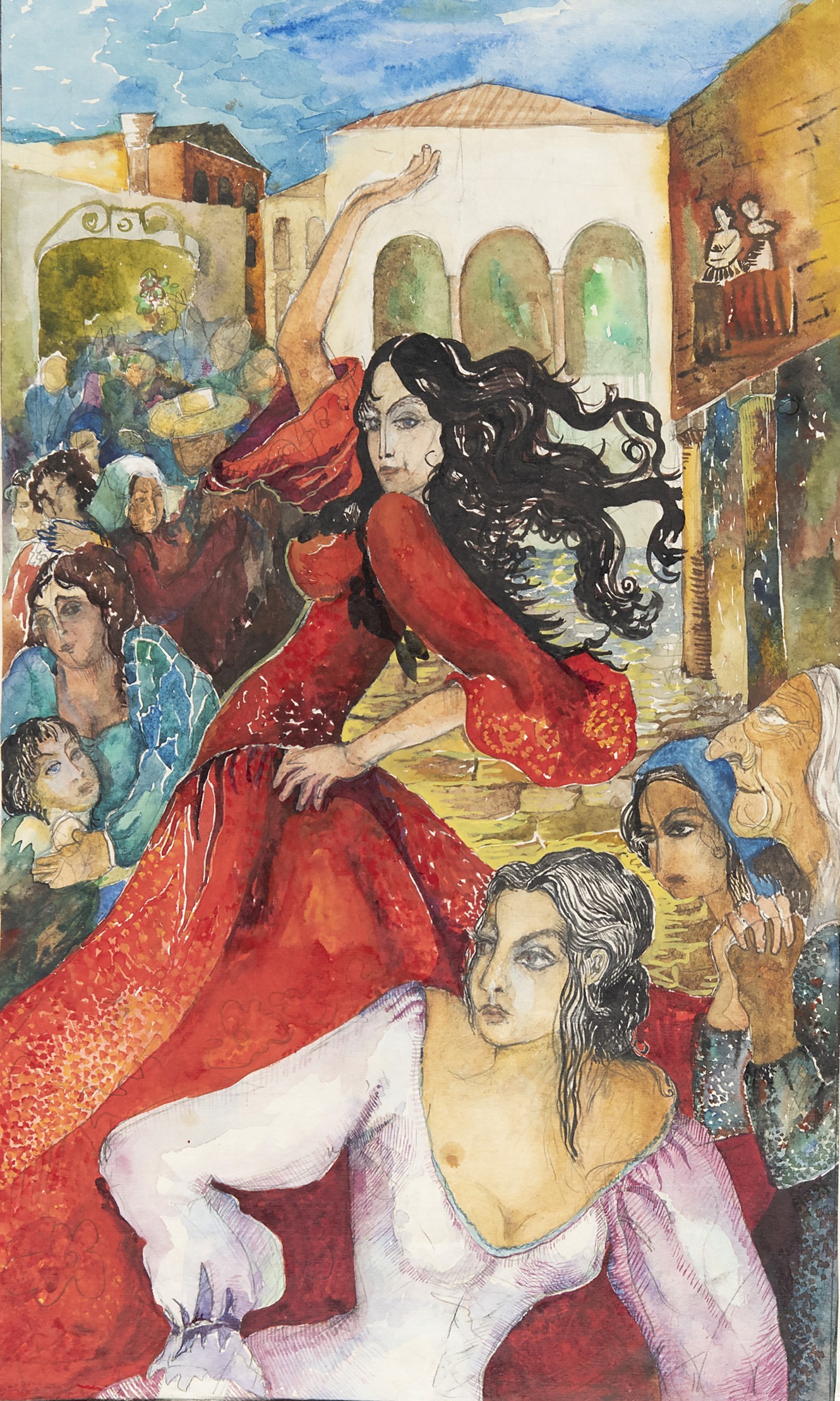
Illustration to Gorky's "Old Woman Izergil," 1973. Graphite and watercolor on paper, 50.8 × 30.2 cm (20 × 11 7/8 in.). Norton and Nancy Dodge Collection of Nonconformist Art from the Soviet Union. D11990

The Judgement of Paris, 1973. Ink and watercolor on paper, 61.3 × 42.8 cm (24 1/8 × 16 7/8 in.). Norton and Nancy Dodge Collection of Nonconformist Art from the Soviet Union. D11992

(Untitled) from the series Hoffman's Tales, 1973. Graphite and watercolor on paper, 58 × 39 cm (22 13/16 × 15 3/8 in.). Norton and Nancy Dodge Collection of Nonconformist Art from the Soviet Union. D11993.01
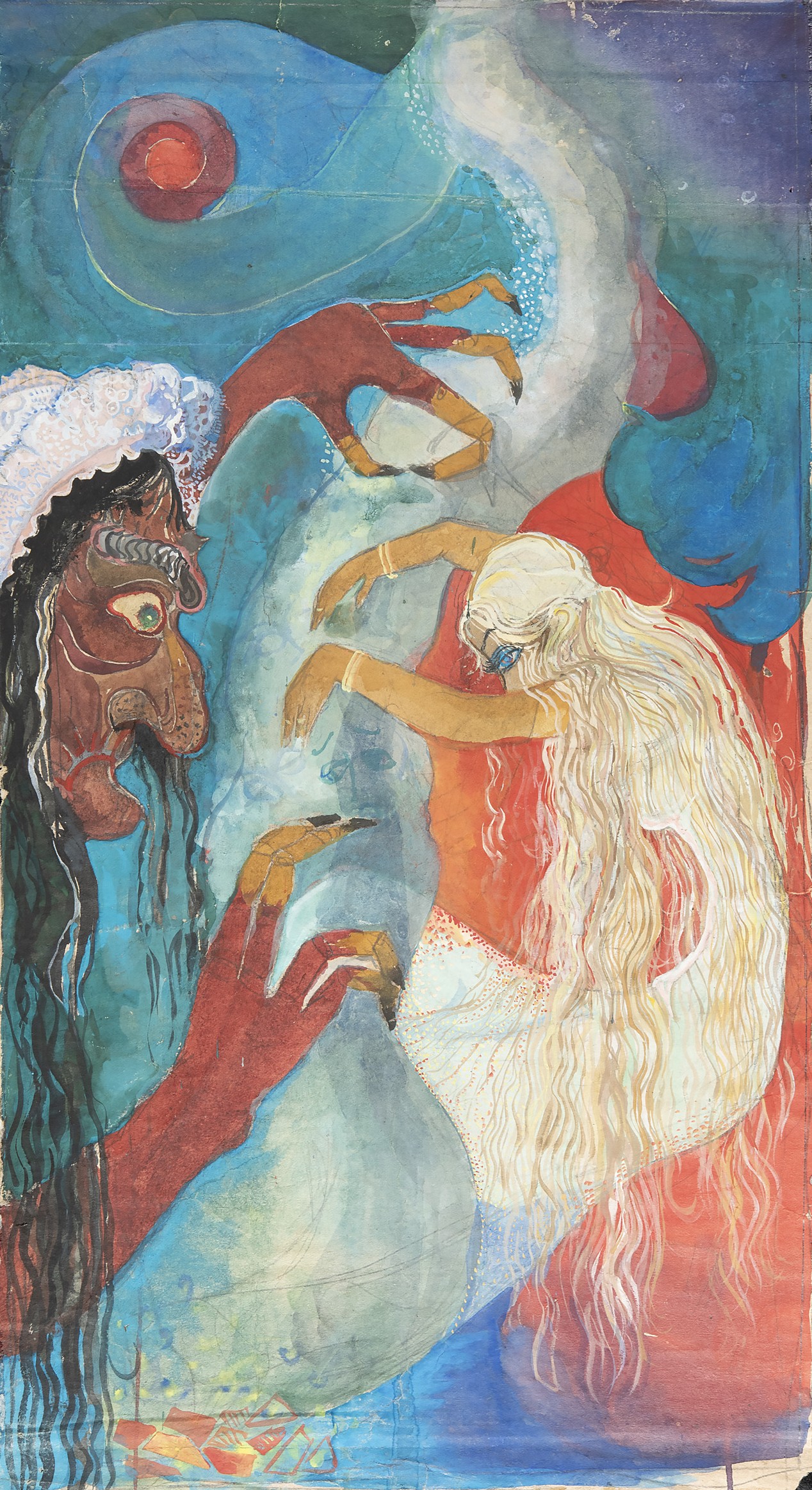
(Untitled) from the series Hoffman's Tales, 1973. Graphite and watercolor on paper, 71.5 × 38.5 cm (28 1/8 × 15 3/16 in.). Norton and Nancy Dodge Collection of Nonconformist Art from the Soviet Union. D11993.02
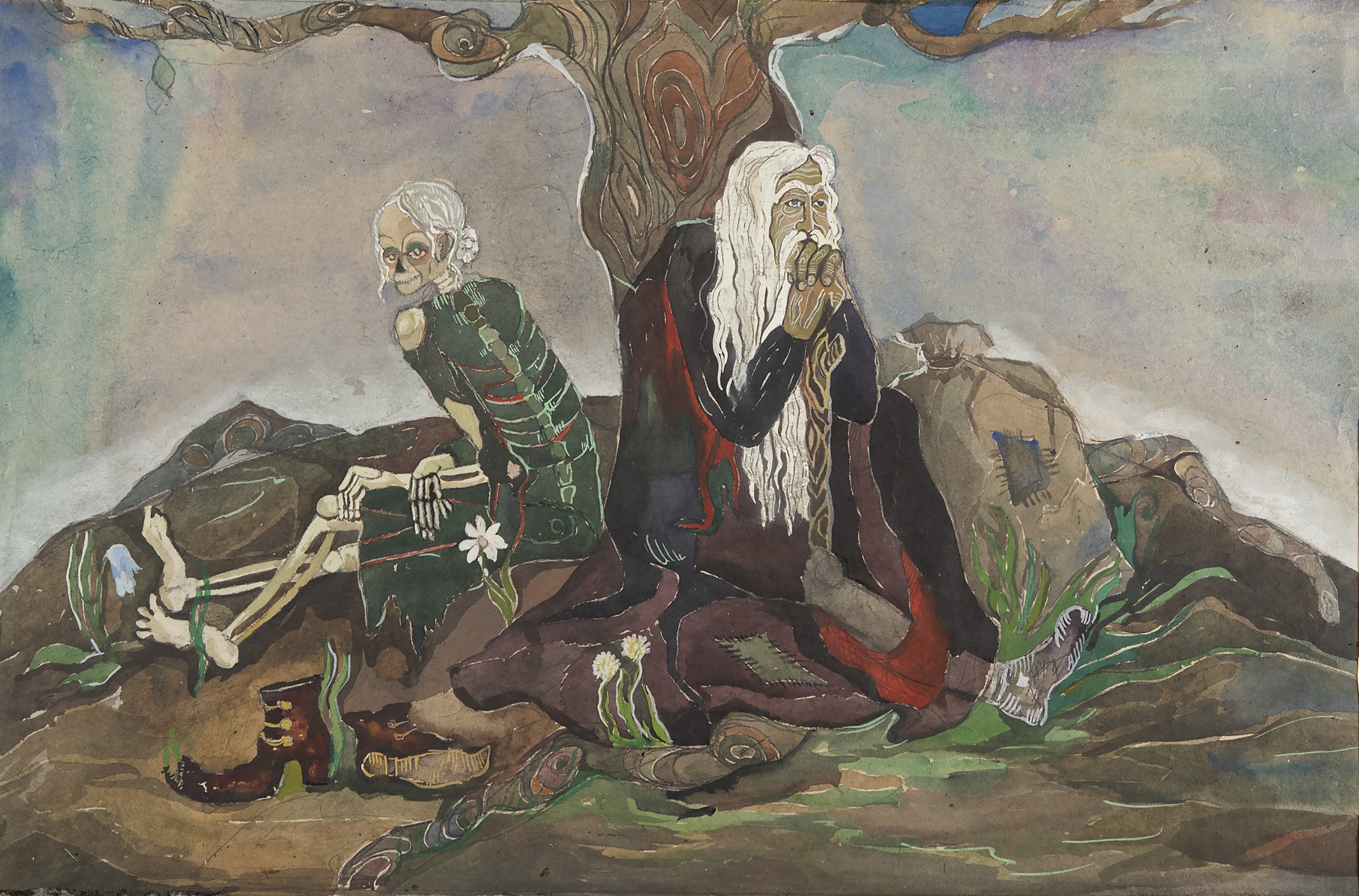
The Old Man and Death, 1974. Graphite and watercolor on paper, 37 × 56.5 cm (14 9/16 × 22 1/4 in.). Norton and Nancy Dodge Collection of Nonconformist Art from the Soviet Union. D11995