

Arsen Savadov
1962 — Kyiv (Ukraine). Worked in Kyiv (Ukraine), Moscow (Russia); currently works in Kyiv (Ukraine) and New York, NY (USA)
Arsen Savadov is one of Ukraine’s leading contemporary artists and one of the founders of the Ukrainian wave of transavantgarde painting. Born in Kyiv in 1962, he graduated from the Kyiv State Art Institute (now National Academy of Fine Arts and Architecture) in 1986. In the early 1990s, he was a member of the Paris Commune squat in Kyiv and, from 1982 to 1996, worked in a creative duo with Heorhii Senchenko. In addition to his paintings, Savadov created well-known photographic series and multimedia projects. He currently works in Kyiv and New York.
A 1986 graduate of the department of monumentalist painting at the Kyiv State Art Institute [1], Savadov began his creative career with the painting Guillaume Apollinaire's Dream, which was shown at the 1987 Republican Youth Exhibition at the House of Artists in Kyiv. That same year, he exhibited the painting Печаль Клеопатри [Cleopatra's Sorrow] (1987) at the State Exhibition of Young Artists in the exhibition hall of the Moscow Manege. [2] This piece caused a great stir and became a landmark in the development of new Ukrainian transavantgarde painting. For the following decade, Savadov mainly worked (with a short break) in collaboration with Georgii Senchenko. Like Cleopatra’s Sorrow, their other paintings from that year, such as Вітальний сезон [Vital Season] and Сади Старі та Нові [Gardens Old and New], [3] had a pronounced stylistic originality, characterized by a green sky, flattened space, curly lines depicting figures in the artworks, and a red outline encircling its subjects. The main signs of postmodernist thought were also present: an eclecticism and referentiality, the use of large-sale figures, an eye-catching and colorful aesthetic, the shifting of meaning, absurdity and irony, along with an authorial indifference thanks to the artists embracing the idea of their own "death" as authors, dictated by the philosophical trend of the 1960s, often reference at the time.
A pause in the collaboration between Savadov and Senchenko occurred between 1988 and 1989. During this period, Savadov painted two large canvases for the State Youth Exhibition at the Moscow Manege. For the first time in the history of these annual exhibitions, artworks were organized into separate national pavilions representing individual Soviet republics, including Ukraine, rather than presented as a unified body of “Soviet art.” This shift allowed for the distinct cultural identities of the republics to emerge within an official exhibition context. Savadov painted Вавілонський притулок [Babylonian Shelter] (1988), in which he used a slightly different pictorial language, gravitating towards energetic expression. He also painted Меланхолія [Melancholy] (1988), [4] which contained all the markers of transavantgarde painting, except that the sky was blue rather than green. The central, and most explicit, artistic reference for this artwork was Pablo Picasso's Two Women Running on the Beach (1922). Savadov continued his individual artistic exploration during a 1989 residency in France, where his style began to change. This could be seen in his use of color as the artist moved from more vibrant paintings, reminiscent of postcards, as in Приборкувач змій [The Snake Charmer] (1989–90, ZAM, 1993.0592), to a darker palette with works such as Чорна мавпа [Black Monkey] (1991), inspired by the visual motifs of French engravings. While at the residency, Savadov also came up with the idea for a new series of works centered on the motif of monkeys upon ruins. He began work on this project with Senchenko upon his return from France. The pair presented this series, Без назви (мавпи) [Untitled (Monkeys)] (1991), at the Central House of Artists in Moscow in 1991, after which Savadov and Senchenko continued their collaboration and went on to create a number of multimedia projects.
By the end of 1996, the creative duo had parted ways: Senchenko left the art world completely to move into design, while Savadov moved to the next stage of his artistic journey and created a whole series of photographic projects. In his staged photographs, Savadov left the traditions of pictorialism behind, carefully building upon each new project to achieve a pompous baroque style while preserving a deep authenticity and social awareness. In 1998, the Soros Center for Contemporary Art in Kyiv hosted Savadov's exhibition Deepinsider. This dynamic megaproject, which gravitated towards a cinematic style, consisted of different subsections and motifs: the Donbas region, fashion at the cemetery, the greenhouse, and the roof. Savadov used Ukrainian coal miners to create the provocative series Донбас-Шоколад [Donbas Chocolate] (1997). Artists, photographers, and male models dressed themselves in ballet tutus and invaded the everyday life of real underground miners. In this work, Savadov explored the identity of two marginalized groups in Ukrainian society: contemporary artists (marginalized yet radical), and miners (a group typically associated with social depression). Savadov's approach is reminiscent of artists who engage in extreme or deviant photography. He managed to bring together the mythological and the real in one space, as if he were reporting live from a metaphorical zone in which the Tartars merged with Eros and Chaos. The coal mine, with its harsh and incredibly risky conditions, becomes a vivid example of the environment of miners and their labor. The mine further serves as the image of both a “catacomb culture” and a special club or community whose membership requires an intense labor. In the series Мода на цвинтарі [Fashion in the Cemetery] (1997), the artist photographed only women. With careful composition of the shots, Savadov’s photographic trickery reduced the distance between the models in frivolous poses and outfits and the juxtaposing real funeral processions taking place nearby. This created a unique spatial effect, which intensified the tragicomic nature of the imagery.
Central to Savadov's oeuvre are two versions of the photographic project Колективне червоне [Collective Red] (1998–99). These works included many images that were set either in the bloody interior of a meat-packing plant in reference to the myth of the Minotaur, or amid a crimson demonstration of communists in Kyiv. Less shocking but no less expressive, Savadov’s project Underground (English title in the original, 2001) was again shot in Donbas, but this time in the salt mines. He used decorations for the scenery, including pinups based on Giotto's frescoes, as well as furniture and other objects. The photo images were produced without any computer manipulation (this is true for nearly all of Savadov’s photographs). The final result was twofold: an emphasis on the ephemerality of the photos’ subject matter and the impression an art historical textbook had come to life. The best way to describe Savadov’s photography projects Янголи [Angels] (2000), Караїмське кладовище [Karaite Cemetery] (2001), Кокто [Cocteau] (2001), Last Project (2002), and Книга мертвих [Book of the Dead] (2002) is to see them as a theater of the absurd. They are in fact grandiose performances shot in the photographic medium.
In 2002, Savadov returned to painting with the work Супутник [Sputnik], followed by Ложка [Spoon] (2004), Вініл [Vinyl] (2004), Pleinair (2004), and Месершміт на місяці [Messerschmitt on the Moon] (2005), which demonstrated the beginning of a new phase of creativity. The works introduced a certain trans-mediality; a sign or symbol could be separated from its original medium and transferred to another medium, yet that sign retained a connection to its "native" source medium, thus reproducing some of its original features. The result was a complex media layering, where, for example, photography acquired the properties of painting or cinema (and vice versa) and performance served as the initial impetus for photographic or video images, and so on in a similar, ever-intertwining vein. This approach didn’t just include photography and cinema, but also mass-media advertising and glossy magazines. The banal nature of much of this media layering helped create a “readymade realism” that strove to be increasingly spectacular.
The large multi-figure canvas До серця [To the Heart] (2006) is symbolic of Savadov’s new artistic line of inquiry. In esoteric traditions, to which he consistently refers, the heart is considered the center of existence and the seat of pure, transcendent reason. Compositionally, the painting simulates a neo-academic style and resembles other artistic representations of the epiphany that center the Heart of Jesus. [5] However, the iconography here is changed, and the heart is wrapped in striped neckties, rather than sharp rays and tongues of flame. At the foot of the staircase, amid theatrical debris, chaotic groups of devotees of the cult of love mingle with fragments of sacred imagery—remnants of former grandeur and its faded meanings. The viewer sees vinyl records in the air, some of which are turning into halos. Together, these elements create a kind of hallucination, with a sense of surrealism and mysticism. The approach found in To the Heart can be found in many of the artist’s other paintings, including Футбол [Football] (2005), Fio Land (2009), Східний маяк [Eastern Lighthouse] (2010), Лабораторія Орфея [Laboratory of Orpheus] (2010), Аврора [Aurora] (2010), Сон Ґуллівера [Gulliver's Dream] (2016), and Готель Елефант [Hotel Elephant] (2018). These pieces were shown at a number of Savadov’s exhibitions from the period, like the solo exhibition Escape to Egypt (2011) at the Kyiv Collection gallery and The Best of Times, the Worst of Times (2012), hosted at the Mystetskyi Arsenal National Art and Culture Museum Complex (which was also the central art project at the International Kyiv Biennale for that year). There were also the group exhibitions Premonition. Ukrainian Art Today (2014) at the Saatchi Gallery in London and Media Dependents (2019) at the Ukrainian House in Kyiv.
However, Savadov wasn’t focused solely on painting in the 2010s. In 2012, he created a series of more than forty color photographs entitled Commedia dell Arte в Криму [“Commedia dell Arte” in Crimea]. The central, hybrid image of the photo series was created by positioning neo-Dadaist and pop art objects into the fabric of everyday reality, thus helping to create a unique mythological space. The mood of these photographic images is close to elegiac, representing a kind of lyrical poetry, while at the same time containing a pensive sadness and reflections on unhappy love and the vanity of existence.
When conceiving his multimedia project Голоси любові 2 [Voices of Love 2] (2020), Savadov was inspired by past events when art, for example, was able to intervene in dangerous military situations and change, however subtly, how that situation was viewed on a human level. This project was a reenactment, or reconstruction, of the famous Marilyn Monroe concert for American soldiers on the border between North and South Korea in 1954. Savadov reproduced this event in eastern Ukraine, where fighting had been raging since 2014. He recorded this hoax event using digital photos and video. Approximately four thousand Ukrainian soldiers were involved in the filming process and are the main characters of the project. Filming took place during rehearsals for a parade at an Antonov aircraft factory, at the Desna firing range, and at Ukrainian positions on the front line in Donbas. The project was shown in its final form at Kyiv's M17 Center for Contemporary Art; it featured five large video projections, an extended photographic series, and a new, epic artistic language. The project opened in February 2021, exactly one year before the full-scale Russian invasion of Ukraine.
Oleksandr Soloviov
Translated from Russian by Nathan Jeffers
Notes:
1. The Zimmerli Museum collection holds a highly expressive academic piece of work by him from the mid-1980s: Untitled (Two seated male figures) and Untitled (Male lying in bed), 1984–85, ZAM, 2001.1320, 2001.1319.
2. A collaboration between Savadov and Heorhii Senchenko.
3. Both of these paintings are held in the Zimmerli Museum collection (Gardens Old and New, 1986–87, ZAM, D21728, D21729).
4. A sketch of this painting is in the Zimmerli Museum collection: Untitled, undated drawing, ZAM, D15468.
5. Which might be referred to as a theophany in Eastern Christian churches.

Snake Charmer, 1989–90. Oil on canvas, 307.3 × 217.2 cm (121 × 85 1/2 in.). Gift of Robert L. and Ann R. Fromer. 1993.0592

Untitled (Horse), 1987. Oil on canvas, 201.3 × 304.8 × 2.2 cm (79 1/4 × 120 × 7/8 in.). Norton and Nancy Dodge Collection of Nonconformist Art from the Soviet Union. D10952
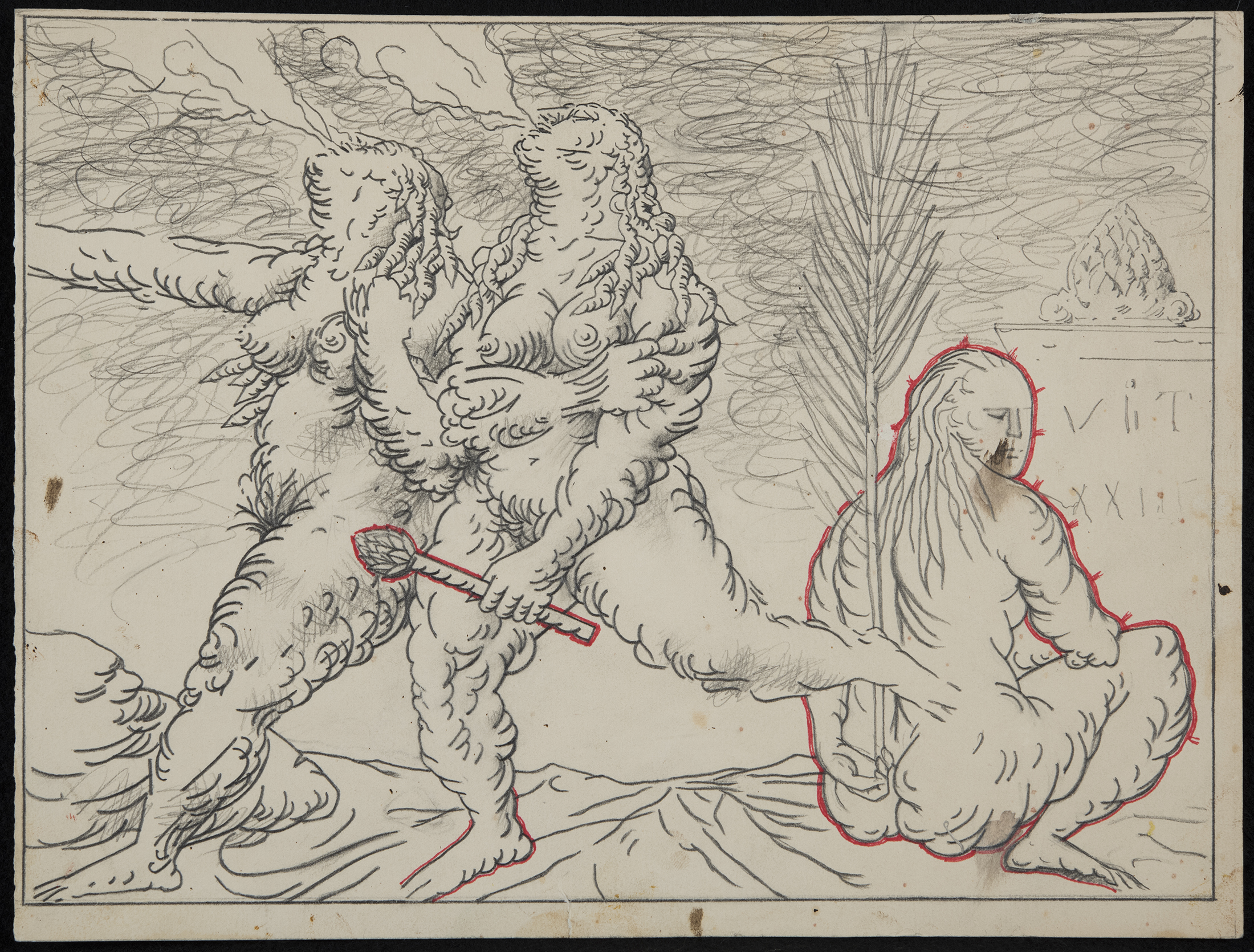
Untitled, undated. Pencil, ink on paper, 22.3 × 29.4 cm (8 3/4 × 11 9/16 in.). Norton and Nancy Dodge Collection of Nonconformist Art from the Soviet Union. D15468
Selected Exhibitions
1987 Republican Youth Exhibition, House of Artists, Kiev, Ukraine
1987 The Youth of the Country, Moscow Manege, Moscow, USSR
1999 After the Wall, Moderna Museet, Stockholm, Sweden
1999 Looking for a Place, Third International SITE Santa Fe Biennial, Santa Fe, NM, USA
1998 Deepinsider, Soros Center for Contemporary Art at the Kyiv-Mohyla Academy, Kyiv, Ukraine
1998 White Outfit, Center for Curatorial Studios at Bard College, Annandale-On-Hudson, NY, USA
2001 First Ukrainian Project, 49th Venice Biennale, Venice, Italy
2001 The Book of the Dead, Central House of Artists, Moscow, Russia
2003 First Collection, House of Artists, Kyiv, Ukraine
2004 Farewell, Arms, Mystetskyi Arsenal National Art and Culture Museum Complex, Kyiv, Ukraine
2005 Love Story, Galerie Orel Art, Paris, France
2007 Reflection, PinchukArtCentre, Kyiv, Ukraine
2007 Paintings, Daneyal Mahmood Gallery, New York, NY, USA
2011 Escape to Egypt, Collection Gallery, Kyiv, Ukraine
2011 Blow-up, PinchukArtCentre, Kyiv, Ukraine
2011 Independents. Ukrainian Art 1991–2011, Mystetskyi Arsenal National Art and Culture Museum Complex, Kyiv, Ukraine
2014 Premonition: Ukrainian Art Today, Saatchi Gallery, London, UK
2017 Gulliver's Dream, Art Ukraine Gallery, Kyiv, Ukraine
2018 Permanent Revolution. Ukrainian Art Today, Ludwig Museum, Budapest, Hungary
2021 Voices of Love, M17 Center for Contemporary Art, Kyiv, Ukraine
Selected Publications
Arsen Savadov, interview by Aksinia Kurina. “Arsen Savadov: ‘S molodezhiu obshchaius neposredstvenno, to deneg dam, to v glaz komu-to’” [I communicate directly with young people, sometimes I give money, sometimes I throw a punch]. Ukrainska Pravda, September 28, 2009.
Arsen Savadov, interview. “Ukrainskii extreme. Interviu s Arsenom Savadovym.” Ogonek, October 12, 2009.
Bazdyrieva, A. “‘Postmodernizm – ne yumor, eto do slez. Net svoego litsa, ispolzui chuzhoe’ – Arsen Savadov o vystavke ‘Begstvo v Egipet.’” [“Postmodernism is not humor, It is tearful. You don’t have a face, use someone else's” – Arsen Savadov on the Flight to Egypt exhibition]. ArtUkraine, March 3, 2011.
Burlaka, Viktoria. “‘Staffazh’ simvolicheskogo v fotoproektakh Arsena Savadova – implantatsiia iskusstva v telo realnosti” ["Staffage” of the symbolic in Arsen Savadov's photo projects – The implantation of art into the body of reality]. ArtUkraine, March 24, 2015.
Burlaka, Viktoria. “Dvoinaia ekspozitsiia v fotoproektakh Arsena Savadova 1990-kh godov: Antropologicheskaia illiusiia vs. Illiuziia esteticheskaia” [Double Exposure in Arsen Savadov's Photo Projects of the 1990s: Anthropological Illusion vs. Aesthetic Illusion]. ArtUkraine, February 27, 2015.
Burlaka, Viktoria. Postmediina optyka. Ukraineka versiia [Postmedia optics. The Ukrainian version]. Kyiv: Art Huss, 2019.
"Gloire aux héros du 'glasnos art'!" [Glory to the heroes of “Glasnost art”!]. Le match de Paris, October 23, 1987.
Lobanovskaia, Anna. “Arsen Savadov: ‘Epatazh - eto glavnyi antibiotik protiv meshchanstva…’” [Arsen Savadov: 'Shock is the main antibiotic against philistinism…’]. Levyi bereg, Lb.ua, March 23, 2010.
Lozhkina, Alisa. “Arsen Savadov: ‘Moi geroi- eto personazhi s razmytym poniatiem realnosti’” [Arsen Savadov: “My heroes are characters with a blurred concept of reality”]. ArtUkraine, November 8, 2011.
Lozhkina, Alisa and Oleksandr Soloviov. “Istoriia sovremennogo ukrainskogo ikusstva. Point Zero. Chast VI – Millenium (prodolzhenie)” [The history of contemporary Ukrainian art. Point Zero. Part VI – The Millennium (Continued)]. Spetsproekt zhurnala TOP10 [Special project of TOP10 magazine], May 2010.
“Novaia mifologiia Arsena Savadova” [The new mythology of Arsen Savadov]. Cameralabs, June 19, 2016.
Soloviov, Oleksandr. “Kiev. 1998 god: ‘Fotoshok bez fotoshopa’” [Kyiv, 1998. “Photoshock without photoshop”]. Khudozhestvennyi Zhurnal [Art Journal] 23 (1999): 75–76.
Soloviov, Oleksandr. “Po tu storonu ochevidnosti. Predvaritelnye razmyshleniia po povodu odnogo yavleniia” [Beyond the obvious. Preliminary thoughts on a phenomenon]. Iskusstvo [Art] 10 (1988): 35–37.
Soloviov, Oleksandr. “Sketch o mladoukrainskoi zhivopisi (vzgliad iz Kieva)” [Sketch on young Ukrainian painting (The view from Kyiv)]. Dekorativnoe Iskusstvo SSSR [Decorative Art of the USSR] 12 (1989): 22.
See also