
Arlen Kashkurevich
1929—Minsk (BSSR, now Belarus) | 2013—Minsk (Belarus). Worked in Minsk (Belarus)
Arlen Kashkurevich was a graphic artist, book illustrator, teacher, and recipient of the People’s Artist of Belarus award. Born in Minsk, he spent his entire life in the city, except for three years during the Second World War, when his family was evacuated to the Russian city of Saratov. In his youth, he was passionate about sports, and he dreamed of becoming an acrobat in the circus. He was able to enter the Minsk Art College (now the Aleksei Glebov Minsk State Art College), but only on his third attempt. In 1953 he graduated from the school and continued his education at the Belarusian State Theater and Art Institute (now the Belarusian State Academy of Arts), specializing in graphics. Kashkurevich’s diploma project consisted of illustrations for the novel Atomic Station by the Icelandic writer Halldór Laxness, the Nobel Prize laureate in literature in 1955. His diploma project already embodied the coordinate system that he maintained throughout his life: a sharply modern artistic language, orientation toward Western European trends, and intellectualism. Even during his student years he began to engage in book graphics, which would become one of the main pursuits of his life.
After graduating from the institute in 1959, Kashkurevich taught there for ten years. In 1960 he was admitted to the Soviet Belarusian Artists’ Union, and from that time on he consistently participated in exhibitions, showcasing his works in various graphic techniques such as lithography, linocut, and etching. His most significant early series include City and People (1963–64), Masters (1966), and Kupalinka (1971). Starting in the 1960s and 1970s, Kashkurevich repeatedly represented Belarusian art at major international art forums in Japan (Exhibition Expo-70, Osaka, 1970), Germany (International Exhibition of Book Art, Leipzig, 1977), and other countries. Continuing his work in book graphics, he would be involved in the creation of more than two hundred publications, many of which were awarded numerous diplomas at republican and all-union competitions of book art. However, Kashkurevich was never just an illustrator, and he did not particularly like that term. He was a full-fledged coauthor who was inspired by the text and created an independent work—a graphic interpretation of the text or a fantasy on the theme.
In the 1960s, while illustrating the poems of the Belarusian literary classic Yanka Kupala (“Bandarouna,” 1962; “The Lion’s Grave,” 1962; “The Gravemound” 1962, 1967), he created a completely new visual image of Belarus. During the Soviet period, Belarus had a reputation as an agrarian, collective-farm republic with a peasant, rural culture. Kashkurevich portrayed his homeland differently: He saw it as a European country with a great history and rich cultural heritage. He depicted majestic castles, beautiful women, and courageous knights. The Art Council (Художественный совет при Министерстве культуры), essentially a censorship body in the USSR, reluctantly gave permission for the publication of these illustrations in the book edition, which shattered the familiar stereotypes. In the 1970s and ’80s the artist also reinterpreted the theme of the Second World War in his illustrations for the works of famous Belarusian writers Vasil Bykov and Ales Adamovich, in series of linocuts such as Partisans (1969–70) and Blockade (1979). Soviet art of that time was characterized by heroization and even romanticization of war, with a triumphant ethos, glorification of victories, and celebration of heroism. Kashkurevich looked at the war differently; for him, it was an ultimate existential tragedy, a catastrophe in which there were no winners, only senseless and absurd destruction.
Particularly ruthless and shocking was his graphic series for Adamovich’s book The Executioners (1981). Here, Kashkurevich not only re-created the horrifying scenes of war but also explored the nature of evil, which knows no spatial, national, or historical boundaries. One of the images from the graphic series The Executioners—a symbol of the human suffering that any war brings—is also used in the work Genocide (1986), from the Zimmerli collection (D18567).
Kashkurevich’s illustrations for Johann Wolfgang von Goethe’s tragedy Faust, produced between 1976 and 1990, are turned not so much toward the past as they are toward the present and even the future. The dust jacket and six triptychs for the book were finished as early as 1976, but the subject fascinated Kashkurevich so much that he continued to work on this series even after the book’s publication. The artistic world created in these works is not bound to a specific time or place; rather, it becomes a space in which the Belarusian graphic artist engages in a conversation with the German poet, deliberating with him on eternal universal truths.
Thus, already in the 1970s, Kashkurevich took on the role of a philosopher-artist. In his worldview, he was perhaps close to existentialism. Such a philosophy contradicted the Soviet ideology, which cultivated optimism and faith in a bright future. It is in this philosophical sense that Kashkurevich can be called a dissident. The artist’s mindset found expression in his highly recognizable, brightly individual style that is characterized by meticulous precision and a certain theatricality of composition, cold expression, nervously dynamic lines, affective expressionism, and characters in ecstatic poses and gestures—all, in concert, creating dramatic tension.
In 1991 Kashkurevich was awarded the title People’s Artist of Belarus. Books with his illustrations were in practically every Belarusian home. These books were printed in huge editions in the 1970s and 1980s, reaching up to 300,000 copies; they were often reissued. Several generations of Belarusians grew up on these books. His remarkable, mesmerizing illustrations in collections of Hans Christian Andersen’s fairy tales (1966, 1977, 1984), Mark Twain’s The Adventures of Tom Sawyer (1973, 1978), H. G. Wells’s The Invisible Man and The Time Machine (1969) are particularly memorable. He also designed a number of national bestsellers, including Vladimir Korotkevich’s epic Kolosya pod serpom tvoim [The Ears Under Your Sickle] (1968) and the historical detective story The Savage Hunt of King Stakh (1964).
Kashkurevich’s had a creative breakthrough with his graphic depiction of biblical narratives. In the 1990s he created a series of drawings based on the New Testament. His graphic interpretation of episodes in the Bible was certainly far from canonical. It represented a philosophical contemplation by modern man on eternal questions. Thus, similarly to his other works, Kashkurevich introduced attributes from different epochs (such as a fascist helmet or police handcuffs) into ancient plots. Later, he turned to the Old Testament: in 1994 in Minsk, The Song of Songs of Solomon was published in Belarusian, Russian, and English, with the second edition published in 2008. Kashkurevich’s sensual illustrations for this book are full of expression and passion.
In the twenty-first century, in Belarus as well as worldwide, book culture faced challenging times. Kashkurevich focused on easel graphics during this period. Among all techniques, he preferred drawing. Unlike engraving, which requires significant preparatory technical work, drawing is direct, allowing for free artistic expression. Kashkurevich returned to some themes that had interested him for decades,: continuing to explore humanity in the space of the modern city in the series This Lovely Urban Life. . ., which he began in 1987. However, now his works on this theme had even more melancholy in them. A new subject emerged: a series of images depicting a naked human figure in complex interactions with a musical instrument (the cycle of drawings Concerto Grosso, 2003–6). The images function as an allegory of the painful pursuit of harmony and the unattainability of this elusive goal, reflecting on the path that every creator traverses. The artist passed away at the age of eighty-four on August 26, 2013, and was buried at the Eastern Cemetery in Minsk.
Volha Arkhipava
Translated from Russian by Sergey Shabohin
Photo portrait by Yaugen Kolchau, 2013
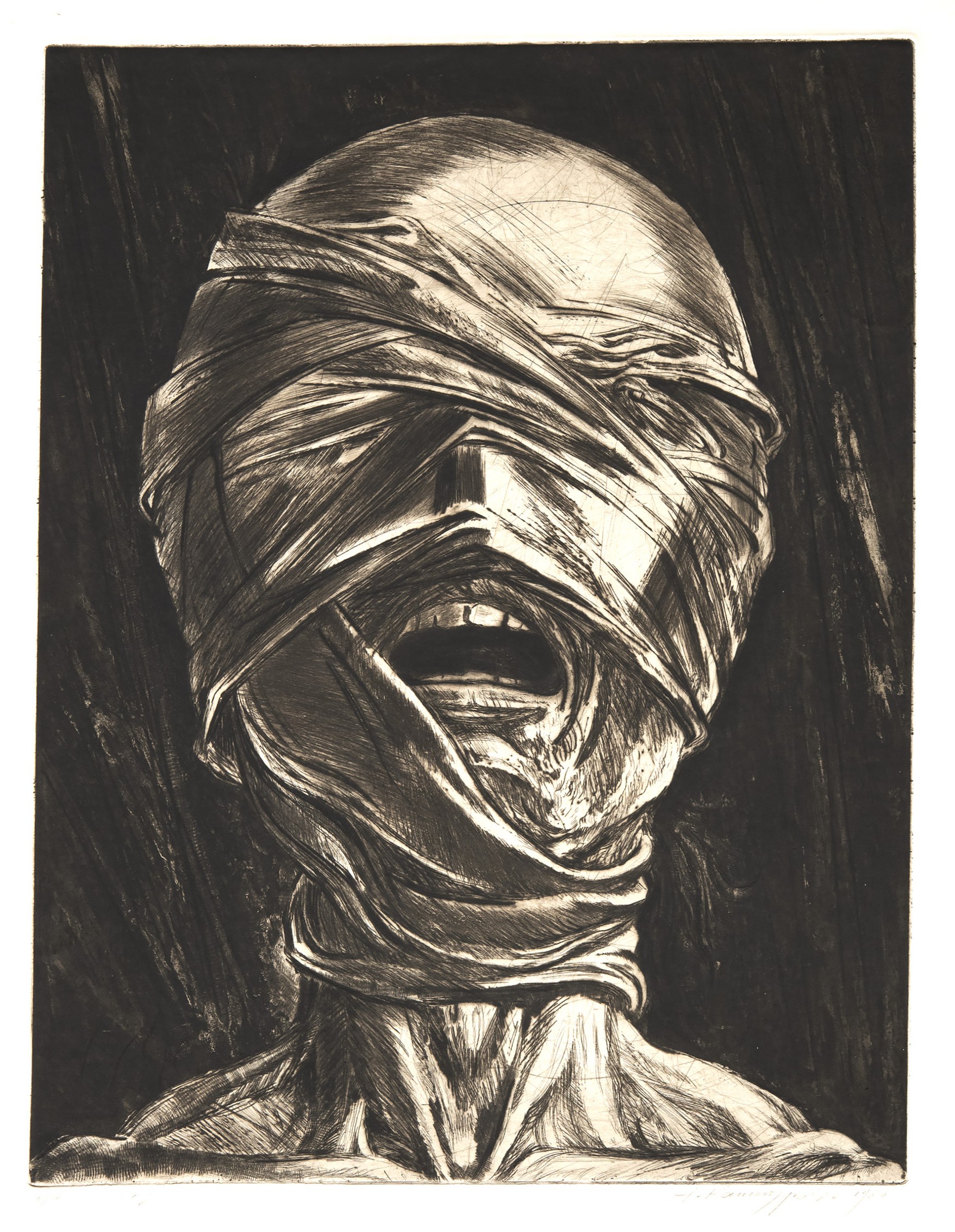
Genocide, 1986. Mezzotint and etching on paper, 63 × 50 cm (24 13/16 × 19 11/16 in.). Norton and Nancy Dodge Collection of Nonconformist Art from the Soviet Union. D18567