
Andres Tolts
1949 — Tallinn (Estonia) | 2014 — Tallinn (Estonia). Worked in Tallinn (Estonia)
The pop artist Andres Tolts was an only child born to a single mother. He was strongly influenced by his mother’s conservative upbringing and old-fashioned manners but also by her political background, as she was born and raised in the 1930s, a time when Estonia was independent. Although Tolts’s childhood in rapidly modernizing Tallinn was one of the inspirational sources for his later output, it contrasted with intermediated memories from his mother’s era, a conflict that led to one of the key features of his oeuvre: irony.
Ever aware of the difference between the rare, unique objects in his mother’s bedroom and mass-produced, cheap Soviet kitsch, between the conservative values of his mother’s generation and the hip culture of his own youth, between the “auratic essence” [1] of art and his own belief that art is rather part of pop culture and has little to do with the magic of brushwork, Tolts maintained throughout his career an irony toward everything deemed essential by the establishment. His messy studio was filled with his own works, but also with books on freemasonry, the history of symbols, and old mansions. He was amused by characterizations of artists who paint with their “soul” and work with their “feelings.” “An artist cannot be stupid,” he would say, keeping a cigarette almost all the time between his fingers. [2]
Tolts’s interest in art began in middle school, where he was a classmate of another future Estonian pop artist, Ando Keskküla (1950–2008). Their teacher was Ludmilla Siim (b. 1938), a pop artist herself, and in these surroundings Tolts started to create the surrealist collages of his youth. These collages from the late 1960s, which mix images of everyday life (workers, furniture, schools) and political life (party bureaucrats, war heroes) in the Soviet Union with images of fish or pyramids, interrogated the common definition of what art is, and thus are considered important contributions to Estonian avant-garde art.
Tolts continued his studies at the State Art Institute of the Estonian SSR (now the Estonian Academy of Arts) in Tallinn—not in the painting department (although painting was held in very high esteem in the Soviet art world) but in the newly opened design department. (The term design was not used in Soviet Estonia; the department’s focus was something like industrial design.) At the institute Tolts developed a certain understanding of composition, which he valued in his art more than auratic tools like atmosphere or color. His work united classical principles of symmetry and harmony with stories hijacked from everyday life and uncanny colors. He also became a participant in the artists’ group SOUP ’69, with fellow artists Keskküla and Leonhard Lapin (1947–2022). [3]
Tolts graduated from the institute in 1973. Having never been highly technically skilled at painting, he was at first not acknowledged as a painter, even being described by older artists as someone who was only good enough to paint fences. Since the 1960s, a tension existed between artists who wanted to carry on with the values of 1930s, pre-Soviet-occupation Estonian art and those of the new postwar generation, who were not interested in this kind of escapism. Tolts quickly became one of the prominent voices of the avant-garde, exhibiting his collages and assemblages of everyday items, such as pillows, lottery cubes, and wallpaper. His paintings mixed images from Soviet publications with abstract networks of dots and lines, cityscape facades with suburban views—all enhanced by a pop aesthetic and elements from classical painting and constructivism. In his role as an editor and designer at the influential magazine Kunst ja kodu [Art and Home], where he worked between 1973 and 1980, he combined contemporary interior design with art theories and experimental ideas. During Tolts’s stint the magazine became one of the leading platforms for new ideas in art and culture.
As was typical for artists of his generation, humans’ relationship with nature was problematized in Tolts’s art. Nature motifs had been the very basis of early modernist Estonian art, but as urbanization increased, the relationship between art and nature grew more tense. Tolts saw in nature a profitable source of kitsch dreams, and he took a rather ironic approach toward attempts to manipulate the viewer with emotional or sentimental imagery of nature (see, for example, Spring Still Life with Summer Landscape [1983, ZAM, D07569] and The Marble Wall [1983, ZAM, 1992.1015]).
For a short while, Tolts also participated in the first happenings of the late 1960s, which were organized mostly by young art students, but soon retreated from this practice, calling such performances “too physical” for his taste. Nevertheless, his appearances around the city conveyed messages of their own. He could often be found dressed in the 1930s style, lured to the outskirts of the town, looking for motifs. He flirted with different esoteric teachings—as did many Estonian artists of the 1970s—and was especially interested in cultural symbols and their usage over time. This interest manifested in his art, as when, for example, he recontextualized symbols used in freemasonry.
The selection of Tolts’s work in the Norton and Nancy Dodge Collection at the Zimmerli Art Museum dates from the late 1970s and ’80s. During this period Tolts established himself as one of the key players in Estonian painting. He often rephrased art historical genres like still life or landscape painting, combining and mixing them with abstract figures, geometrical elements, and visual patterns. While one of the primary values for his contemporaries was “good taste,” Tolts has been described as a “perfect gentleman whose hobby is bad taste.” He boldly blurred the borders between high and low, kitsch and art. He “comes from opera and talks about rock,” wrote the Estonian poet Juhan Viiding in his poem about Tolts.
Although often characterized as a pop artist, Tolts displayed some reluctance around mass culture. His work is rife with cultural references, including to his own work, but he was more interested in creating well-designed, unique objects that carry cultural meaning, and he can therefore be interpreted as an artist more preoccupied with retaining aesthetic positions than with demolishing them. He was married to printmaker Mare Vint (1942–2020), who was interested in deploying “pure aesthetics” in her work, which mostly consists of metaphysical landscapes. Tolts’s paintings reveal attempts to turn vulgarity into refinement, irony into hedonism, the mechanical into the singular. Artistic freedom and creative autonomy were of the utmost importance, which perhaps explains why he never took up teaching. Tolts’s style and thematic interests remained relatively consistent throughout his career, up to his death in Tallinn in 2014.
Eero Epner
Photo portrait: Andres Tolts, 1982. Photo by Alar Ilo. Archive of the Magazine Kultuur ja Elu [Culture and Life] in FOTIS database. EFA.332.0.131283
Notes:
1. In his 1936 essay “The Work of Art in the Age of Mechanical Reproduction,” the German philosopher Walter Benjamin defined an object’s “aura” as its unique presence in time and space—a quality that cannot be reproduced or even, sometimes, described with words.
2. These observations as well as all the quotes in the essay come from conversations the author had with the artist between 2005 and 2014.
3. SOUP ’69 was an artists’ group active from 1969 to 1971 that worked primarily with pop art tools. The name was inspired by Andy Warhol’s work.

The Marble Wall, 1983. Oil on canvas, 120.2 × 94.8 cm (47 5/16 × 37 5/16 in.). Norton and Nancy Dodge Collection of Nonconformist Art from the Soviet Union. 1992.1015

Apple Year, 1983. Oil on canvas, 127.5 × 148.5 cm (50 3/16 × 58 7/16 in.). Norton and Nancy Dodge Collection of Nonconformist Art from the Soviet Union. 1992.1031
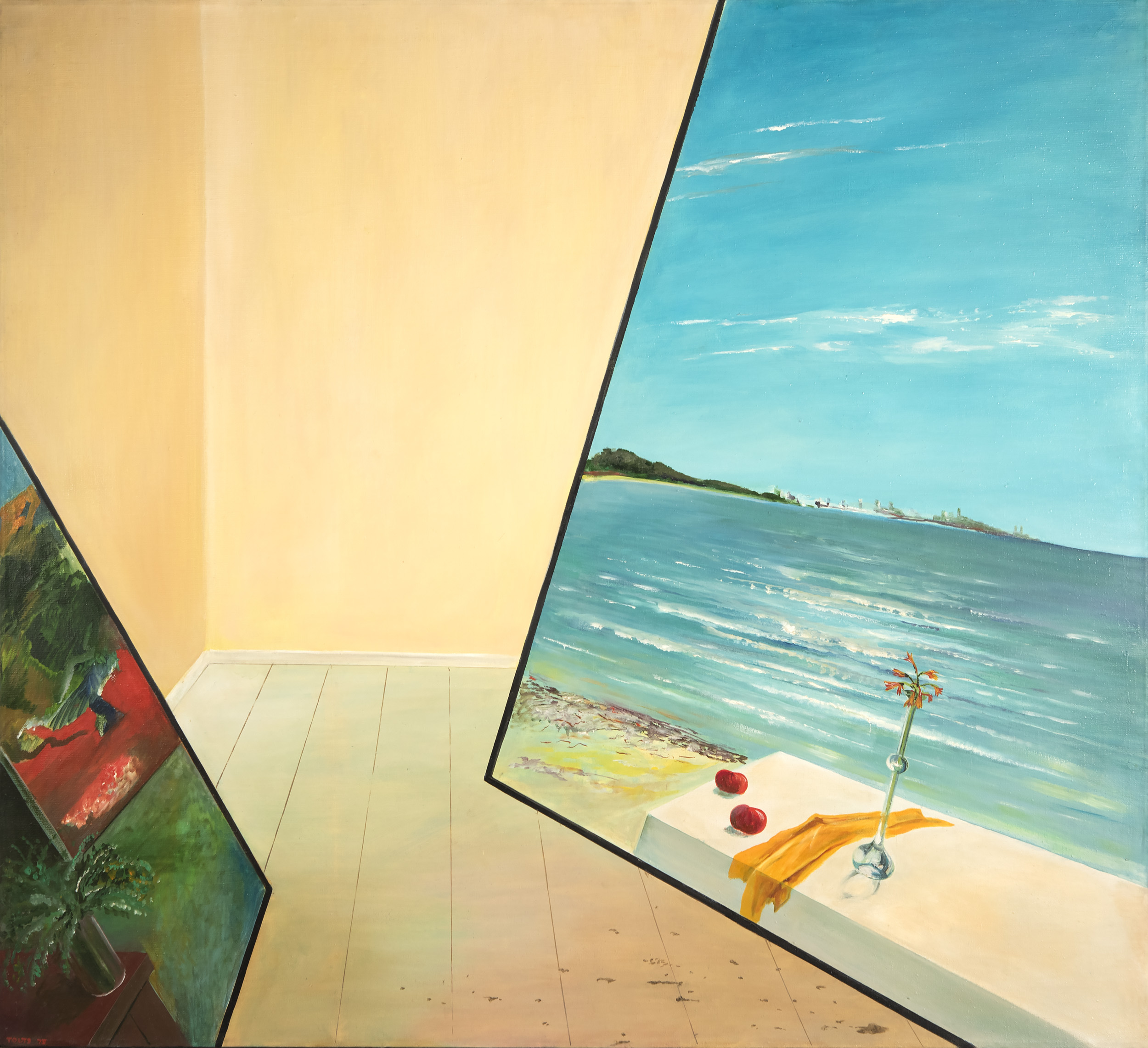
Two Paintings, 1978. Oil on canvas, 136.5 × 151.5 cm (53 3/4 × 59 5/8 in.). Norton and Nancy Dodge Collection of Nonconformist Art from the Soviet Union. D07562
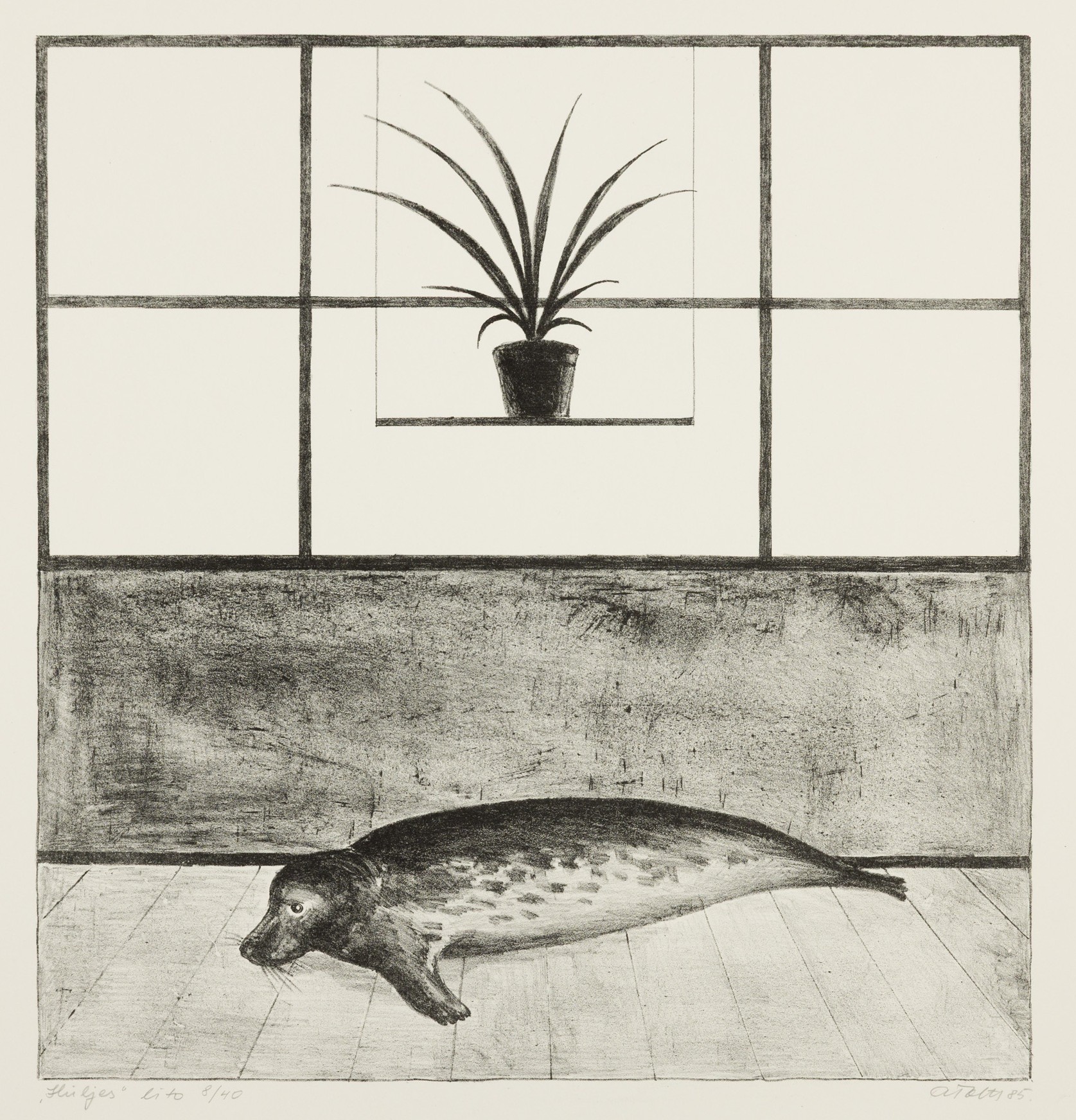
Seal, 1985. Lithograph on paper, 40.2 × 38.4 cm (15 13/16 × 15 1/8 in.). Norton and Nancy Dodge Collection of Nonconformist Art from the Soviet Union. D03104
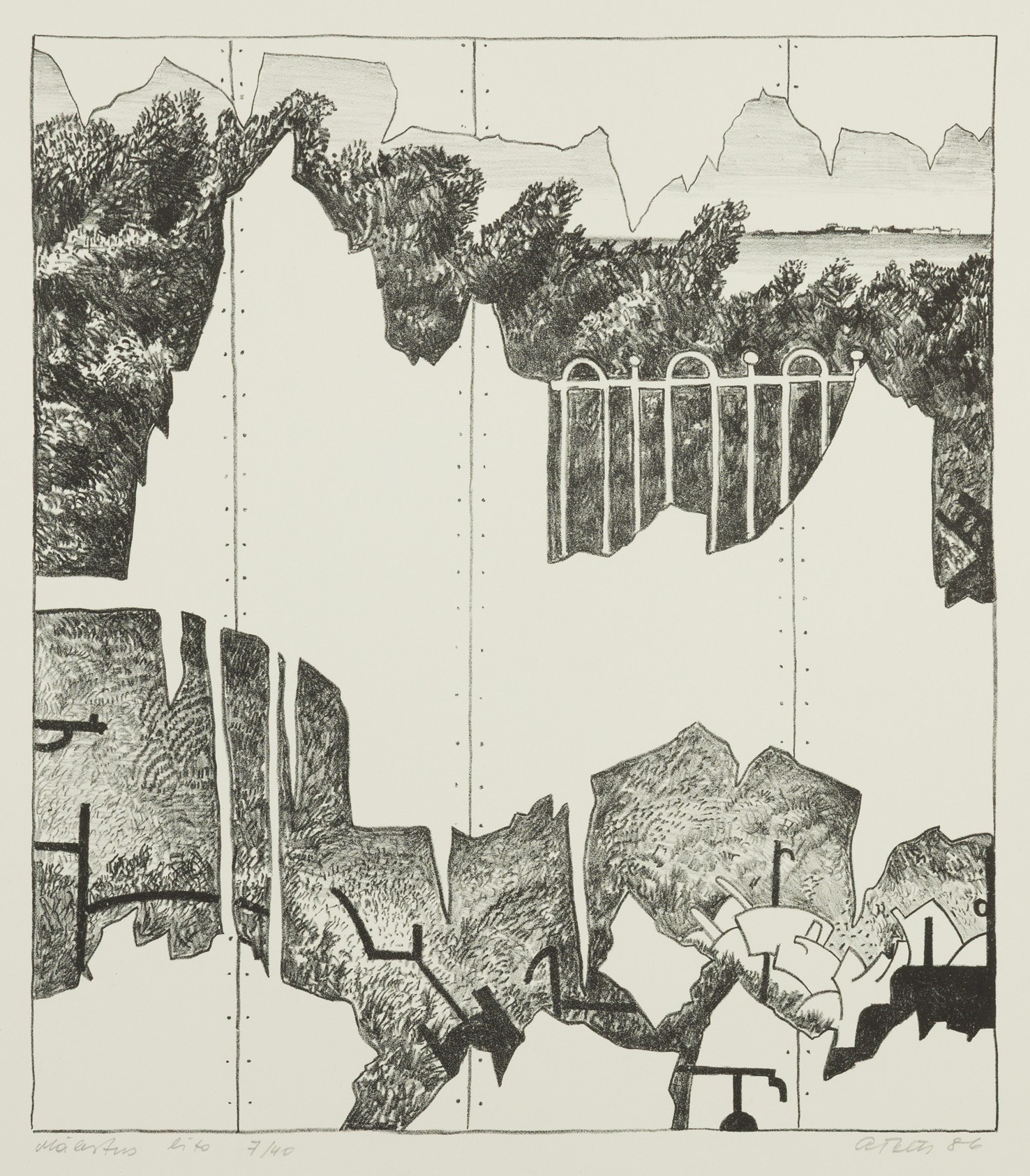
Recollection, 1986. Lithograph on paper, 40 × 35.2 cm (15 3/4 × 13 7/8 in.). Norton and Nancy Dodge Collection of Nonconformist Art from the Soviet Union. D03106
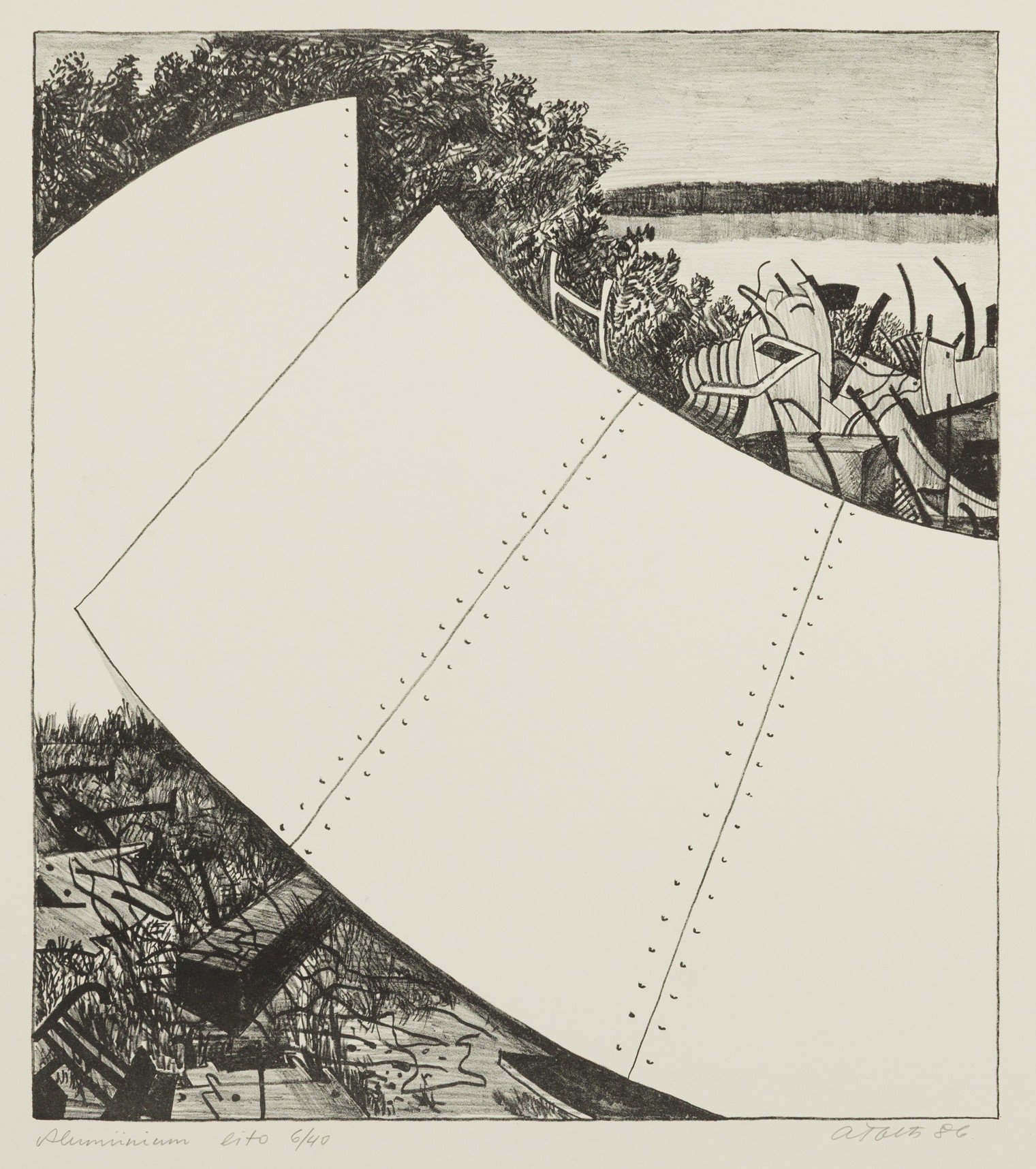
Aluminum, 1986. Lithograph on paper, 40 × 35.7 cm (15 3/4 × 14 1/16 in.). Norton and Nancy Dodge Collection of Nonconformist Art from the Soviet Union. D03703