
Andrei Khlobystin
1961 — Leningrad (USSR). Works in Saint Petersburg (Russia)
Andrei Khlobystin is an artist, art historian, and cultural promoter, whose creative practices are imbued with a syncretism that combines art, theory, curating, archival work, and artistic activism. His work is rooted in the Saint Petersburg tradition where art is inseparable from life, and the “luxury of self-care” is a core value. His projects, texts, and books continue to influence the contemporary Saint Petersburg art scene, preserving the memory of its nonconformist past and exploring the role of the curator in the face of ethical and political challenges.
Khlobystin’s parents were archaeologists, and as a child he liked to add his own illustrations to their scholarly books on archaeology. He often accompanied them on archaeological digs all over Russia, from Central Asia to the Arctic. His interest in drawing did not go unnoticed, and his parents sent him to study in the fine arts studio at the Vyborg Palace of Young Leninists. Continuing along this track, in 1977, he graduated from Primary Art School No. 1 in the Dzerzhinsky district, but then enrolled in the history department at the University of Leningrad, intending to become an archaeologist like his parents. At the university, however, he met several teachers who encouraged his interest in art. One teacher who had a particularly important influence on his life was Ivan Dmitrievich Chechot. [1]
In 1983, Khlobystin defended his graduate thesis in art history and began working concurrently as an art critic at the Manege Central Exhibition Hall, as the divisional head of palaces in Peterhof Lower Park, and as a librarian at the State Hermitage Museum. He also taught art history at Herzen University. Around this time, several enterprising recent graduates of the art history department founded the Leningrad Club of Art Critics, which would play an important role in the conceptualization, description, and exhibition practices of the Saint Petersburg contemporary art scene. [2] The previous school of art criticism was limited by the ideology of socialist realism and simply ignored these issues, which by this time were being openly discussed in the public sphere.
His own work as an artist began in the era of “everything all at once.” The 1980s saw the emergence of the Новые художники (Novye khudozhniki, New Artists) group, which openly disagreed not just with Soviet officialdom, but also with the earlier tactics and aesthetics of Leningrad nonconformism during the 1970s and ’80s. [3] They painted on wallpaper and staged performances in bomb shelters, and their exhibitions resembled bacchanalia in which spectators became active participants. At the time, Khlobystin believed that “stupidity and savagery were the only way to preserve freedom.”
Khlobystin sees art not as the production of objects, but as a mode of existence. This idea hearkens back to the Saint Petersburg tradition of “life-creation,” where the artist dissolves into the creative act, blurring the boundaries between the personal and professional. For example, Khlobystin’s involvement in the famous НЧ/ВЧ (Low-Frequency/High-Frequency) squat in the late 1980s became an exercise in communal living within an art space, where performances, exhibitions, and everyday life merged into a single process. [4] Khlobystin explained this in simple terms: “In Petersburg, there’s a tradition that you make art because it’s a vital necessity, because it’s woven into the very texture of your existence. You are an artist not because you work in some industry or other, producing goods or running a workshop. You are an artist because the whole community sees you as an outcast, because you said goodbye to routine existence.” [5]
Beginning in 1989, he traveled extensively, and he has lived and worked in Paris, France; New York, USA; Mexico City, Mexico; Berlin, Germany; and Vienna, Austria, and rubbed shoulders with many luminaries of contemporary art and popular culture, including John Cage, Nam June Paik, and Donald Judd. He has participated in over a hundred exhibitions around the world. His idea that art isn’t just the production of objects, but a mode of existence, is reflected in his participation in the rave culture of the 1980s, and in his self-fashioning as a cultural arbiter––artist, curator, and event coordinator rolled into one.
By the mid-1990s, however, when “underground” had become a buzzword at art fairs, he changed tack, trading rebellion for archival work. His Petersburg Archive and Library of Independent Art (PAiBNI) is not a collection of dusty folders, but a performance of memory. [6] Here, the manifestos of Timur Novikov’s New Academy can be found alongside photographs of raves and exhibitions becoming séances, where the ghosts of Leningrad nonconformists come to life in clouds of cigarette smoke. Since 1993, he has published––in samizdat form––the magazine Художественная воля [Artistic Will], dedicated to independent art, as well as the newspapers Susanin 2003 and Гений [Genius], which became platforms for his manifestos and critical texts. [7] His artworks from this period, such as Ugly Beauty (2058) (2013), combine painting, collage, and text, reflecting a multidisciplinary approach. His work lies at the intersection of historical reflection, philosophical conceptualization, and experimental form. Of particular significance to him are questions about art’s boundaries and the links between various artistic and non-artistic processes. In studying the development of nonconformism and the problem of the “political” in art, Khlobystin takes a cultural studies approach, and sees parallels between the crises of culture in the early twentieth century and the late 1950s. There is an element of syncretism in his numerous roles as well; he is simultaneously an artist, a curator, an art critic, and a teacher. His magazine Artistic Will became a sounding board for his ideas and an instrument of artistic expression.
His turn from anarchy to cataloguing was criticized by many of his peers. But Khlobystin, it seems, has always played the long game. When Timur Novikov announced the creation of the New Academy of Fine Arts, Khlobystin became its secretary, like a Mercury to Novikov’s Jupiter. [8] Their joint exhibition, Нагота и Модернизм [Nudity and Modernism] (1996), was not a nod to classical art, but its deconstruction: antique torsos were installed among dull residential complexes in Saint Petersburg’s commuter towns, as if to suggest that high art in Russia could only exist as parody. His paintings of this period are a hybrid of icons and graffiti, whose golden underpainting shines through the cracks in the Soviet plaster. As he wrote at the time, “The neo-expressionist youth movement of the Leningrad ‘New Artists’ of the 1980s, and the Petersburg neo-academism of the ’90s that paradoxically grew out of it, represent what sociology and cultural studies have, since the ’70s, called a subculture. These art movements also had their own literature, fashion, cinema, music, publications, and other classic hallmarks of ‘styles’ like surrealism or pop art. ...This Petersburg ‘titanism’ comes from the deep-seated local tradition of the interconnectedness between art and everyday life—you are an artist not because you are involved in the art production industry, but because you are perpetually in a state of high creativity, which, by necessity, allows you to move easily from one form of creativity to another.” [9]
In 1997, Khlobystin published the book Schizorevolution: Essays on Petersburg Culture of the Second Half of the Twentieth Century. [10] This book, which combines the history of unofficial art with personal reminiscences, has become a key source for the study of local artistic practices between 1979 and 1990. Khlobystin ironically analyzes Saint Petersburg culture through the lens of Deleuze and Guattari’s philosophy. His use of the term “schizorevolution” describes the collapse of Soviet ideology in the 1980s and ’90s, while art is presented as a form of resistance to systematization.
The Norton and Nancy Dodge Collection of the Zimmerli Art Museum has six works by Andrei Khlobystin, comprising works on paper and objects made in 1990–91.
Dmitrii Pilikin
Translated from Russian by Philip Redko
Notes:
1. Ivan Chechot (b. 1954) is a Russian art historian, head of the sector of the history and theory of fine arts and architecture at the Russian Institute of Art History, professor at the Smolny Institute of Liberal Arts and Sciences. He was the founder of the Leningrad Club of Art Critics (1986) and the art gallery Navicula Artis (1992).
2. The Leningrad Club of Art Critics was founded in 1986 at the USSR Cultural Foundation by Ivan Chechot, a professor at what was then called the Leningrad State University, along with several recent graduates (Ekaterina Andreeva, Alla Mitrofanova, Olesya Turkina, and Andrei Khlobystin). In 1987, the club hosted a conference devoted to “problems of art and culture in the second half of the twentieth century.”
3. New Artists was an art group that formed in Leningrad in the 1980s. The group’s main interests included primitive art, primitivism more generally, and expressionism.
4. НЧ/ВЧ (LF/HF, the Music and Art Amateur Association “Low Frequencies/High Frequencies,” usually shortened to Club “LF/HF,” or sometimes “LF-HF”) was a club for artists, rock musicians, filmmakers, theater actors and directors, and writers, founded in Saint Petersburg in the autumn of 1986 by Oleg Mikhailovich Sumarokov (Papa OM).
5. Khlobystin, Andrei. “Энциклопедия неофициального искусства. Художник Андрей Хлобыстин о своем фундаментальном труде,” [Encyclopedia of unofficial art: The artist Andrei Khlobystin discusses his major works], interview by Lizaveta Matveeva, Kommersant.ru, May 23, 2018.
6. Andrei Khlobystin founded the Petersburg Archive and Library of Independent Art (PAiBNI) in 1999 at the Pushkinskaya-10 art center.
7. Художественная воля. Журнал [Artistic Will magazine] (1994–98). Garage Museum Archive.
8. As an alternative to institutions offering a nominal education in contemporary art, in 1989 the artist Timur Novikov (1958–2002), founded the New Academy of Fine Arts “with the goal of preserving classical aesthetics in contemporary artistic practice.” To this end, professors from the Academy taught the theory and history of classical art, traditional techniques, and modern technologies with a view to preserving classical academic traditions.
9. Khlobystin, Andrei. “Фотопрактики Новой академии изящных искусств,” [“Photographic practices of the New Academy of Fine Arts”]. In Iskusstvo 4–5, no. 578 (2011).
10. Khlobystin, Andrei. Шизореволюция - очерки петербургской культуры второй половины XX века [Schizorevolution: Essays on Petersburg culture in the second half of the twentieth century]. Saint Petersburg: Borei, 2017.
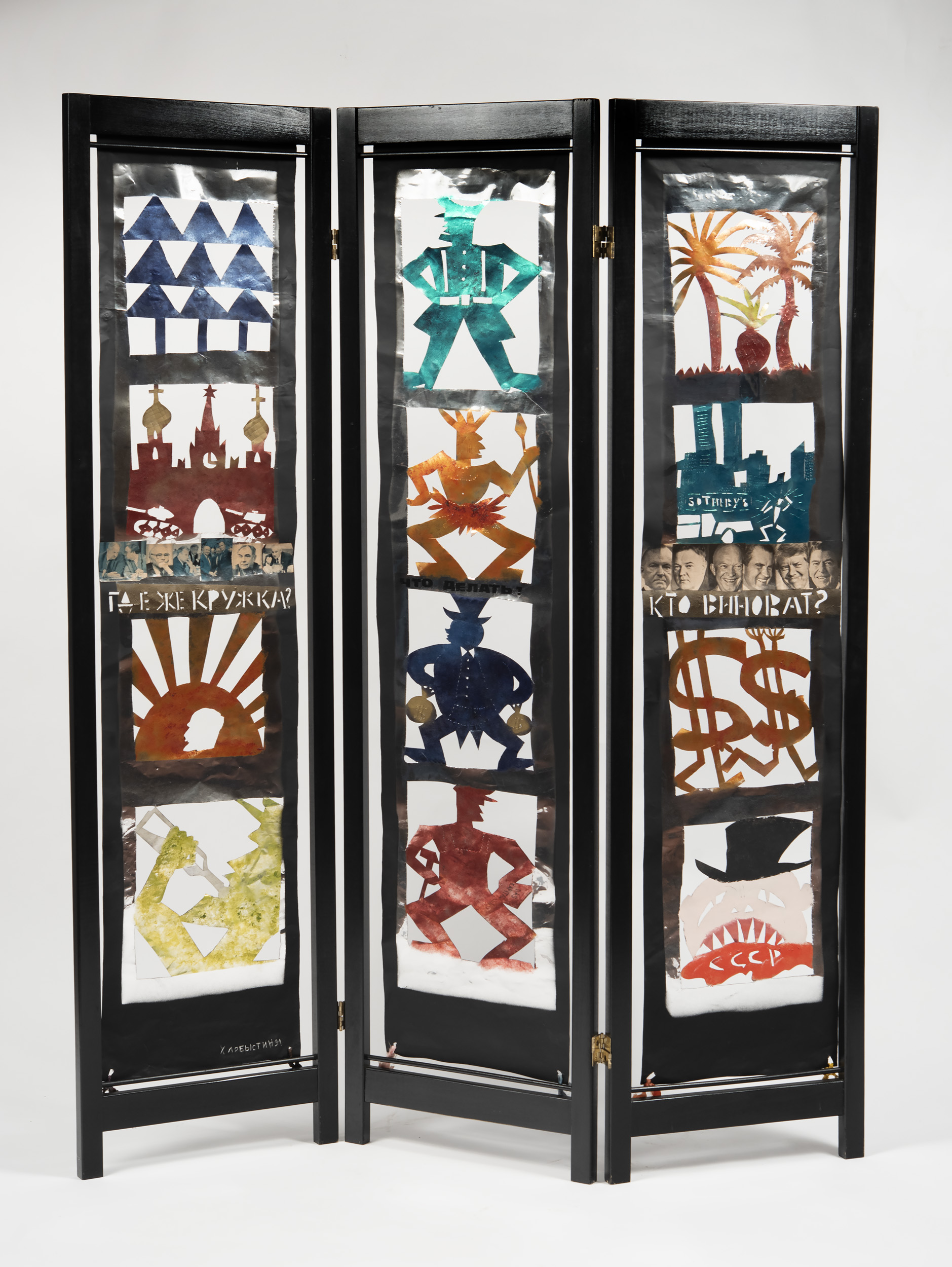
Where is the glass? What is to be done? Who is to blame?, 1991. Acrylic on metallic paper set in three-panel folding screen, 181.5 × 108.5 × 35 cm (71 7/16 × 42 11/16 × 13 3/4 in.). Gift of Vals Osborne and José Moreno-Lacalle. 2017.011.004
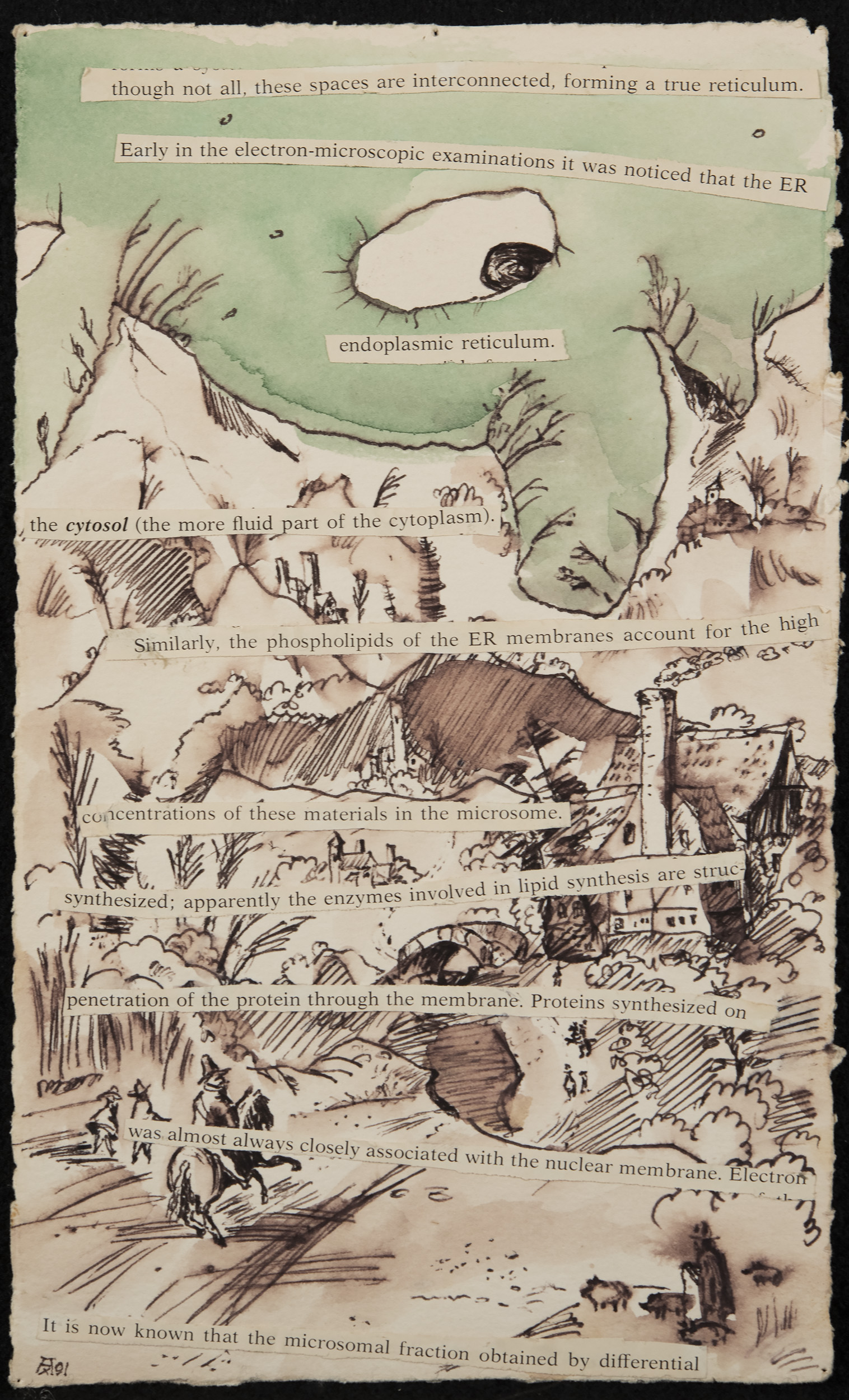
Untitled ("though not all, these spaces are interconnected, forming a true reticulum"), 1991. Pen and ink with ink wash on paper and printed paste-ups, 22.2 × 13.3 cm (8 3/4 × 5 1/4 in.). Gift of Vals Osborne and José Moreno-Lacalle. 2017.011.005
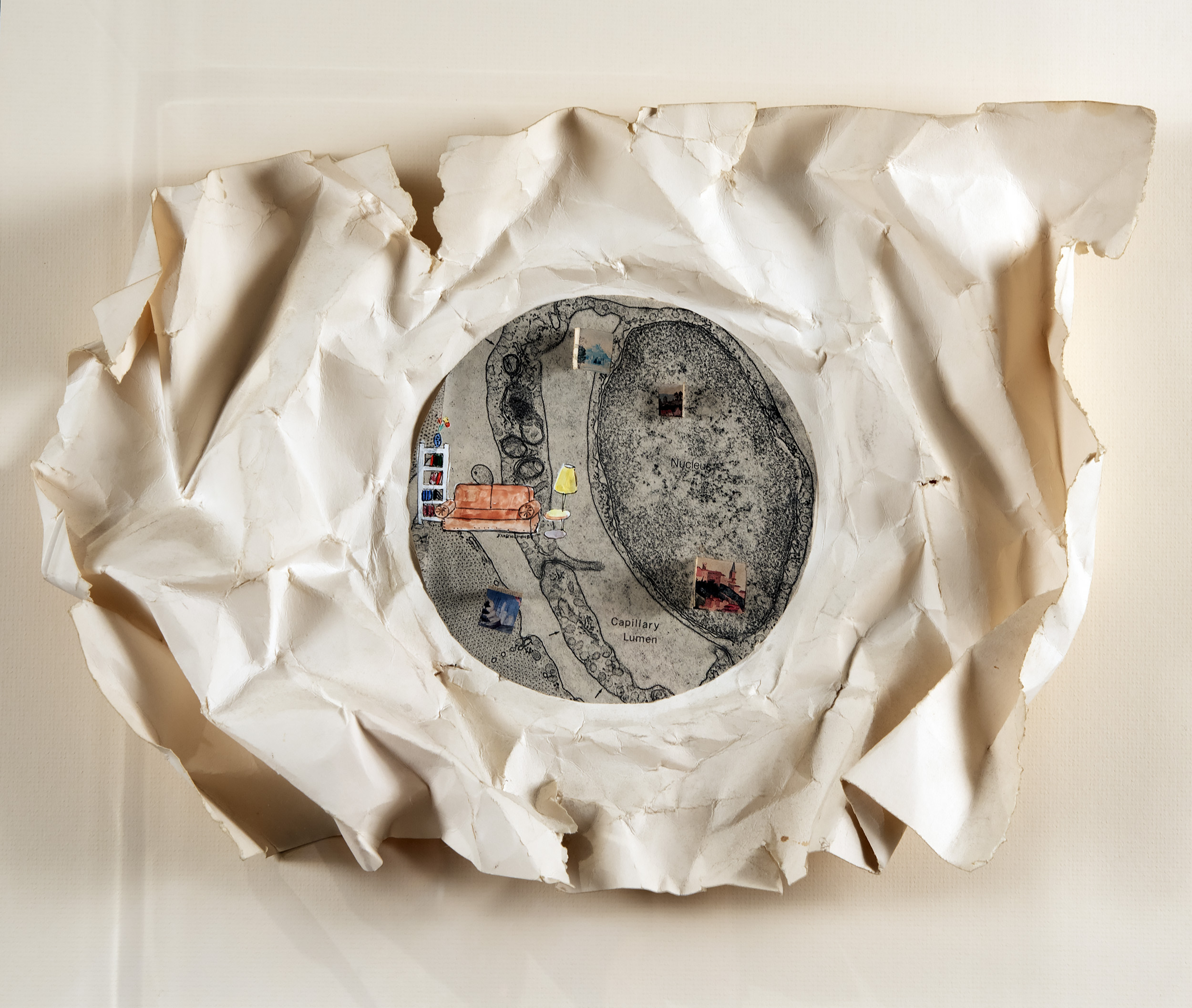
Untitled (windows on a cell), 1991. Mixed media collage with watercolor and print on paper, 49 × 50 × 7.5 cm (19 5/16 × 19 11/16 × 2 15/16 in.). Gift of Vals Osborne and José Moreno-Lacalle. 2017.011.006

Around the Hole, 1990. Mixed media on paper, 122 × 96 cm (48 1/16 × 37 13/16 in.). The Claude and Nina Gruen Collection of Contemporary Russian Art. 2005.0076

No Hope, 1993. Screenprint on paper, 43.2 x 27.9 cm (17 x 11 in.). Norton and Nancy Dodge Collection of Nonconformist Art from the Soviet Union. D20464

No Love, 1993. Screenprint on paper, 43.2 x 28 cm (17 x 11 in.). Norton and Nancy Dodge Collection of Nonconformist Art from the Soviet Union. D20465
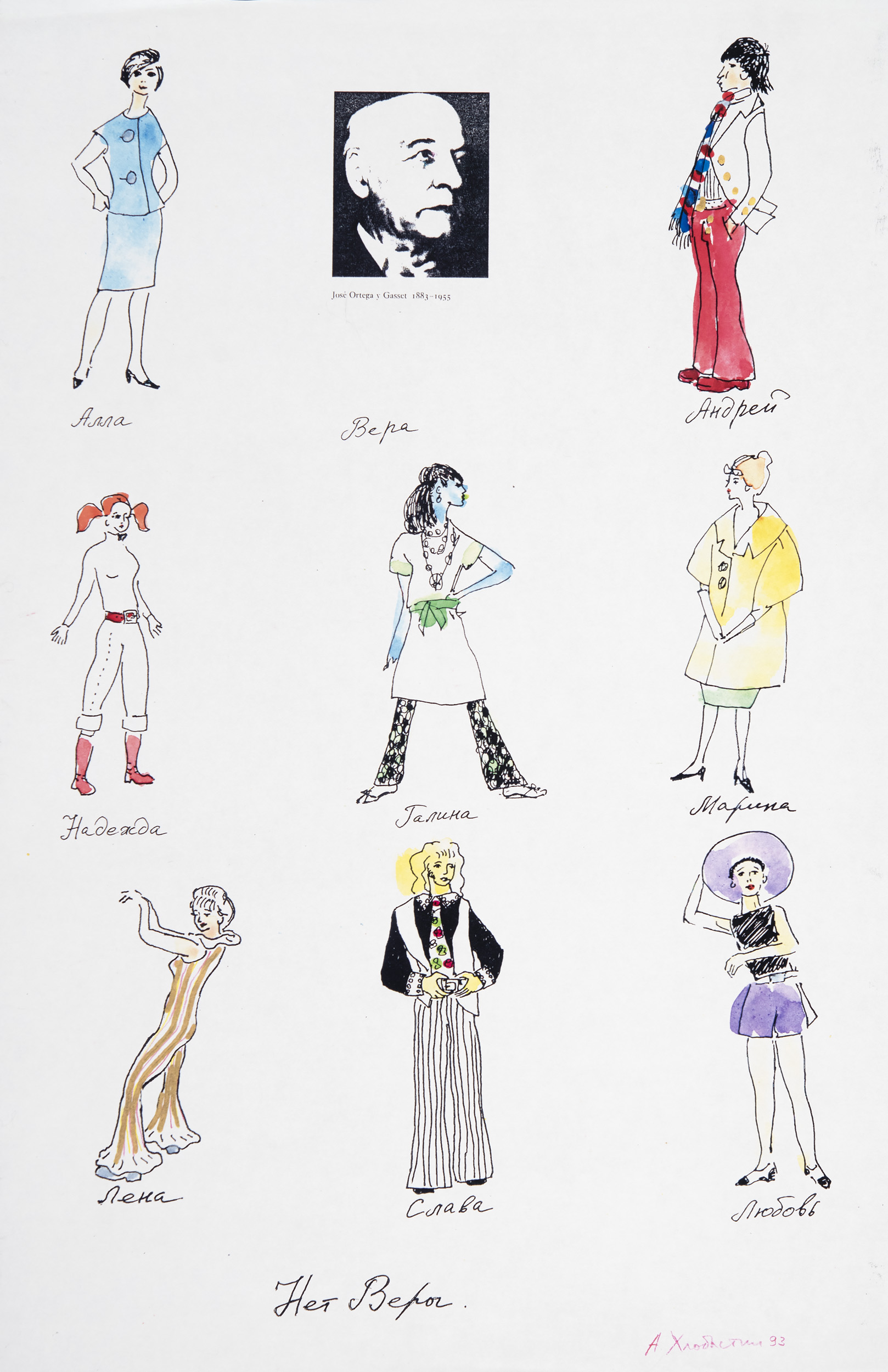
No Faith, 1993. Screenprint on paper, 43.2 x 27.9 cm (17 x 11 in.). Norton and Nancy Dodge Collection of Nonconformist Art from the Soviet Union. D20466