
Alyona Kirtsova
1954 — Spitsbergen (Norway). Lives in Moscow (Russia)
For five decades, Moscow-based artist Alyona Kirtsova has challenged the conventions of mainstream art, exploring the fine line between figurative art and abstraction—in painting, assemblage, collage, print, and installation. Working on art rooted in her personal experience, her memories, and the mindful exploration of the plastic possibilities of painting, Kirtsova has defied the demands of a fast-paced art market in the same way she resisted the strategies of the nonconformist art scene in Moscow in which she first emerged in the 1970s. She has gained the reputation of an accomplished and actively exhibiting actor in the developing contemporary art world in Russia, is friendly with art groups and circles there, yet is steadfastly independent in her art making. The large, silent, austere canvases she paints at present encourage a mindful and deliberate approach to unravel the multitude of references that fed into their wholeness.
Kirtsova was born in 1954 in the far north settlement of Barentsburg, on the archipelago of Spitsbergen. She spent her early childhood in Canada before her family (father a diplomat, mother an international journalist) returned to Moscow, where she has lived ever since. She received her art training in 1973–75 in the informal private school of the renowned nonconformist painter Vasily Sitnikov (1915–1987). While she absorbed his mastery of craft, she deliberately eschewed his stylistic and iconographic influences, forging an independent path. Sitnikov taught her that “a painting is not created in the moment the artist applies paint, but in the moments spent contemplating and thinking about it.” [1]
In 1970s Moscow, Kirtsova was already well versed in contemporary Western art, thanks to her fluent English and frequent visits to the Foreign Literature Library, where she accessed European and American art books and magazines. In her formal language and in her worldview, she belonged more to the historic Russian avant-garde and to the older generation of Russian nonconformists—such as Aleksei Tiapushkin, Marlen Spindler, Mikhail Chernyshov, and others—than to the younger generation of the Moscow Conceptualists. Kirtsova embraced the plastic qualities of paint and the emotional resonance of color and form, committing herself to that path. View from the Balcony (1982, Thomas Krens Collection, USA) distills the landscape into pure geometric planes, establishing a dynamic tension between figuration and abstraction and marking her decisive turn toward a distinct painterly sensibility.
Kirtsova transformed the shapes of architecture in Moscow into purified geometries of refined color planes, as seen in Night Walks: Me—You (Part I, II, III, 1988, State Tretyakov Gallery, Moscow). Simultaneously, she began experimenting with assemblages, creating a series of works titled Boxes and Treasure Boxes—compositions made of found materials, such as broken wine bottles, pieces of wood, stones, etc. Their “poor” aesthetics reference both the Russian avant-garde, particularly Vladimir Tatlin, and arte povera, yet they stand essentially as late-Soviet nonconformist pieces. The curator of one of her first solo exhibitions, Alexander Borovsky, observed: “Kirtsova remains unwavering in her central pursuit—the universal response of color within the context of a profoundly focused, purified artistic consciousness that has fully reflected upon its priorities.” [2]
Kirtsova’s figurative ambiguity and her rigorous exploration of painting’s elemental language aligned with the European transavantgarde movement, championed by Harald Szeemann and Achille Bonito Oliva at the 1980 Venice Biennale, which signaled painting’s resurgence onto the global stage. The latter was a visitor to Kirtsova’s studio in Moscow in 1990s.
By the late 1980s, Kirtsova had gained a reputation as an “artist’s artist” who was widely respected among her peers for her practice. She was a cofounder of one of the first contemporary art institutions to emerge in the wake of perestroika, the Hermitage Association (1986). In the 1990s, Kirtsova expanded her painterly vocabulary, incorporating use of the palette knife to create richly textured surfaces that became focal points of her work. During this period, extensive travels exposed her to new art museums and landscapes, deepening her engagement with color and material. Her works of that time, such as The Cloud (1995), displayed her appreciation of the sophisticated color harmonies of the old masters, at the same time that her color palette was tempered by her interest in natural pigments that retain memories of place, situation, and experience. Another example is The Second Wall (1995). In the catalogue for one of her solo exhibitions at the Russian Museum (Saint Petersburg), Michael Govan observed: “This abstract luminescent effect of Kirtsova's oil paintings, sculptures of prismatically arranged shards of old glass, and meticulously rendered drawings is important not only for the pure visual pleasure it inspires, but also, in metaphorical terms, for the fleeting sense of life it allows.” [3] Her exploration of color’s emotional resonance reached a new dimension in her commissioned wall painting installation for the Mikhail Vrubel retrospective at the Kunsthalle Düsseldorf (1997), where she created subdued tonal fields that heightened the radical chromaticism of the early modernist master. This approach extended to her own practice, transforming her solo exhibitions into immersive installations, with paintings at times extending beyond the canvas and directly onto the gallery walls. One of Kirtsova’s notable public commissions is a large mural at the Krasnoyarsk Art Museum in Siberia, which transformed the museum lobby by visually expanding its spatial dynamics. Through painterly planes of classical landscape distilled into pure geometry, the work creates a striking three-dimensional effect.
Vasily Rakitin, surveying the artist’s oeuvre, wrote: “Kirtsova seeks a balance between the ideal representation of the object (painting, relief, sheet) and the immediate impression. To make a self-contained structure architectonically precise is not easy. Nor is easy to translate and dissolve a real landscape into a color field. Or to find one’s own light and one’s own air. To move from the general to the personal. Toward one’s clarity and silence. Toward a saturated, concentrated simplicity of form—detached, yet alive. Some might suspect—is this all minimalism? No. Not minimalism as a particular set of devices and a style. It has long been present as a kind of background in the whirl of changing artistic fashions. With Kirtsova, it is an aspiration to overcome and organize chaos, to discipline the eye.” [4]
Kirtsova’s paintings unfold at a slow pace, inviting a contemplative mode of perception. Their integrity emerges through a delicate equilibrium of sensory richness tempered by an acute observation of nature. Engaging the imagination of the discerning viewer, they conjure a plethora of references through the sophisticated orchestration of color, light, and the subtle vibrancy of the painted surface. Rooted in the artist’s personal experience, these works transcend mere representation, becoming meditative encounters in themselves—silent, deliberate, and immersive.
Elena Zaytseva
Photo portrait: Alyona Kirtsova in the studio, 2014. Photo by Yuri Avvakumov.
Notes:
1. Alyona Kirtsova, interview to Evgenia Kikodze, in DI: Dialogi Iskusstv [Dialogues of the Arts] no. 1 (2011).
2. Alexander Borovsky, “Somnambulistic Abstraction of Alyona Kirtsova.” In Alyona Kirtsova, catalogue of exhibition. (Saint-Petersburg, State Russian Museum, 1994): [n.p.]
3. Michael Govan, “Art into (and out of) Life: The Art of Alyona Kirtsova.” In Alyona Kirtsova, catalogue of exhibition (Saint Petersburg: State Russian Museum, 1994): [n.p.]
4. Vasilii Rakitin, “Iskusstvo konspiratsii” [The Art of Secrecy] in Alyona Kirtsova: Pigment, Kraska, Tsvet [Alyona Kirtsova: Pigment, Paint, Color] (Moscow: Meier, 2025): 12.
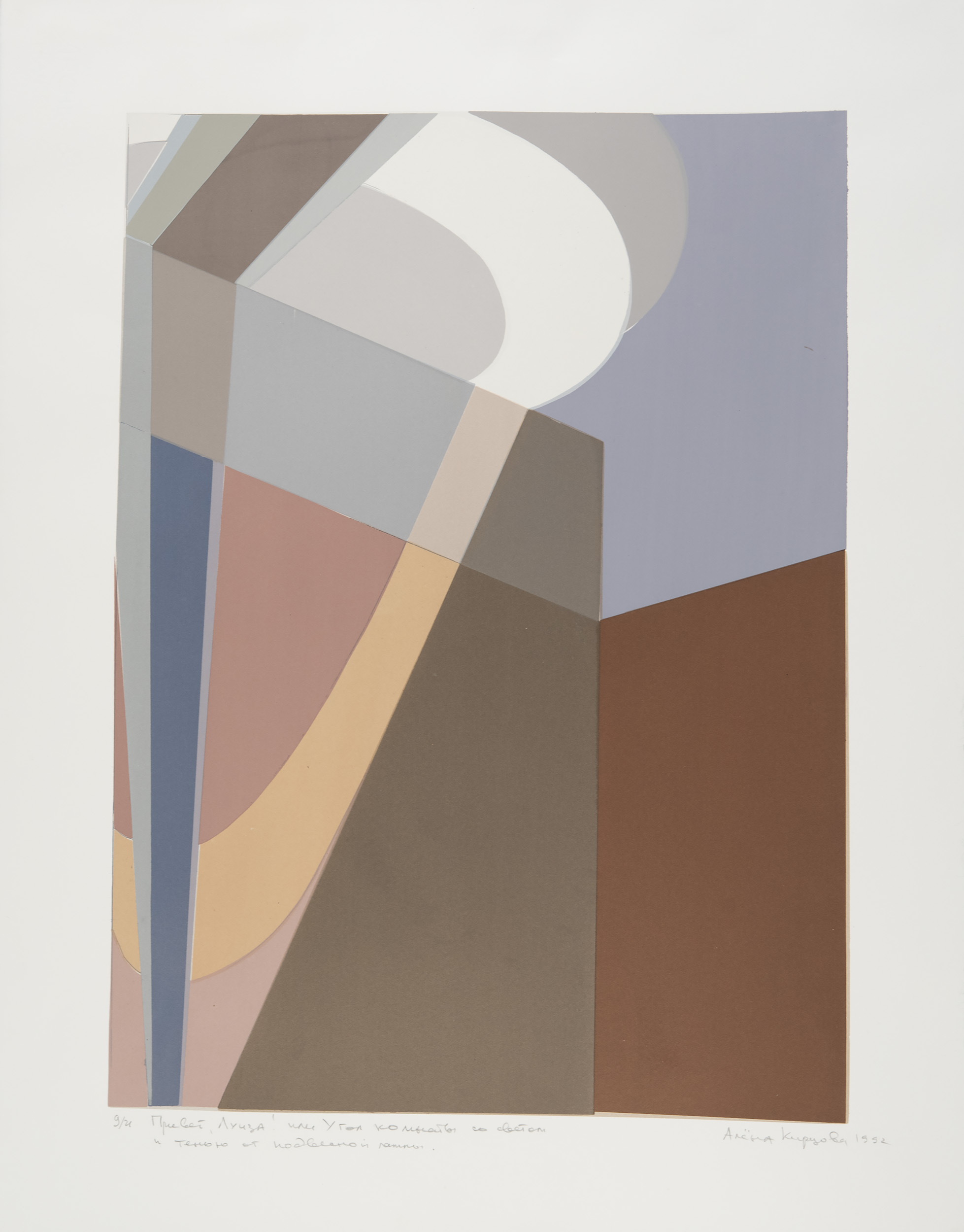
Hi, Louise, or the Corner of the Room with Light and Shadow from a Pendant Lamp, 1992. Color screenprint, 58.8 × 43 cm (23 1/8 × 16 15/16 in.) / 73.5 × 57 cm (28 15/16 × 22 7/16 in.). Gift of Dianne Beal and Paul Blue. 2020.010.020