
Alexander Manusov
1947 — Omsk (Russia) | 1990 — Leningrad (now Saint Petersburg, Russia)
Worked in Leningrad (now Saint Petersburg, Russia)
Alexander Manusov, a painter and graphic artist, was born in Siberia, where his mother was evacuated to during World War II. In 1957, the family returned to Leningrad. From early childhood, Manusov enjoyed drawing, and when he was older, he took classes at a Palace of Young Pioneers art studio with Solomon Levin, a well-known teacher and follower of the new French painting, who nurtured several generations of artists. Manusov studied at Secondary School no. 190, which had special classes in drawing and painting, and also attended an evening art school from 1964 to 1966. Subsequently, he entered the department of artistic design of industrial machinery and transport facilities at the Vera Mukhina Higher School of Art and Industry (now Stieglitz State Academy of Art and Design). He graduated in 1972 and began to work as a design artist.
It was at this time that Manusov became acquainted with nonconformist artists of the previous generation, whose personal examples (such as that of Alexander Arefiev and other members of the Arefiev circle) had a great influence on the painter’s choices in life and art, which, in the Soviet context, had obvious political significance and consequences. Manusov became associated with the unofficial art movement, and in 1974, he participated in the first authorized exhibit of Leningrad’s nonconformist artists at the Ivan Gaza Palace of Culture. In his early work, Manusov sought to synthesize the artistic discoveries of the various groups and movements that interested him, whose lessons he actively assimilated, including the influential school of Osip Sidlin and the followers of Vladimir Sterligov. Focusing on resolving formal problems in painting became, for Manusov, a refuge from the ideological pressures of the Soviet age and served as his main means of individual artistic expression.
In 1976, Manusov became part of the Jewish artists’ group Alef, participating in several apartment exhibitions in 1976 and 1977, prior to the emigration of the group’s main members. In 1981, he began actively taking part in the activities of TEII (Fellowship for Experimental Fine Art, an independent association of nonconformist artists, active in Leningrad during the years 1981–91). Manusov suffered from a congenital heart defect, and in 1983, he underwent surgery. For the rest of his life, he worked continuously, recognizing the inevitable brevity of the time allotted to him.
The works of Manusov’s early period demonstrate an involvement with the art of Pavel Filonov (1883–1941) and Viktor Boris-Musatov (1870–1905) in equal measure. The combination of the analytic and poetic approaches in art reflected Manusov’s personality and became an important theme throughout his entire body of work; to address this theme, he turns to the art of the past. Generally, Manusov’s art was formed, on the one hand, through contact with the world art represented in the State Hermitage Museum collection, and, on the other, with the practices of his nonconformist contemporaries. He himself described his art as a “path to understanding nature in connection with the work of the masters of world culture.” [1] His search for a “harmonious connection of all that exists,” [2] which he affirmed in his diaries, found expression in special attention to music. Bach, Vivaldi, and Schoenberg were important figures for the artist, who drew parallels between his painting and music: “My painting is a language of artistic plasticity and the unified colored fabric of the plane, just like music, which is perceived by a person directly.” [3]
Manusov’s early period is represented by his work from the 1970s to the mid-1980s. His mature period, which lasted until the artist’s untimely death, may be divided into three stages, each of which is characterized by its own coloristic emphasis—the dark stage (1986–87), the blue stage (1987–88), and the final, yellow stage (1988–90). Manusov’s painting is limited to a narrow range of themes and subjects; the space and particulars in his works are incidental and subordinate to the main theme, which may be defined as the “life of color.”
Manusov’s principal genre is landscape. Прогулка [Walk] is not only the title of a large number of his works (ex., D17071), but also a generic characteristic: as a rule, several figures in a natural setting are immersed in a color-saturated environment. The semantic center of many compositions is a tree, which divides the represented space and at the same time unifies it. The artist aims for a serious stylistic and conceptual generalization: his works are grounded in observation, but the resulting painting is not defined by the real-life prototype. The depth and volume of pure color, emancipated from objects, serve to express emotions directly. Spatial solutions are defined by the horizon line and the sequence of interconnected spatial planes in the paintings, which are distinguished by their chromatic intensity. As a result, every depicted landscape acquires a heightened symbolic meaning. Most of Manusov’s paintings are connected with biblical subjects and represent their universal interpretations.
In paintings from Manusov’s mature period, the material distinction between studies and paintings becomes insignificant; often, the artist makes use of the triptych format. The picture plane is understood by him as the location of a painterly event and evaluated from this viewpoint. Manusov’s art moves toward objectlessness, but—as with the horizon line—never reaches it. Among the artists of the Saint Petersburg art scene of the 1970s–90s, Manusov remains one of the most subtle and gifted colorists.
Pavel Gerasimenko
Translated from Russian by Ilya Bernstein
Photo portrait: Alexander Manusov, 1990. Photo by Lev Berman.
Notes:
1. Alexander Manusov: Zhivopis'. Grafika [Painting, graphic art]. Saint Petersburg: NP Print, 2001: 27.
2. Ibid., p. 27.
3. Ibid., p. 29.

Sunset, 1986. Oil on linen, 70.5 x 100.5 cm (27 3/4 x 39 9/16 in.). Gift of Barbara J. Hazard. 1994.0070

Family in the Garden, 1975. Oil on canvas, 71 × 101 cm (27 15/16 × 39 3/4 in.). Norton and Nancy Dodge Collection of Nonconformist Art from the Soviet Union. D12908
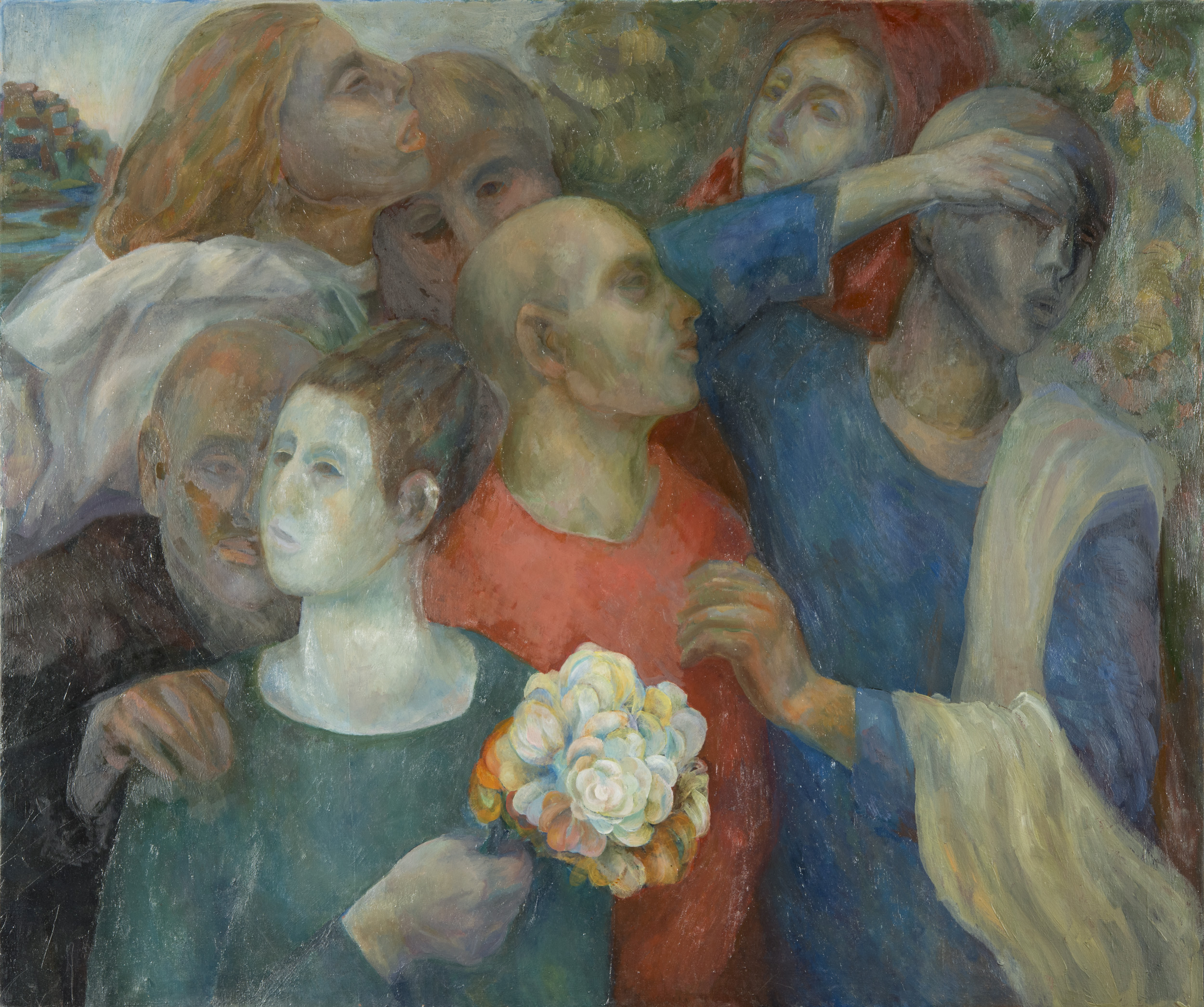
Walk, 1976. Oil on canvas, 92 × 109.5 cm (36 1/4 × 43 1/8 in.). Norton and Nancy Dodge Collection of Nonconformist Art from the Soviet Union. D17071
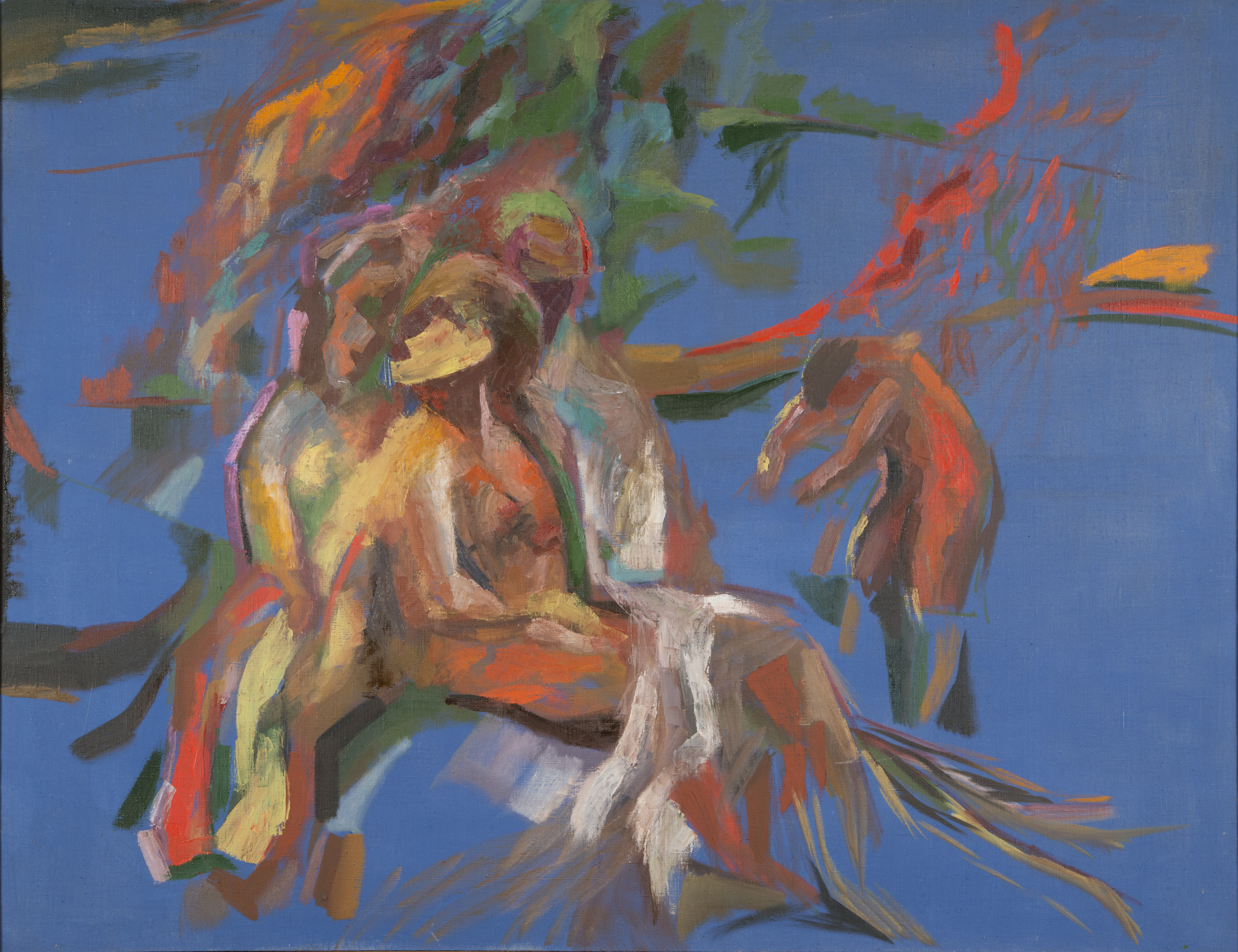
Women Swimming, 1986. Oil on linen, 117 × 150 cm (46 1/16 × 59 1/16 in.). Norton and Nancy Dodge Collection of Nonconformist Art from the Soviet Union. D21758