
Aivar Taziev
1955 — Zhezkazgan (Kazakhstan). Currently works in Almaty (Kazakhstan)
Aivar Taziev is a painter, graphic artist, and set designer. Over the course of his career, he has experimented with cubism, surrealism, and abstraction, and used a variety of approaches to conceptualize reality. Taziev’s creative method is an organic synthesis of technology and free-flowing imagination, which the artist himself has termed “metaphysical synthetism.” This style, which was first developed by the world-renowned artist Mihail Chemiakin and his Leningrad circle, has become bolder and more prominent today as a result of the development of this creative direction and its ever-deepening investigation by other artists. As noted by art critic Oksana Tanskaia, “his techniques include traditional painting and relief, airbrushing and appliqué, while his wealth of imagery alludes to a variety of religions and cosmogonic ideas.” [1] His paintings include elements of collage; images from reality are introduced into an imaginary mystical space, and abstract symbols interact with real-world objects. Taziev’s work combines philosophy with symbolic and sacred principles. According to art critic A. Dzhadaybayev, Taziev’s art is interesting for its ability to “create a unique aesthetic environment with its own specific system of images, where universal concepts are perceived through the prism of subjectivity.” [2]
Taziev was born in Zhezkazgan in 1955. In 1975, he graduated from the scenography department of the N. V. Gogol Art School in Alma-Ata. After defending his graduation project—a set design for Shakespeare’s King Lear—he was drafted into the Soviet army. Upon completion of his military service, Taziev quickly became a fixture of Alma-Ata’s art scene. At first he worked as a designer at the Directorate of Parks; later, he was accepted into Sergei Dikansky’s mock-up design studio at SoyuzGiproSvodStroy. Concurrently, he fulfilled printing commissions for various publishing houses, as well as for the Chamber of Commerce. Taziev’s professional training was put to use when he began working with the director Kuzbol Karimbayev, who founded the avant-garde (by the standards of that era) Art Theater of Plastic Play, whose performances were held in the building of the Baspager publishing house in Alma-Ata. The theater staged unique productions of Samuel Beckett’s Waiting for Godot, Andrei Platonov’s The Foundation Pit, and Peter Weiss’s The Investigation, which was performed in Kazakh, Russian, and German at the Mukhtar Auezov Kazakh National Drama Theater.
Despite this large variety of creative interests, Taziev continued to paint and considered that medium to be his primary calling. Greedily absorbing every drop of information about Western contemporary art that seeped through the Iron Curtain, he grew into an independent artist with an original bent of mind. Though he knew that in life, compromise was inevitable, Taziev categorically refused to compromise in his art, believing that conformist art was meaningless. The first exhibition in which he took part was held at the apartment of the now-famous director Rashid Nugmanov, and had a conspiratorial air of dissent.
His first solo exhibition was held in the early 1980s at the Poligrafist House of Culture, thanks to the courage of the club’s leadership. The reviews were mixed; the mildest of them accused Taziev of being apolitical. He subsequently participated in a number of underground exhibitions, all of which were officially illegal, since they had not been sanctioned by the Artists’ Union. Taziev’s relationship with this organization was based on mutual disregard. The State Security Committee, which vigilantly controlled art and culture, received a denunciation against Taziev that accused him of noncompliance with the ideological canons; this resulted in a number of difficult experiences for the artist. [3]
In the late 1980s, slides of Taziev’s paintings ended up in the hands of Georgy Mikhailov (1944–2014), a Leningrad collector, patron of the arts, and dissident. Although many artists were banned from exhibiting in the 1970s and ’80s, Mikhailov, a former physicist with a passion for art, collected paintings by these banned artists and exhibited them in his apartment, later opening the Foundation for Free Contemporary Russian Art in Munich. It was in Munich that Taziev had his first international exhibition. The artist’s first serious international showing was at the foundation’s exhibition in Paris, which was held in the UNESCO building in 1990. The exhibition was met with highly positive reviews, and Taziev’s works were singled out for praise. The foundation subsequently held a series of exhibitions in various cities across the Soviet Union, a difficult undertaking that also involved a great deal of risk. For his activities, Mikhailov had already served out a prison sentence in Kolyma. Thanks to the foundation, Taziev’s works made their way around half the globe.
With the collapse of the USSR, the persecution of unofficial artists ceased, and their lives took a strange turn. A new generation of connoisseurs and collectors built up a local equivalent of the Western art scene. By this time, Taziev had already risen to fame as a dissident and surrealist, because it was surrealism that had opened his eyes to the multilayered nature of reality. Following Taziev’s success abroad, success came to him in Alma-Ata as well. The early 1990s saw the opening of the OKO private gallery, a museum dedicated to Taziev in his lifetime. This period was marked by his discovery of a personal and instantly recognizable artistic language.
At the heart of his creative approach lay a fascination with the subconscious, which manifested itself in fantasies, dreams, and intuitive insights. His experimentation led him to combine biblical and mythological images, motifs from medieval mystery plays, and fantastical and real-life objects. In many of his works, Taziev makes use of painted optical effects, achieving photographic accuracy in paradoxical combination with fantastical subject matter. There is also a strong emphasis on the interplay between the forms of objects and figures, and the space of the painting. Taziev’s work is characterized by its close attention to detail and to the rendering of textures. His mastery of technique allows him to achieve an effect of realistic illusion in his depiction of objects on the picture plane. At times, the artist begins to feel hemmed in by the picture plane, at which point he supplements his paintings with three-dimensional elements, such as the collage-like texture of fabric (Антропометрия [Anthropometry], 1993, Kasteyev State Art Museum), or a piece of rope representing the reins of horse held by a rider (Открытие луны [Discovery of the Moon], 1996, Kasteyev State Art Museum). Naturally, his paintings always contain elements of theatricality, since this had been the artist’s original area of expertise.
Taziev’s paintings often feature symbols of Christian faith, expressing his own desire for perfection and his striving after the divine principle (Пасха [Easter, 1997]). Often, the artist attempts to depict fantastical phenomena or visions produced by his imagination using the style of academic painting, something that can also be observed in other surrealists and metaphysical painters, such as Salvador Dalí, Paul Delvaux, and Giorgio de Chirico. The figure of the female nude frequently appears in his work; the artist considers the female nude to be “the limit of perfection from an aesthetic point of view,” one that will always remain an object of admiration. [4] In his works, the female body is often subjected to mysterious and frightening metamorphoses; his female nudes emerge gradually from—and simultaneously dissolve into—the surrounding space. In torsos frozen in ice (Холодный огонь [Cold fire, 2009]) or turning into gold (Прикосновение Мидаса [Midas’s touch, 2009]), the artist seeks to record the stages of an object’s transformation in response to external factors. Here, contrast is everything: a living body is submerged in a lifeless environment, heat comes into contact with cold, and the softness and roundness of corporeal forms contrast with the broken planes of the background. These intersections give rise to a hidden internal conflict that verges on the absurd. Sometimes, in random signs—cracks in a wall or interwoven branches—he finds secret messages, pregnant with meaning, which he takes as a kind of key, a code that is both intentional and fateful (Ориентир Омега [Landmark Omega, 2002]; Ориентир Z [Landmark Z, 2002]). With his heightened perceptions and intuition, the artist becomes a kind of transponder capable of picking up encrypted meanings that are hidden from the profane gaze.
Taziev is also a passionate hobbyist-armorer, manufacturing replicas and sometimes restoring antique munitions as well. For many years, he has been reconstructing medieval helmets, chain mail, crossbows, and coats of arms in his workshop, using techniques that have been preserved for hundreds of years. Often these objects are organically incorporated into his paintings and drawings.
As Lyudmila Yastrebova wrote about Taziev’s work: “It begins with an irrevocable immersion in a unique space, a distinctive hypnotic atmosphere. … By surrendering to the unstoppable flow of feelings, you soon find yourself in an immense ocean of life and death, darkness and light, in the presence of an enigma and of mystical sounds.” [5] Taziev himself expressed it on a grander scale: “In the beginning was the word. The word was spoken and everything was given a name. From that moment onward, our existence became abstractly conventional. Even as children we know up from down, light from darkness. But we only think that we know these things. Those who were born before us would explain them to us. From time to time the individual is enlightened, and he makes adjustments. But whatever adjustments he makes, they are just more stones added to the unfinished pyramid of truth—the pyramid of our reality, which is ninety percent created by our squalid imagination and learning.” [6]
Taziev is the foremost Kazakh artist working in a surrealist vein. “In his canvases, he often creates images of a world that is unthinkable, impossible in reality. Taziev’s unique style of surrealism usually takes the form of a pronounced desire to reproduce objects with the accuracy of an illusion, whether it be imaginary (Плащаница в саду [Shroud in the garden, 2004]) or almost real (Античный этюд [Ancient study, 2004]). Thanks to these realistically depicted objects, the viewer's gaze is magnetically drawn into a convincingly constructed surrealist space, pervaded by fantastical absurdism, illogic, paradox, and visual instability. Taziev uses special artistic techniques in order to entice the viewer into a labyrinth of insoluble riddles, whose meanings not everyone can piece together.” [7]
Since 1979, the artist has held more than forty solo exhibitions in Kazakhstan and abroad. He has taken part in exhibitions in the CIS countries, France, Germany, the United States, Australia, Liechtenstein, England, and the Netherlands.
Ekaterina Reznikova
Translated from Russian by Philip Redko
Notes:
1. Tanskaia, Oksana. “Ayvar Taziev” in Zhivopis’ Kazakhstana [The painting of Kazakhstan], vol. 2. Almaty: Tau-Kainar, 2016: 228–31.
2. Wall text mounted for the exhibition ОКО [Eye] at Kasteyev State Museum of Arts, 2003.
3. Aivar Taziev, Autobiography
4. Goncharova, Anna. “Chego khochet zhenshchina. Interv’iu s A. Tazievym.” In Ekspress-K 65 (April 16, 2010).
5. Yastrebova, Liudmila. “Aivar Taziev.” In Kazakhstansko-rossiiskaia gazeta 2 (February 1995).
6. Yastrebova, “Aivar Taziev.”
7. Tanskaia, “Ayvar Taziev.”
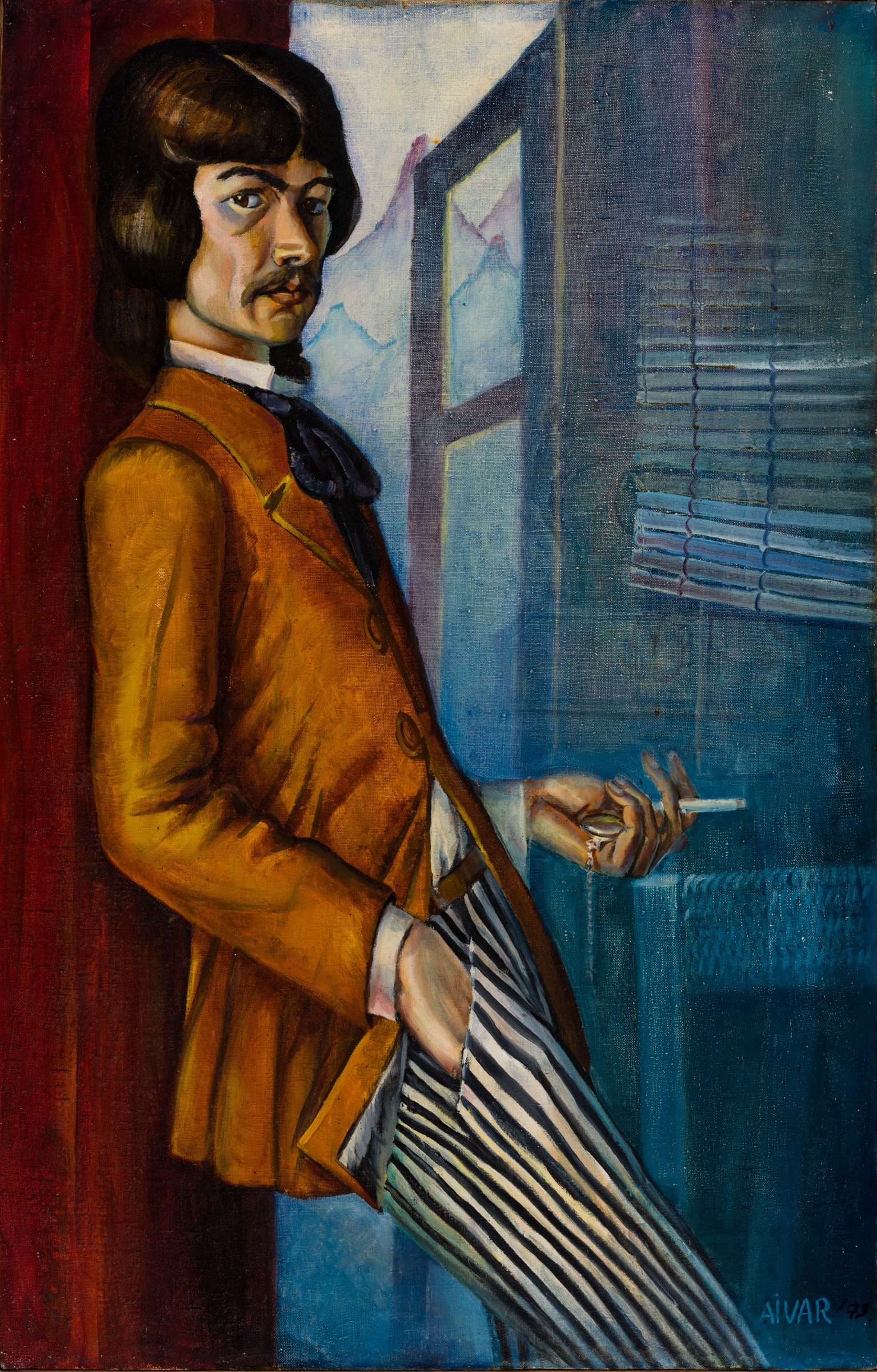
Self-Portrait, 1973. Oil on canvas, 101 x 65 cm (39 3/4 x 25 9/16 in.). Purchased with funds donated by Norton Dodge and Nancy Dodge. 2001.0119
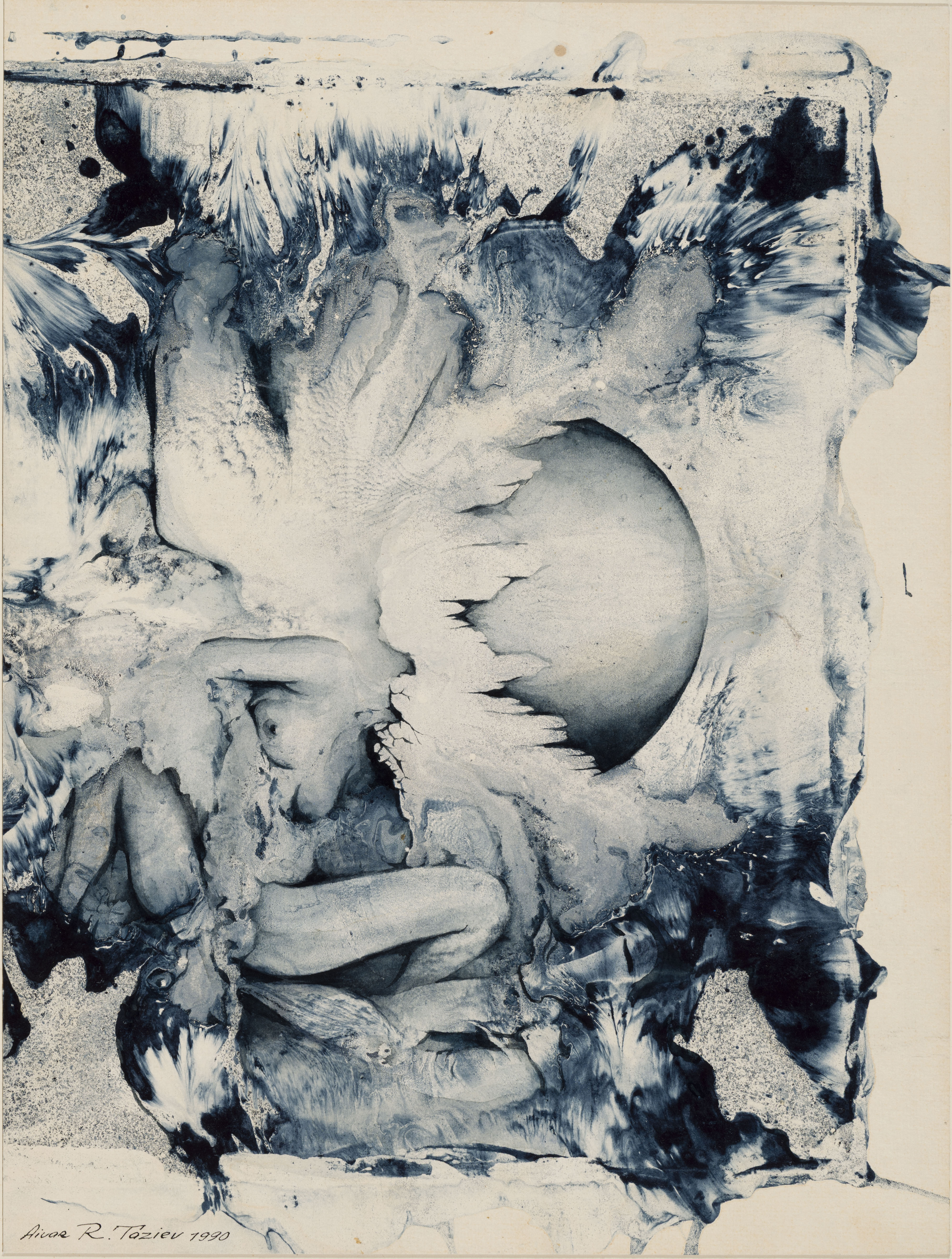
Untitled, 1990. Ink on paper, 39 × 29.5 cm (15 3/8 × 11 5/8 in.). Purchased with funds donated by Norton Dodge and Nancy Dodge. 2000.0779
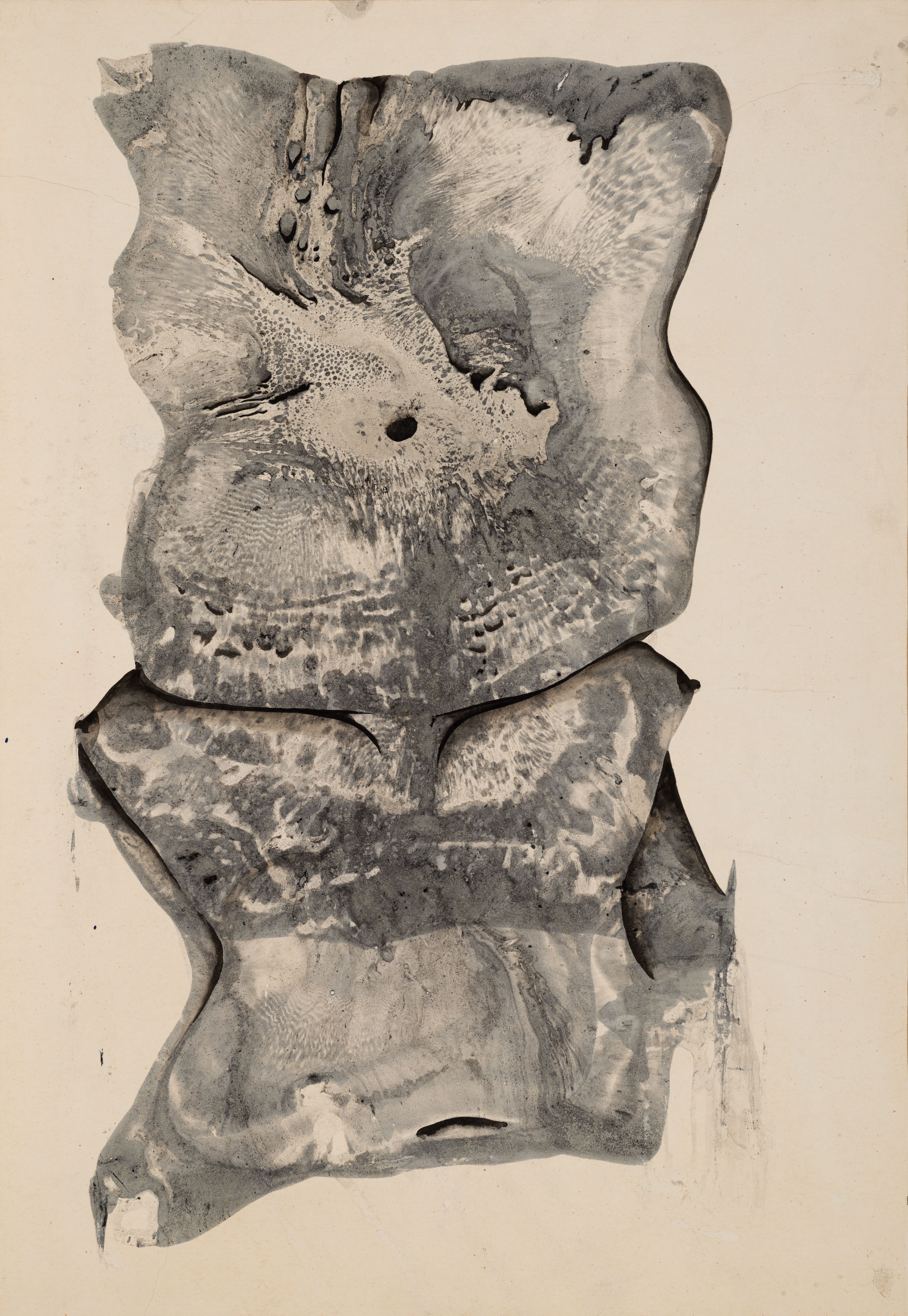
Untitled, c. 1990. Ink on paper, 59 × 42.8 cm (23 1/4 × 16 7/8 in.). Purchased with funds donated by Norton Dodge and Nancy Dodge. 2000.0780
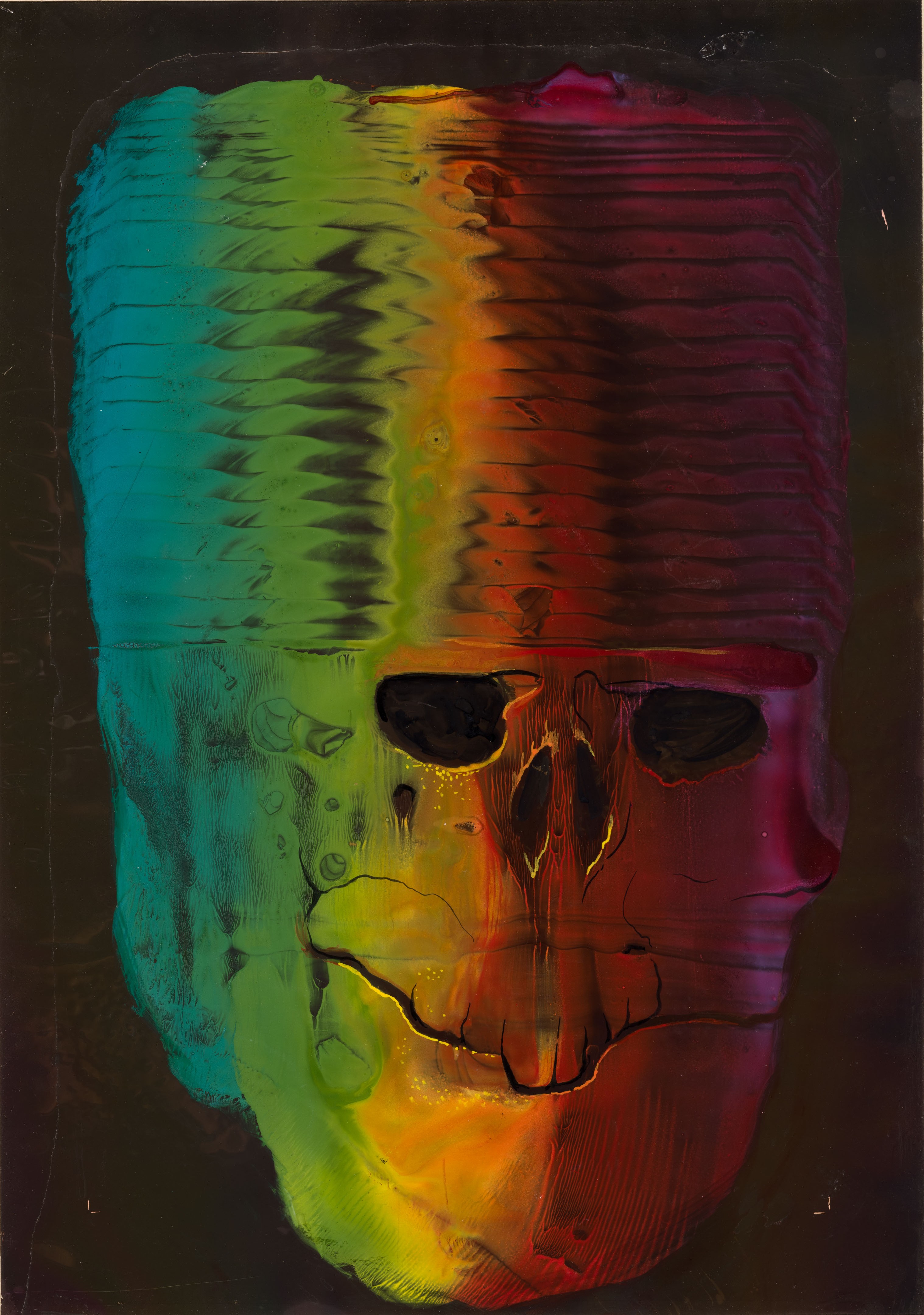
Untitled, c. 1987. Gouache on film, 59.7 x 44 cm (23 1/2 x 17 5/16 in.). Gift of the artist. 2000.0781
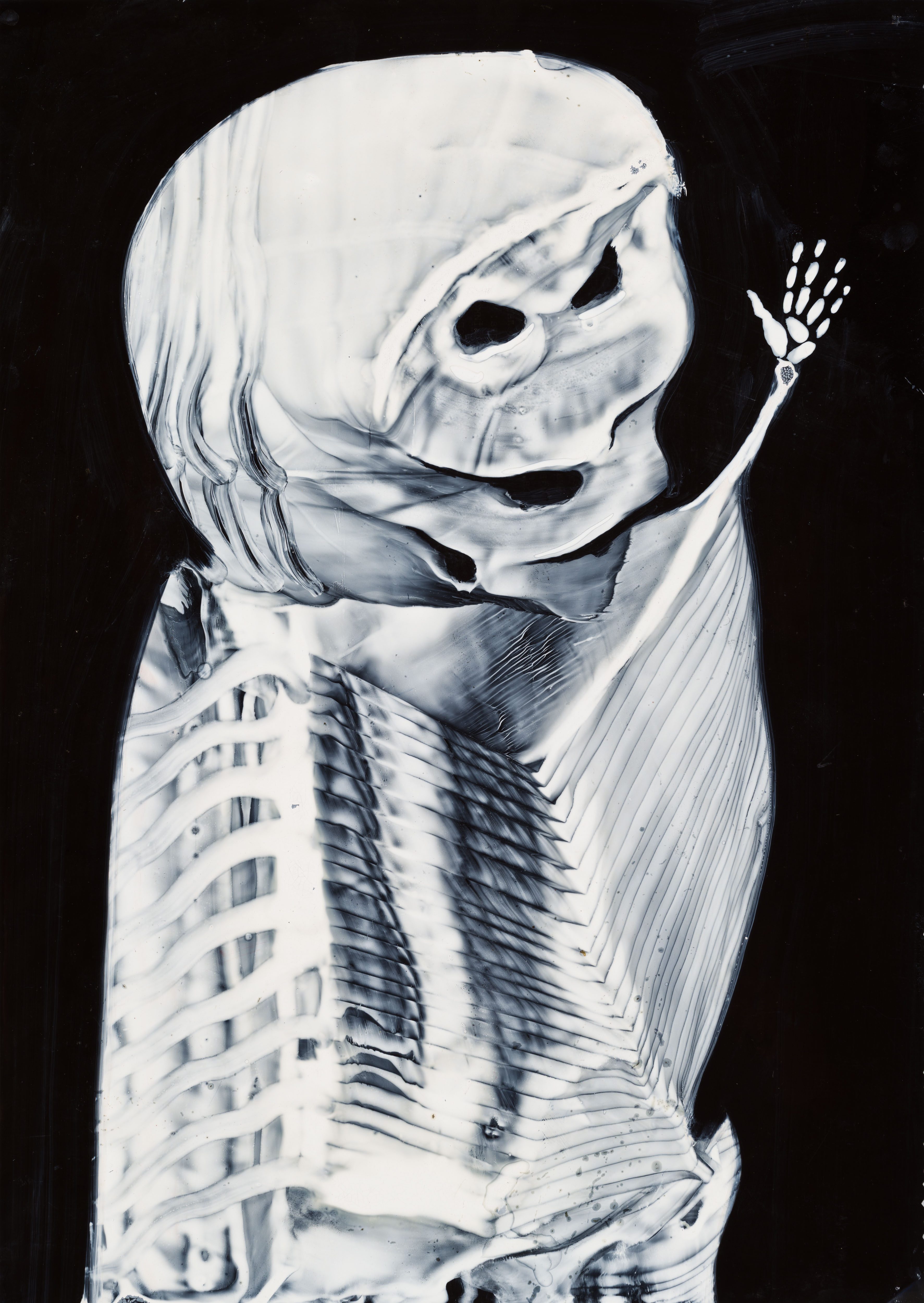
Untitled study, c. 1987-c. 1990. Gouache on film, 49.2 x 35.7 cm (19 3/8 x 14 1/16 in.). Gift of the artist. 2000.0782

Untitled, c. 1987-c. 1990. Gouache on film, 36.2 x 32.8 cm (14 1/4 x 12 15/16 in.). Gift of the artist, 2000.0783