
Aija Zariņa
1954 — Saukas, Jēkabpils district (Latvia) | 2025 — Riga (Latvia). Lived and worked in Riga (Latvia)
Aija Zariņa launched her art career in the 1980s, during the collapse of the Soviet Union. At the time of Gorbachev’s perestroika, young artists began to establish the avant-garde of contemporary Latvian art. Zariņa’s art has always been an alternative to the dominant culture.
She studied painting at the Art Academy of Latvia (1976–82, then called Teodors Zaļkalns LSSR State Art Academy) and has practiced painting, graphic art, and book design, and produced installations, site-specific works, murals, earthworks, and set designs for theater performances.
Zariņa painted her early works of the first half of the 1980s in a synthesis of fauvism and cubism. Her domestic scenes, still lifes, and small landscapes evoke the spirit of French and German modernism from the early twentieth century, particularly reminiscent of André Derain’s early landscapes. Additionally, her art bears a resemblance to the perceptions and representations of nature seen in the work of Erich Heckel (1883–1970), Raoul Dufy (1877–1953), Maurice de Vlaminck (1876–1958), and Max Pechstein (1881–1955).
In the mid-1980s Zariņa switched to large-scale compositions featuring human and animal figures. Her solo show at the exhibition hall of the Artists’ House in Riga in 1986 was an unprecedented violation of the Soviet art canon. With figures painted to resemble children’s drawings, Zariņa took a stand against political dependence and philistine tastes. She applied smooth blocks of pure color, emphasizing the plane, and used bold black contours to outline her figures—a woman and a man engaged in a dance, in the act of love, and in a confrontation between two people. The censors considered Zariņa’s form of painting a threat to the art of socialist realism. The exhibition was open for two weeks, but one week before its original closing date, it was ordered to close.
Zariņa’s painting was also influenced by the changes global art was undergoing in the early 1980s, including the international Transavantgarde: the Neue Wilde of Germany, the Italian Transavantgarde, and the American “bad painting.” Zariņa, like these movements, rebelled against “good taste,” the cool intellectualism of conceptual art, and the dematerialization of art. In Zariņa’s work, “bad taste” was emphasized by a seemingly fast and sloppy execution. At the time, painting was marked by the arrival of the figurative, corporeal image saturated with emotions, subjectivism, and pain. Latvian art was largely influenced by German neo-expressionism. In an interview following her 1989 solo exhibition at Riga’s Arsenāls exhibition venue, Zariņa said, “Evidently, in Berlin, I received confirmation that my exploration is not in vain and gained more self-confidence.” [1]
Her works from the second half of the 1980s feature overturned figures, parts of them being unfinished blocks and paint dribbles. The works grew ever larger, and the cardboard surfaces were most often two-figured compositions with intensity of different emotions—playfulness, ugliness, grotesqueness, passion, tenderness, love, hate, brutality, and violence.
From the mid-1980s to the early 1990s, Zariņa painted works for the series The Rape of Europa, He and She, Princess Gundega, Carmen, The Dancer, Fate, and Processes. These works, especially the mythological Rape of Europa series, which explores the coexistence of love and violence, are part of the feminist discourse. “In my art, the beast has crawled into the relationship between a woman and a man. . . Gradually, the relationship between man and beast became symbols—of the nation, sacrifice, violence, earth, heaven. And the boundaries of ‘he and she’ were transgressed.” [2]
In the 1990s Zariņa crafted installations and earth art pieces alongside her paintings. In 1991 she produced the installation Princess Gundega’s Black Room—a room made of black painted paper on which a surreal mechanism, like a fragile machine with wheels, was drawn with a simple white line—at the Gallery Jāņa Sēta in Riga. “It was a generalized, activated character, and my propensity toward creating something of personal meaning—man himself, and something mysterious inside man, in myself. In which I embodied the totality of the problems of human existence, which I was aware of and felt at the time,” the artist wrote. [2]
In the 1990s she was increasingly preoccupied with existential questions of life, death, and faith. Her art began to feature images of angels, death, the Virgin Mary, the infinity symbol, archangels, and mythological beasts. The art forms of this period included both figurative characters and abstract paintings. The 1993–96 paintings for the exhibitions Centaur, Bird, and Elephant and The Head of the Virgin Mary are colorful and ornamental. A network of thick lines completely covers the plane of the painting and intertwines with animal figures in the Centaur, Bird, and Elephant exhibition and with the figures of the Virgin Mary and Child in The Head of the Virgin Mary. This was followed by a completely abstract meditative collection—the Infinity Symbol cycle (1996–98), which the artist showcased at her solo exhibition Aija Draws at the Latvian National Museum of Art (1998). Large frameless canvases hung loosely from the walls, two to three colors mingled, and infinity symbols flowed into each other, twisted and merged. The artist stated that the series expressed “humankind’s belonging to the infinite cosmos.” [3]
A secular spirituality and an interest in both Christianity and Eastern teachings appeared in Zariņa’s work. She painted a Buddhist ritual bell (seen at the solo exhibitions Bell at the Giedre Bartelt Gallery in Berlin, 1998; Ritual at the Amfilada Gallery in Szczecin, 1999; and Awakening at the Dům umění města in Brno, 2001). In the second half of the 1990s, Saint George, a character from the world of sacred painting, appeared in her art, becoming her alter ego.
In the 1990s Zariņa created a series of site-specific murals at her solo exhibitions (in Riga, Paris, Hamburg, Munster, and Warsaw). She produced The Sea, one of her most poetic environmental installations, at Pedvāle Nature Park (Latvia), in which she used branches to re-create the rhythm of waves in a wild meadow. Pedvāle was also the site of the earthwork Head of the Virgin Mary—a plowed circle in a cornfield, a circular line seemingly drawn by the invisible hand of a large being. The artist explained, “I draw attention to the existence of higher vantage points.” [2] The work formed part of the Big Minds series, in which Zariņa addressed the existence of a “great intellect” or higher reason.
From 2002, the artist began to embrace linguistic conceptualism. She painted the words of Latvian poet Eduards Veidenbaums (1867–1892) “Mosties, mosties reiz, svabadais gars” [Awaken, awaken for once, free spirit] (2002)—as a call to political activism—in massive block letters as a poster. Subsequently, Zariņa’s paintings often included text in the form of important statements, theses, and questions for society and politicians.
A turning point in her painting aesthetic was the appropriation of Kuzma Petrov-Vodkin’s The Bathing of the Red Horse (1912). From then on, Zarina’s painted figures became more plastic, still simple—childlike, but very carefully rendered.
Around 2010, Zariņa’s creative strategy shifted, and she began to depict a vision of an idealistic world where humanism, secular spirituality, and culture prevail. She has shaped and participated in projects related to relational aesthetics, humanized cooperation among social networks, reduced the social isolation of certain individuals, and opposed the standardization of human relationships. Zariņa’s ideals propose an alternative to the rational, materialistic, competitive consumer life.
Zariņa’s paintings became softer and lighter, the layers of paint thinner, almost transparent. Sculpturesque—but fine, delicate, elongated, and still naive and childlike—lines replaced the geometrically jagged forms. At times, the human body is painted to look fragile and vulnerable, giving an ethereal impression of beings seemingly unrelated to the material world (Tendencies, 2006; To Fly, 2006).
The narratives of Zariņa’s art start to reveal an interest in evolutionism. Her paintings depict prehistoric periods in the context of the mythical lost continents. In her interest in the past, the artist has also touched on Latvian history, mythology, and the celebration of nature. Her artistic interpretations of history, events, characters, and mythology do not correspond to known world history. She uses deconstruction, joining unrelated characters and assigning other roles to them. In recent years, the ideological evolution of her art has reached to ecology. With an emphasis on the preservation of human life, Zariņa is moving more and more decisively toward ecofeminism.
Elita Ansone
Translated from Latvian by Lelde Beņķe-Lungeviča
Photo portrait: Aija Zariņa, 1989. Photo by Gunārs Janaitis
Notes
1. Elita Ansone, “Kо saka Aija?” [What Does Aija Say?], Literatūra un māksla, June 10, 1989, 1.
2. Aija Zariņa, “Aijas Zariņas izstādē ‘Gids’ piedāvātais mitoloģiskais skatījums” [The Mythological View from the Exhibition Guide by Aija Zariņa], MA thesis, Art Academy of Latvia, 2000, 1.
3. Anita Vanaga, ed., Aija (Riga: Blankenfelde, 2007), 146.
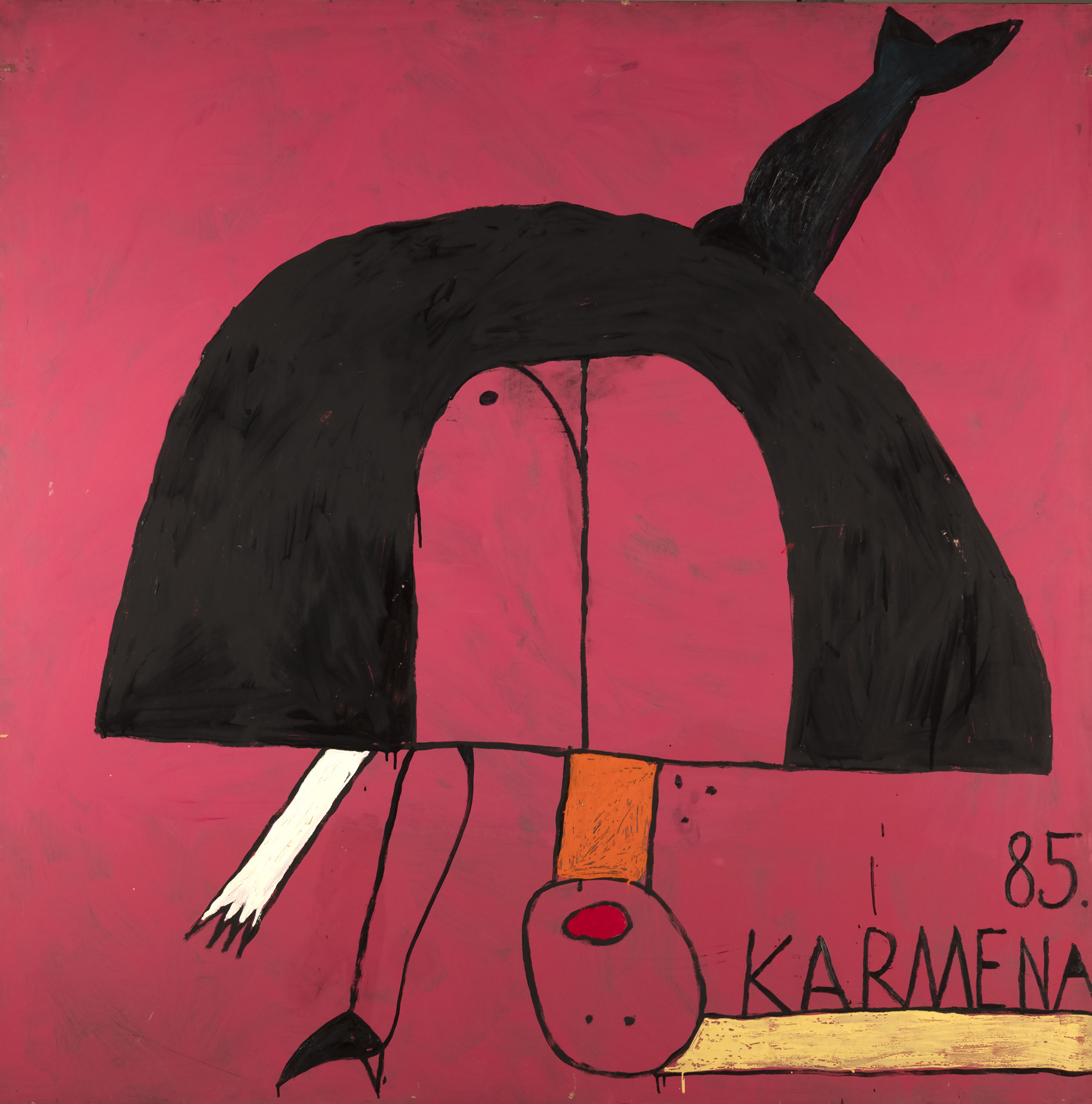
Carmen, 1985. Oil on fiberboard, 145 x 145 cm (57 1/16 x 57 1/16 in.). Norton and Nancy Dodge Collection of Nonconformist Art from the Soviet Union. D04711

Husband, 1986. Oil and acrylic on fiberboard, 170 × 170 cm (66 15/16 × 66 15/16 in.). Gift of Robert E. Falcone. 1995.1021
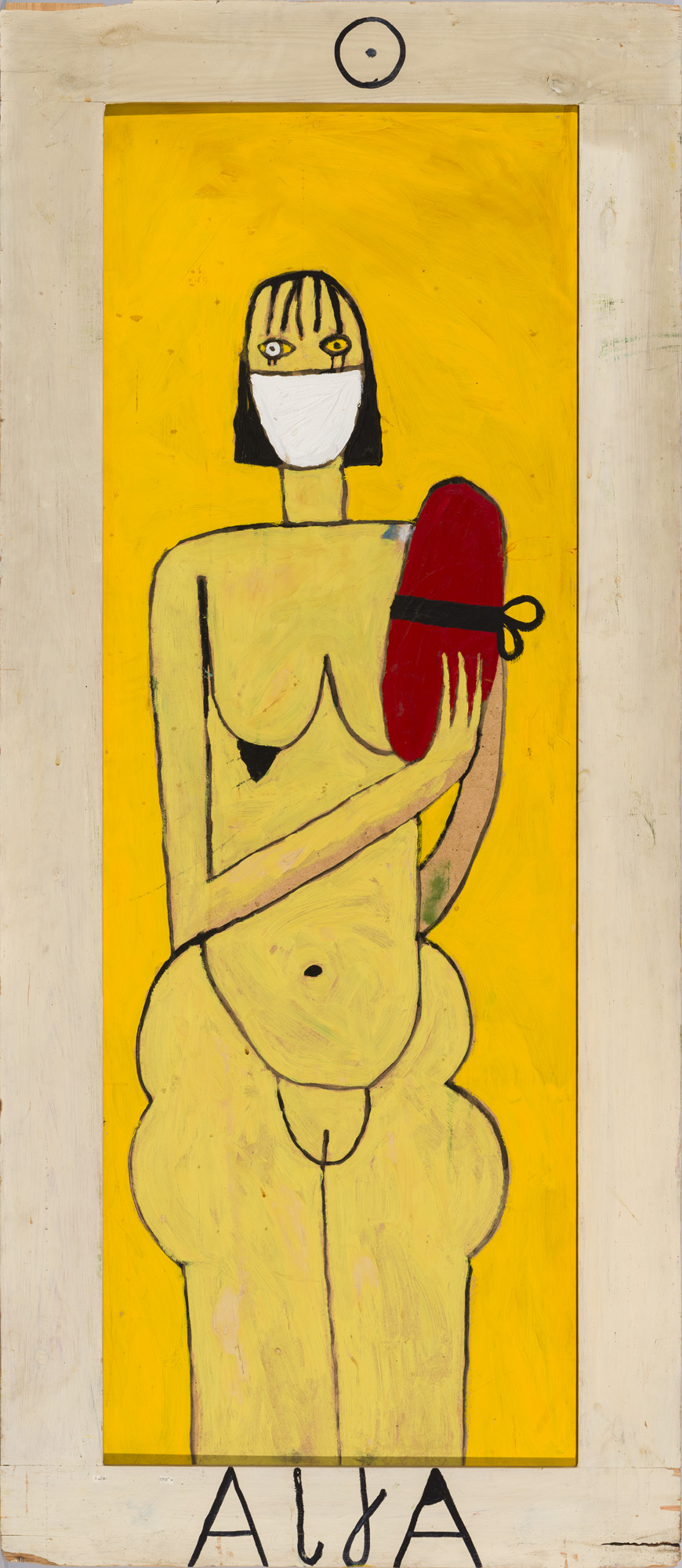
Woman and Baby, 1985. Oil on fiberboard, 131.5 × 66 cm (51 3/4 × 26 in.). Norton and Nancy Dodge Collection of Nonconformist Art from the Soviet Union. D04683
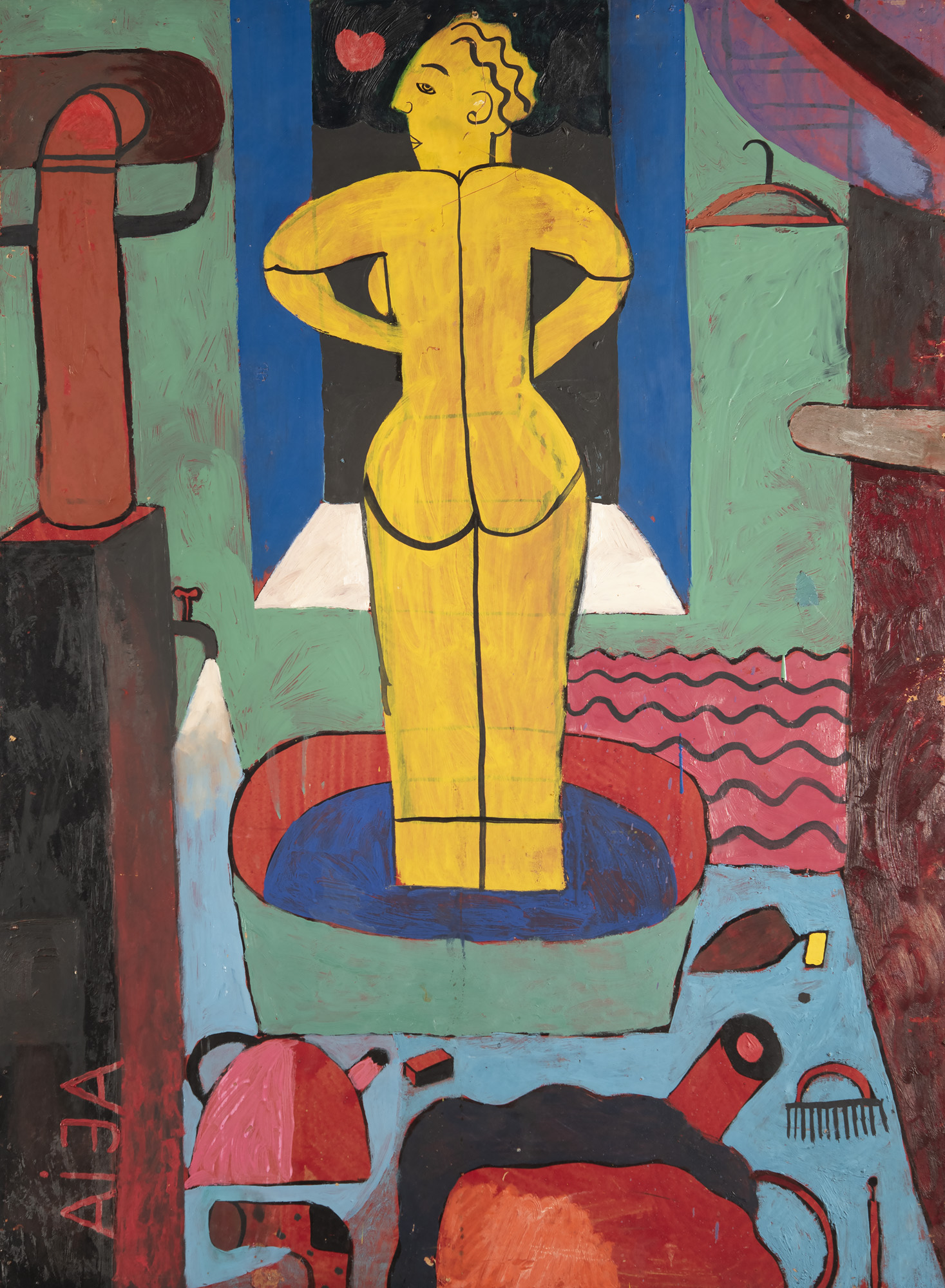
Bathroom, 1982. Oil on fiberboard, 127 × 93 cm (50 × 36 5/8 in.). Norton and Nancy Dodge Collection of Nonconformist Art from the Soviet Union. D04687

Woman and the Night, 1986. Oil on fiberboard, 145.1 × 81.1 cm (57 1/8 × 31 15/16 in.). Norton and Nancy Dodge Collection of Nonconformist Art from the Soviet Union. D11140